The universe is a place of violent beauty, illuminated by the invisible glow of X-rays. These high-energy signals are the calling cards of the cosmos’s most extreme environments, from the superheated gas swirling around black holes to the explosive fury of solar flares and dying stars. For decades, these signals have remained largely out of reach, not because they are rare, but because our own home protects us from them. The Earth’s atmosphere acts as a stubborn shield, absorbing X-rays before they can ever touch the ground. To see the high-temperature secrets of the stars, humanity has to leave the planet, sending instruments into the void on balloons, sounding rockets, and satellites. But even once we reach the stars, a new problem emerges: how do you focus a light that refuses to be caught?
The Mirror That Caught the Ghostly Light
Traditional telescopes use mirrors to reflect light into a sharp image, but X-rays are different. They are so energetic that they pass through most materials or get absorbed by them. To reflect an X-ray, you cannot hit it head-on; instead, you must catch it at an incredibly shallow, glancing angle, much like a stone skipping across the surface of a pond. This requires a mirror of almost impossible smoothness and precision. In Japan, a team of researchers realized that to build a better eye for the sky, they needed to borrow a trick from the world of particle physics.
They turned to SPring-8, one of the most powerful synchrotron radiation facilities on Earth. Located in Hyogo Prefecture, this massive accelerator produces intense beams of X-rays for laboratory research. The scientists there had already mastered the art of precision mirror-making to focus these beams, and the astronomy team from Nagoya University realized this was the key they had been looking for. Using a specialized electroforming technique, they crafted a single, seamless nickel mirror shell. Standing 200 millimeters tall and measuring 60 millimeters in diameter, this mirror wasn’t pieced together like a mosaic. It was a single, continuous funnel. By eliminating joints and seams, the team ensured there were no tiny ridges to deflect the X-rays, creating a path that guided the light toward a perfect focal point with nanometer-level precision.
A Long Distance Test of Sharpness
Building the mirror was only half the battle. Once a mirror is mounted into a telescope assembly, the mere act of securing it can introduce tiny stresses that warp its shape, blurring the final image. The team needed a way to prove their telescope was sharp enough before it ever left the ground. They set a goal that sounded like a dare: they wanted a telescope sharp enough to distinguish an object just 3.5 millimeters wide from a distance of one kilometer. Achieving this required a testing ground that could simulate the behavior of a star.
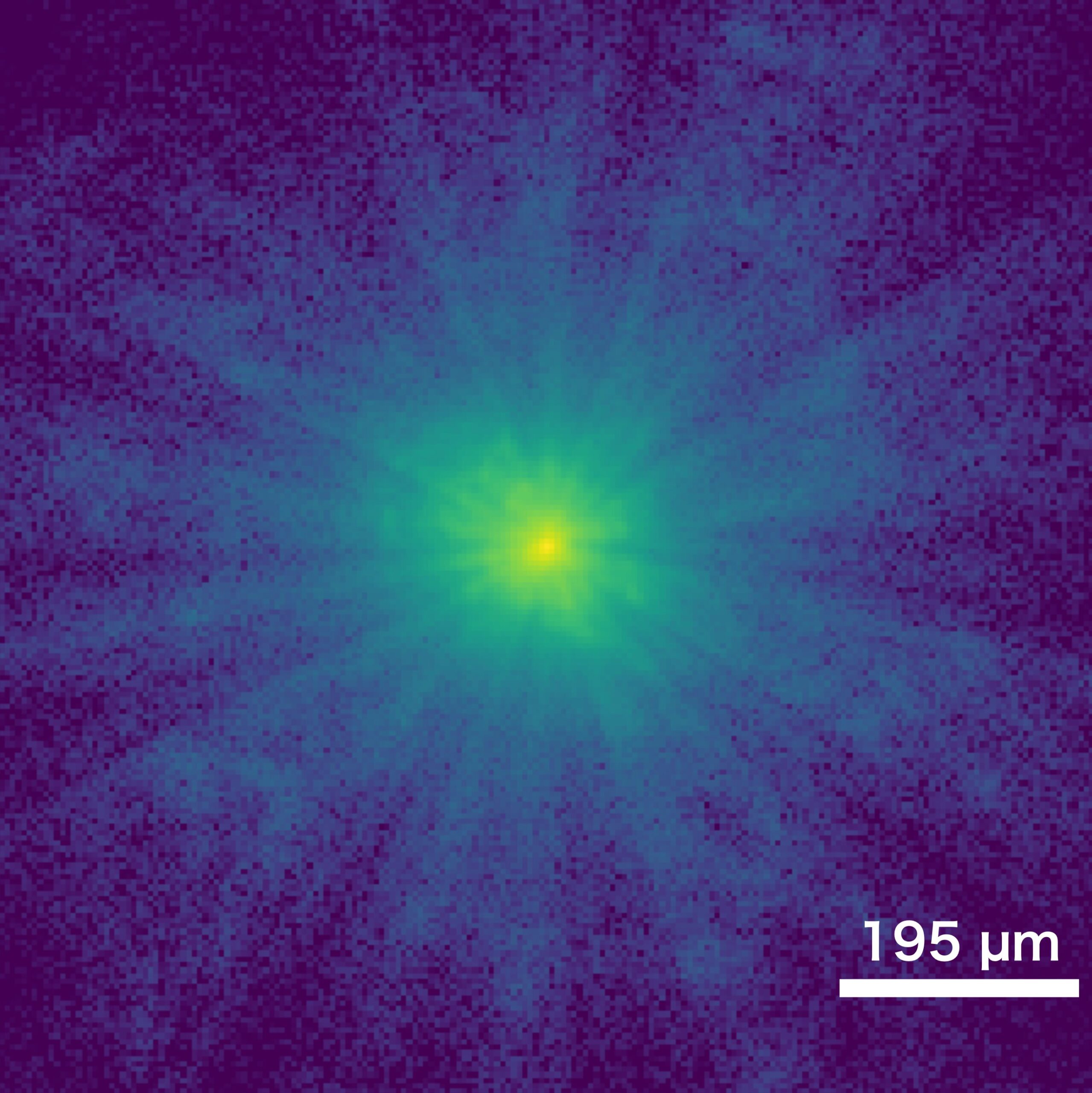
Starlight is unique because it travels across such vast distances that by the time it reaches us, the rays are almost perfectly parallel. Recreating those parallel rays in a lab is notoriously difficult. To solve this, the researchers built a first-of-its-kind ground-based evaluation system at the SPring-8 facility. They placed a tiny X-ray source, measuring a mere 10 micrometers across, at one end of a long corridor. The telescope was placed at the other end, 900 meters away. At this nearly kilometer-long distance, the X-rays behaved just like light from a distant star. This setup allowed the team to measure the telescope’s sharpness with unprecedented accuracy, confirming it could handle the hard X-ray energies it would encounter in the vacuum of space.
Into the Heart of the Sun
On April 17, 2024, the years of precision engineering and long-distance testing culminated on a launchpad in Alaska. The telescope was loaded onto the FOXSI-4 sounding rocket, a joint mission between Japan and the United States. Sounding rockets are the sprint runners of the space world; they don’t stay in orbit for years, but instead leap briefly into space to capture data before falling back to Earth. This mission was a historic milestone: the first time a high-resolution X-ray telescope developed entirely in Japan had flown on an international mission of this scale.
As the rocket roared into the sky, it had to endure intense vibrations that could easily rattle a lesser instrument out of alignment. But the seamless nickel shell held firm. While in space, the telescope turned its gaze toward our own star and successfully captured a solar flare in progress. It saw the sun’s corona not as a hazy glow, but with the high-resolution clarity that the team had spent years perfecting. This success wasn’t just about one flight; it was a proof of concept that the marriage of synchrotron radiation science and space astronomy could push the boundaries of what we can see.
The Future of the Shoebox Observatory
While the FOXSI-4 mission was a triumph, the researchers are already looking for ways to make their “X-ray funnel” even better. By analyzing their data, they identified that the main hurdle to even greater sharpness is tiny, microscopic imperfections along the length of the mirror surface. With a clear target for improvement, an even more refined version of the telescope is already being prepared for the FOXSI-5 mission scheduled for 2026.
The ultimate goal, however, is to take this massive technology and shrink it. The team is working on miniaturization, aiming to fit these high-precision mirrors into CubeSats—satellites no larger than a shoebox. Currently, high-resolution X-ray optics are too bulky for these small, cost-effective platforms. If the researchers can successfully scale down their technology, it will democratize X-ray astronomy. Instead of relying on a few massive, expensive satellites, scientists could deploy fleets of compact observatories, making the high-energy secrets of black holes and solar flares accessible to researchers across the globe. By mastering the small details on Earth, these scientists have opened a much wider window into the most violent and mysterious corners of our universe.
Study Details
Ryuto Fujii et al, Development of Electroformed X-Ray Optics Bridging Synchrotron Radiation Technology and Space Astronomy, Publications of the Astronomical Society of the Pacific (2026). DOI: 10.1088/1538-3873/ae3b74