For decades, the dawn of our universe was a story written only in the ink of mathematics and the whispers of theoretical models. Astronomers could imagine the first light, but they could not see it. They spoke of a phantom generation of celestial giants called Population III stars—titanic, fiery suns that were the very first to ignite in the cooling embers of the Big Bang. These stars were the architects of the cosmos, yet they remained ghosts, hidden by the immense distance of time and space. Now, the James Webb Space Telescope (JWST) has peered back over 13 billion years to find what may be the first physical fingerprints of these ancient ancestors, clustered around a small, mysterious companion object named Hebe.
The Ghostly First Light
To understand why this discovery is so profound, we have to look at what the universe lacked 400 million years after its birth. Today, every star we see is “polluted” by metals—the astronomical term for any element heavier than hydrogen or helium. These metals, like the oxygen we breathe and the iron in our blood, were forged inside the bellies of stars over billions of years. But the first stars had no such inheritance. They formed from clouds of almost pure hydrogen and helium, the only ingredients available in a newborn cosmos.
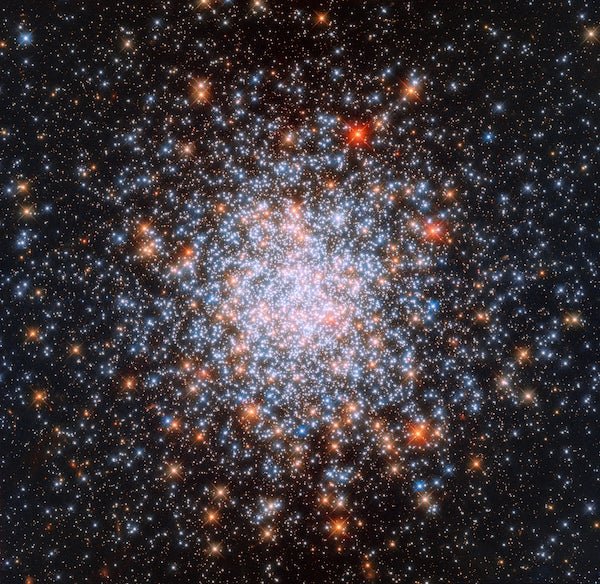
Theoretical models suggested these Population III stars were unlike anything in our modern sky. Because they lacked heavy elements to help them cool as they formed, they grew to be extremely massive and hot. They were the ultimate “live fast, die young” celestial bodies, burning through their nuclear fuel in just a few million years—a mere heartbeat in the life of a galaxy. When they died, they did so in colossal supernovae, spraying the first heavy elements into space and seeding the universe so that future, more familiar stars could eventually form.
A Faint Signal in the Dark
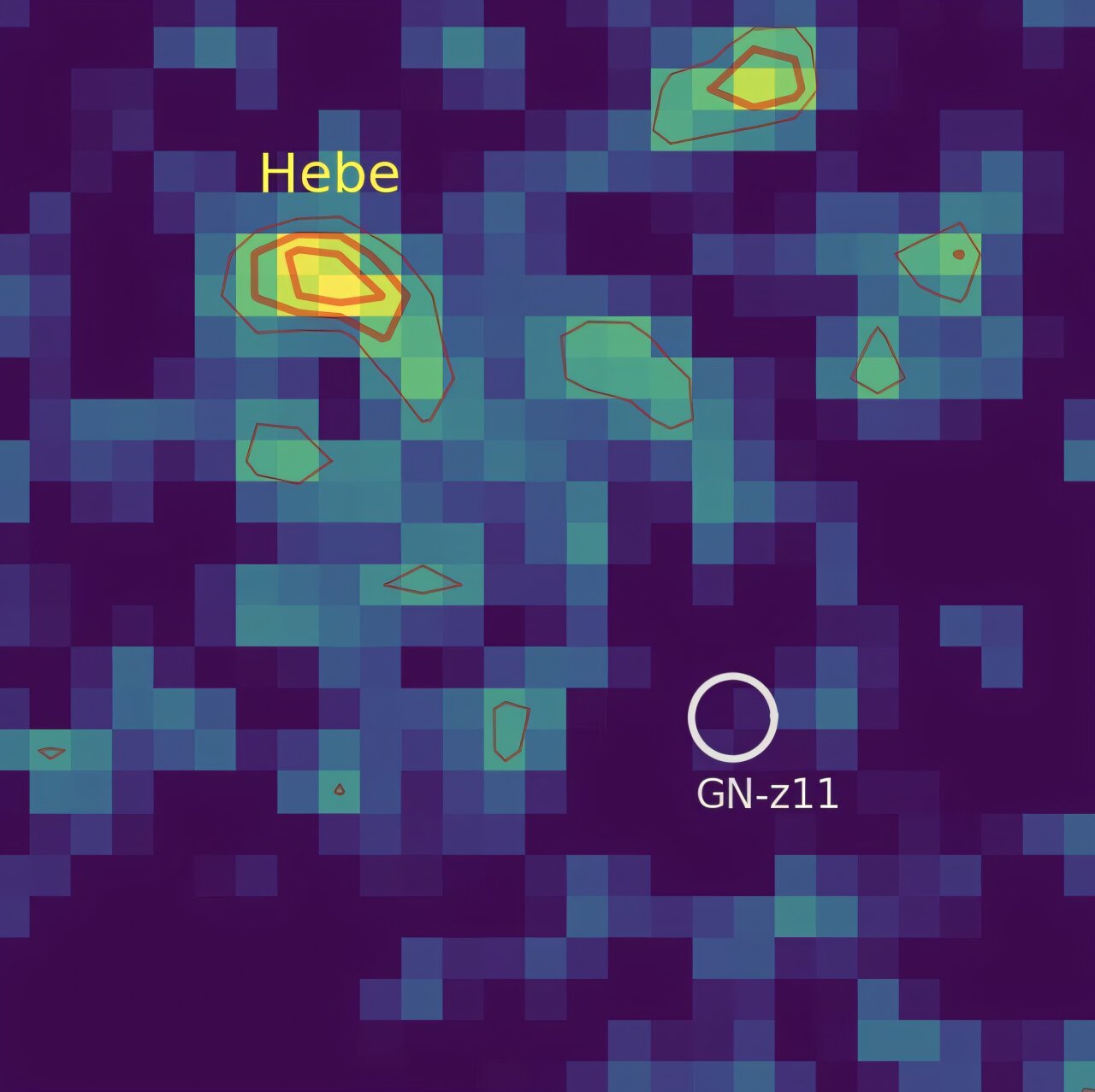
The hunt for these ghosts led a team of researchers, including Roberto Maiolino from the University of Cambridge, to a galaxy known as GN-z11. This is no ordinary galaxy; it is one of the brightest and oldest ever detected in the early universe. In 2024, while scanning the glowing halo surrounding this galaxy, the team noticed something strange. About three kiloparsecs away from the main galactic body, a small companion object—later dubbed Hebe—was emitting a very specific, very faint signal.
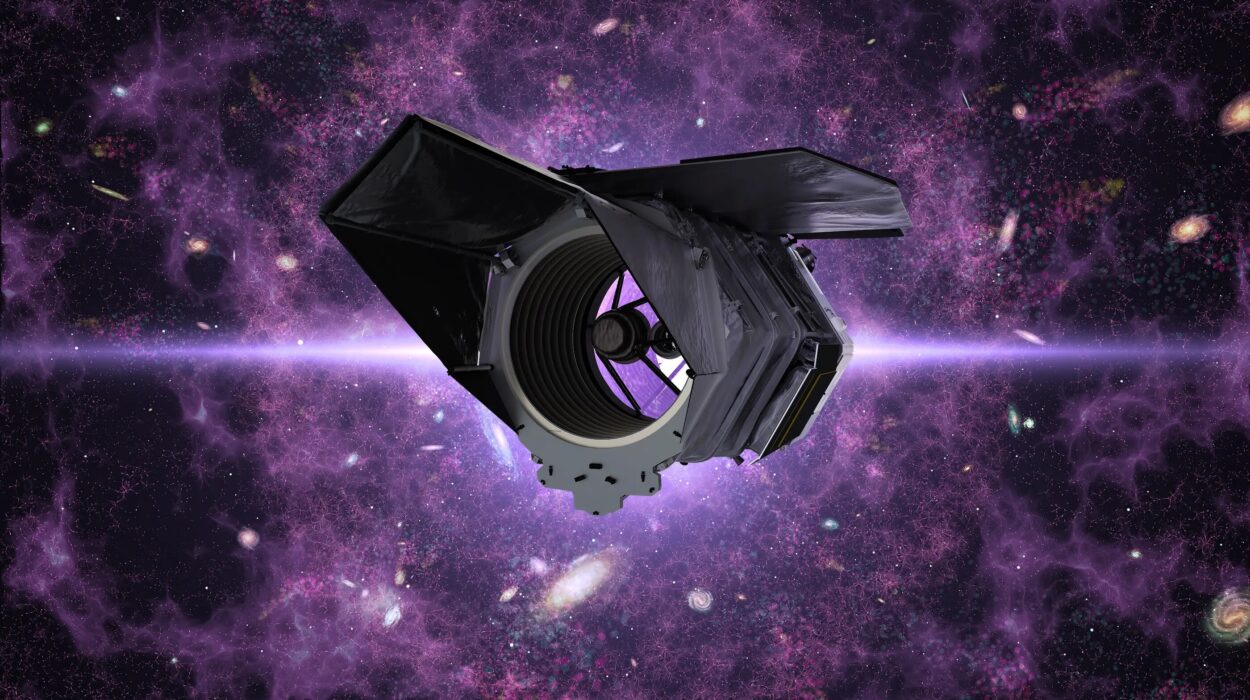
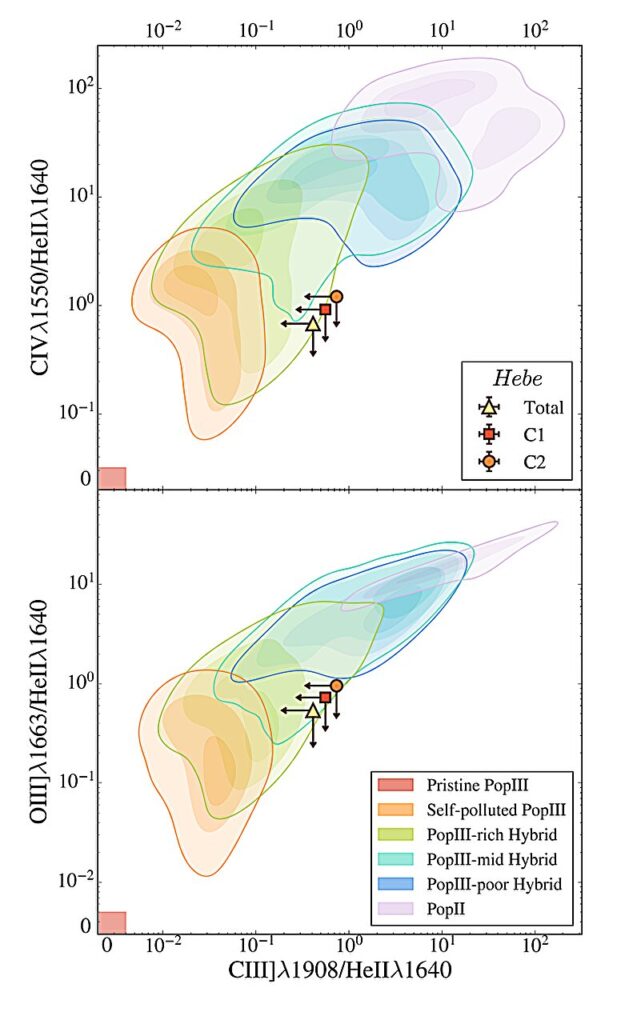
Using the NIRSpec-IFU, a sophisticated near-infrared spectroscopy instrument on the JWST, the scientists detected the signature of doubly ionized helium. This was a massive clue. To ionize helium to such a degree requires a torrent of extraordinarily energetic radiation, far more than what a typical star produces. Most importantly, when the team looked for the signatures of oxygen, carbon, or iron, they found nothing. It was a spectrum of pure, primordial gases being blasted by an invisible, powerful light source. It was the perfect profile for a cluster of Population III stars.
Two Teams and a Cosmic Anchor
Science rarely rests on a single observation, and the case for these ancient stars grew stronger through the work of two independent groups. While Maiolino’s team used high-resolution data to confirm that the helium signal was not a fluke but a resolved, distinct reality, another team led by Elka Rusta at the University of Florence was looking at the same patch of sky from a different angle.
Rusta’s team detected a hydrogen emission line coming from the exact same location as the helium signal. This served as a “second anchor,” confirming that the light was indeed coming from a cloud of gas at the edge of the known universe. By comparing the two signals, the researchers could look at the helium-to-hydrogen ratio. This ratio is a vital piece of data; it acts as a thermometer and a scale for the stars hidden within the gas. Because there were still no detectable metals in either study’s data, the evidence pointed squarely away from modern stars and toward the long-lost first generation.
The Weight of Ancient Giants
With these two signals in hand, the researchers turned back to theoretical modeling to figure out exactly what kind of stars were hiding in the Hebe cluster. The data from Rusta’s team suggested a top-heavy mass distribution. In the modern universe, small stars are common and massive stars are rare, but in the era of Hebe, the opposite seems to have been true.
The analysis indicates that most of these first stars were between 10 and 100 times the mass of the sun. These were behemoths, glowing with a fierce, ultraviolet intensity that could strip the electrons off helium atoms across vast distances. This mass range aligns perfectly with what astronomers had predicted for years: that the first stars had to be massive and hot to survive in a universe that hadn’t yet been “enriched” by the chemical diversity we see today. It was a beautiful moment of theory finally meeting reality.
Why These Ancient Ancestors Matter
This discovery is more than just a record-breaking observation; it is a fundamental piece of the puzzle of our own existence. If confirmed, these findings provide the first direct observational window into the conditions of the early universe. We are finally seeing the transition point where a dark, simple universe of gas began to transform into a complex, structured cosmos of galaxies and heavy elements.
By studying Population III stars, astronomers can begin to understand how the very first light shaped the evolution of everything that followed. These stars were the ones that broke the “dark ages” of the cosmos, and their explosive deaths provided the building blocks for the planets, the sun, and eventually, us. The research into Hebe and GN-z11 marks the beginning of a new era in astronomy where we no longer have to guess how the universe began its long journey toward complexity—we can finally watch it happen.
Study Details
Roberto Maiolino et al, The search for Population III: Confirmation of a HeII emitter with no metal lines at z=10.6, arXiv (2026). DOI: 10.48550/arxiv.2603.20362
Elka Rusta et al, The Pristine HeII Emitter near GN-z11: Constraining the Mass Distribution of the First Stars, arXiv (2026). DOI: 10.48550/arxiv.2603.20363