Somewhere in the vastness of the sky, a source of radiation is hurling particles across space with energies so extreme they defy easy explanation. It carries the name LHAASO J2108+5157, a designation that sounds clinical and distant. Yet behind that name lies one of the most perplexing mysteries in modern high-energy astronomy.
This object is not just another distant flicker. It emits gamma rays at energies above 100 teraelectronvolts (TeV), placing it in the rare class of ultra-high energy (UHE) gamma-ray sources. For context, astronomers classify sources emitting photons between 100 GeV and 100 TeV as very-high energy (VHE) emitters. But once those photons exceed 100 TeV, they enter an even more extreme category. That is where this source lives — in a realm of physics that scientists are still struggling to understand.
Since its discovery in 2021, LHAASO J2108+5157 has refused to reveal its identity. It shines fiercely in gamma rays, yet at other wavelengths — radio, optical, infrared — it appears to vanish. It is as if something powerful is happening there, but whatever engine drives it is hiding in the dark.
The Discovery That Raised More Questions Than Answers
The story begins with the Large High Altitude Air Shower Observatory (LHAASO) collaboration. In 2021, during a survey of the sky, this observatory detected LHAASO J2108+5157 as a source emitting above 100 TeV. That alone made it extraordinary.
But what truly set it apart was what astronomers did not see.
In the LHAASO survey, this source stood alone as the only detected object without a firmly identified counterpart at longer wavelengths. No clear signal in radio. No obvious optical glow. No strong infrared signature. It was a powerful gamma-ray beacon with no visible anchor in the broader electromagnetic spectrum.
And so it earned a reputation as one of the most enigmatic objects in the UHE sky.
Without a known distance, without a clear astrophysical structure attached to it, and without a standard explanation that fits neatly into existing galactic models, LHAASO J2108+5157 became a persistent puzzle. The absence of evidence was not silence — it was an invitation.
Turning to the Invisible: A Near-Infrared Hunt
Determined to probe deeper, a team of Spanish astronomers led by Josep Martí from the University of Jaén decided to investigate the mystery in a new way. If optical light revealed nothing, perhaps near-infrared (NIR) observations could expose hidden structures veiled by dust or distance.
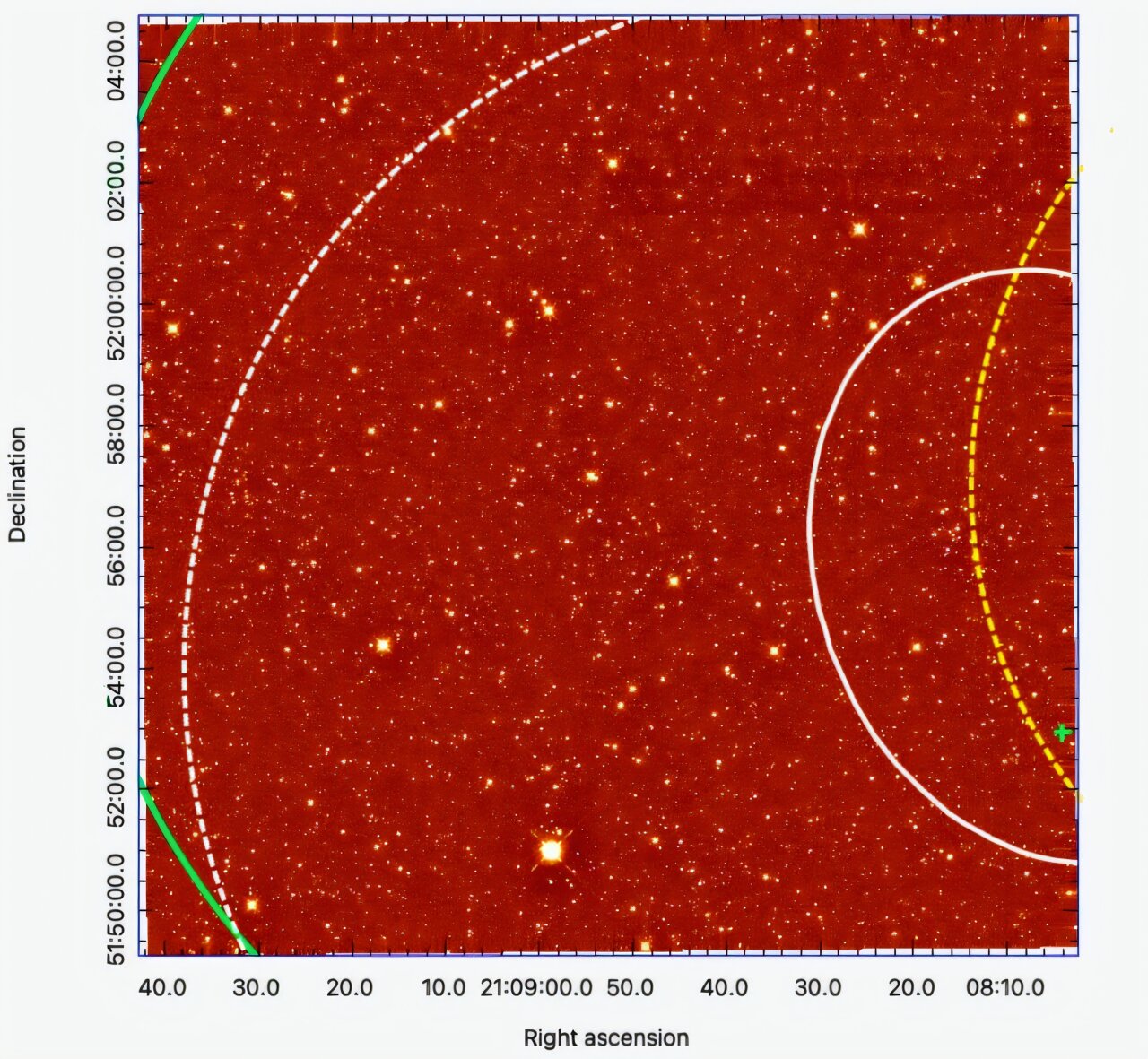
The team conducted a systematic near-infrared study of the region surrounding LHAASO J2108+5157. They combined archival datasets with dedicated observations carried out at the Calar Alto Observatory (CAHA) in Spain.
Their motivation was clear. The source’s lack of a counterpart at radio, optical, or infrared wavelengths — combined with the incomplete viability of standard galactic scenarios and the unknown distance — made it a compelling scientific riddle. If something energetic enough to produce ultra-high energy gamma rays was present, surely some trace of its environment would appear in the infrared.
What they hoped to find were signs of violent cosmic processes. Shocked gas glowing from energetic interactions. Structures resembling a supernova remnant. Extended nebular emission that might hint at a powerful central engine disturbing its surroundings.
Instead, the darkness held.
An Unexpected Candidate
The near-infrared observations revealed no evidence of shocked gas. No supernova-remnant-like arcs. No glowing nebula spreading across the field. The cosmic landscape appeared, at first glance, surprisingly quiet.
But there was one conspicuous object.
In the data stood an extended bipolar radio source. Its structure showed two-sided jets and a nonthermal spectral index, characteristics that immediately attracted attention. Such morphology can be associated with energetic systems capable of accelerating particles to high energies.
Some researchers had recently proposed that this radio source might be a microquasar — a system known for launching jets and producing high-energy radiation. If that were true, it could potentially explain the ultra-high energy gamma rays observed from LHAASO J2108+5157.
For a moment, it seemed as though the mystery might finally be narrowing.
A Closer Look Changes the Story
Martí’s team scrutinized the bipolar radio source carefully. If it were a galactic microquasar, its near-infrared properties should align with that identity. Alternatively, it could be a nearby radio galaxy, another type of energetic object capable of launching jets.
But the data refused to cooperate with either scenario.
The near-infrared characteristics ruled out the possibility that the source was a galactic microquasar. They also excluded the idea that it was a nearby radio galaxy connected to the gamma-ray emission.
Instead, the astronomers reached a more sobering conclusion. The radio source is almost certainly an unrelated background radio galaxy. Its accreting core appears intrinsically faint, and its morphology — striking and jet-like — had led to confusion in previous studies.
In other words, the most promising suspect turned out to be an innocent bystander.
The bipolar jets, dramatic though they appear, are almost certainly not responsible for the ultra-high energy gamma rays. The apparent alignment is a cosmic coincidence.
The Silence Remains
After months of analysis and careful cross-checking, the team arrived at a conclusion that is both honest and frustrating.
None of the objects examined within the positional uncertainty of LHAASO J2108+5157 can satisfactorily account for the observed gamma-ray emission.
No convincing counterpart has emerged.
The ultra-high energy photons continue to arrive, silent messengers from an unknown engine. Yet the sky, when viewed in near-infrared light, offers no clear clue about what is producing them.
The mystery remains intact.
Why This Matters More Than a Single Source
It might be tempting to see this as a negative result — a search that failed to find what it sought. But in science, clarity about what something is not can be just as important as discovering what it is.
Ultra-high energy gamma-ray sources represent some of the most extreme environments in the universe. Understanding them is essential for piecing together how nature accelerates particles to extraordinary energies. Each unidentified source challenges existing models and forces astronomers to question assumptions about cosmic accelerators.
LHAASO J2108+5157 is particularly important because it stands alone in a key way: it was detected without a firmly identified counterpart at longer wavelengths. That absence highlights gaps in our understanding. If known categories like supernova remnants, microquasars, or radio galaxies cannot explain it, then either our models are incomplete or something entirely unexpected is at work.
The new study does not provide the breakthrough scientists hoped for. But it does refine the search. It eliminates a tempting explanation and strengthens the case for deeper, more sensitive observations.
In the vast theater of the cosmos, some actors step into the spotlight fully illuminated. Others remain cloaked in shadow, revealing themselves only through indirect signals. LHAASO J2108+5157 is one of the latter — a powerful, unseen engine announcing its presence only through torrents of ultra-high energy light.
And until astronomers find the source of that light, the mystery will continue to glow in the darkness, urging us to look closer, think deeper, and question what we believe we know about the most extreme corners of the universe.
Study Details
Josep Martí et al, Unmasking LHAASO J2108+5157: Near Infrared Insights into a Mysterious TeV Source, arXiv (2026). DOI: 10.48550/arxiv.2602.11148