For centuries, invisibility belonged to myths and imagination. It lived in stories of magic rings and hidden realms, far from laboratories and equations. But at the University of Leicester, a group of engineers has quietly been working on a different kind of invisibility—one that does not bend light or erase objects from sight, but instead makes them disappear from the influence of magnetic fields.
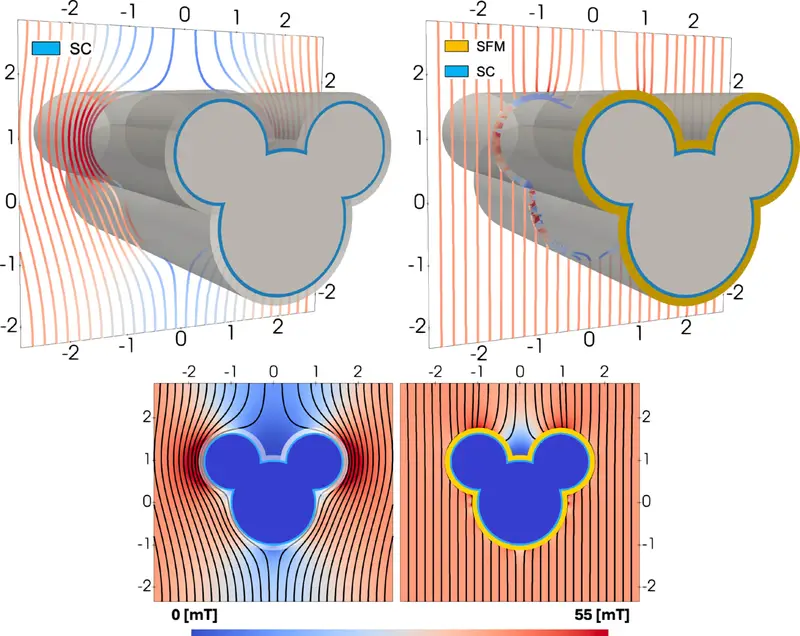
Their newly unveiled concept is a magnetic cloak, a device designed to protect sensitive components by guiding magnetic fields around them so smoothly that, from the outside, it is as if the protected object simply is not there. No distortion. No disturbance. Just silence in the magnetic landscape.
This is not invisibility for spectacle. It is invisibility for survival in a world increasingly crowded with powerful magnetic forces.
Teaching Magnetic Fields to Look Away
Magnetic fields are everywhere. They are essential to countless technologies, yet they can also become disruptive intruders. When magnetic fields stray where they are not wanted, they can twist signals, corrupt data, and cause precision instruments to fail. The challenge has grown alongside technological progress, especially in environments packed with sensitive electronics.
The idea behind a magnetic cloak is deceptively simple: hide an object from magnetic fields by carefully controlling how those fields flow. Instead of crashing into a component or warping around it in detectable ways, the fields are redirected, slipping past as though the object never existed.
Until recently, this idea lived largely in theory. Magnetic cloaks were often tied to perfect conditions or limited to idealized shapes like simple cylinders. Real life, however, is not made of perfect cylinders. It is full of sharp edges, uneven curves, and awkward geometries that resist neat mathematical solutions.
That is where the University of Leicester team stepped in.
From Elegant Theory to Messy Reality
Publishing their work in Science Advances, the engineers demonstrated for the first time that practical magnetic cloaks can be designed for real-world shapes using materials that can actually be manufactured. This marks a significant shift from elegant but impractical theoretical models toward solutions that acknowledge the complexity of actual devices.
Their breakthrough rests on a new physics-informed design framework. Instead of forcing real objects to fit old theoretical molds, the researchers built a method that adapts to the object itself. Using advanced mathematical modeling and high-performance simulations based on real-world parameters, they showed how magnetic cloaks could be engineered for objects of any shape.
This approach allows engineers to start with the object they want to protect—irregular, complex, imperfect—and then design a cloak that works specifically for it. The result is a custom solution rather than a one-size-fits-all approximation.
Crucially, the cloaks are not fragile tricks that work only under narrow conditions. The study shows that they maintain their effectiveness across a broad range of magnetic field strengths and frequencies, making them far more useful outside the lab.
Materials That Already Exist
One of the most striking aspects of the research is what it does not rely on. It does not demand exotic materials that exist only in theory or in specialized facilities. Instead, the designs use superconductors and soft ferromagnets in forms that can already be manufactured.
This matters because it moves magnetic cloaking from a distant possibility to something that could realistically be built, tested, and deployed. The research opens the door to creating cloaks and magnetic guides tailored to specific devices using materials that are already commercially available.
In practical terms, this means the leap from simulation to physical object is no longer a speculative dream. It is a technical challenge with a visible path forward.
Why Magnetic Interference Has Become a Growing Threat
Magnetic interference is no longer a niche problem. As technologies become more sensitive, the environments they operate in grow more magnetically noisy. Unwanted magnetic fields can disrupt precision instruments, sensors, and electronic components, leading to signal distortion, data errors, or outright equipment malfunction.
This is especially concerning in places where failure is not an option. Hospitals rely on delicate instruments. Power grids depend on stable electronic control systems. Aerospace systems and scientific laboratories operate at the edge of precision, where even minor interference can have outsized consequences.
Magnetic cloaks offer a way to create pockets of calm within these turbulent magnetic environments. By shielding sensitive components without disturbing surrounding systems, they promise protection without unintended side effects.
Imagining Where Cloaks Could Make a Difference
The potential applications of this research stretch across some of the most demanding technological frontiers. Magnetic cloaks could help shield components in fusion reactors, where intense magnetic fields are both essential and hazardous. They could protect medical imaging systems like MRI scanners, where precision is critical and interference costly.
They could also isolate quantum sensors used in navigation or communication systems, technologies that are extraordinarily sensitive to their surroundings. In each case, the ability to tailor a magnetic cloak to a specific device and geometry could mean the difference between theoretical capability and reliable operation.
What makes this especially compelling is that the cloaks are not limited to shielding alone. The same design principles could be used to guide magnetic fields intentionally, shaping them to perform useful tasks while keeping sensitive areas untouched.
A Turning Point, According to the Researchers
For Dr. Harold Ruiz from the University of Leicester School of Engineering, the significance of the work lies in its practicality. He sees it as a turning point in how magnetic cloaking is understood and pursued.
“Magnetic cloaking is no longer a futuristic concept tied to perfect analytical conditions. This study shows that practical, manufacturable cloaks for complex geometries are within reach, enabling next-generation shielding solutions for science, medicine, and industry.”
His words reflect a shift in tone that runs through the entire study. This is not about proving something can exist in theory. It is about showing that it can be built, adapted, and used where it is needed most.
From Simulations to the Physical World
The work does not stop at design. The next phase is about turning digital models into tangible devices. Dr. Ruiz explains that the team is already preparing for fabrication and experimental testing.
“Our next step is the fabrication and experimental testing of these magnetic cloaks using high-temperature superconducting tapes and soft magnetic composites. We are already planning follow-up studies and collaborations to bring these designs into real-world settings.”
This step is crucial. Simulations can reveal what should work, but experiments reveal what actually does. By moving into fabrication and testing, the researchers are committing to the difficult but essential work of translating theory into hardware.
Why This Research Truly Matters
At its core, this research matters because it addresses a problem that is quietly growing alongside modern technology. As devices become more sensitive and environments more complex, controlling magnetic interference is no longer optional. It is a prerequisite for reliability, safety, and progress.
The University of Leicester team has shown that magnetic cloaking does not have to remain trapped in idealized models or limited shapes. By embracing real-world complexity and using manufacturable materials, they have taken a meaningful step toward solutions that engineers can actually deploy.
This work also reshapes how we think about invisibility in science. It is not about vanishing acts or illusions. It is about understanding forces deeply enough to work with them, redirect them, and ultimately tame them.
If successful in real-world testing, magnetic cloaks could become quiet guardians of future technologies, standing between fragile systems and the magnetic chaos around them. They may never be seen, and that is precisely the point.
More information: Yusen Guo et al, Designing Functional Magnetic Cloaks for Real-World Geometries, Science Advances (2025). DOI: 10.1126/sciadv.aea2468. www.science.org/doi/10.1126/sciadv.aea2468