Standing beside a horse often feels like a meeting of minds. There is the warmth of a large body, the soft movement of breath, the sense that the animal is paying attention in ways words cannot reach. A new study now suggests that this silent connection runs even deeper than touch or sight. Horses can smell human fear, and that invisible message alone is enough to change how they feel and how they behave.
The finding comes from a study published in PLOS One, where researchers explored whether horses, like dogs, can detect human emotions through scent. What they discovered is both subtle and powerful: when a horse encounters the smell of a frightened human, its body and behavior shift, even when no human face or movement gives anything away.
This is not a story about dramatic gestures or obvious cues. It is a story about chemistry, about the quiet signals carried in sweat, and about how two species that have lived side by side for thousands of years may be communicating in ways we are only just beginning to understand.
Fear, Captured on Cotton
To test whether horses could detect emotional states through scent alone, the researchers needed a way to collect fear without letting it be seen. They turned to sweat, a natural carrier of chemical signals released by the human body.
Thirty human volunteers took part. Each person watched a horror movie called Sinister, chosen to reliably trigger fear and tension. While the volunteers were immersed in the frightening scenes, cotton pads were used to collect their sweat. Later, the same people watched uplifting or funny clips, moments designed to create a joyful and relaxed emotional state, and sweat samples were collected again.
By using the same individuals for both emotional conditions, the researchers could compare how horses responded to scent linked to fear versus scent linked to joy. The cotton pads became quiet witnesses to two very different inner worlds.
These samples held no words, no expressions, no gestures. They carried only what the body released naturally during emotional experiences.
Meeting the Horses
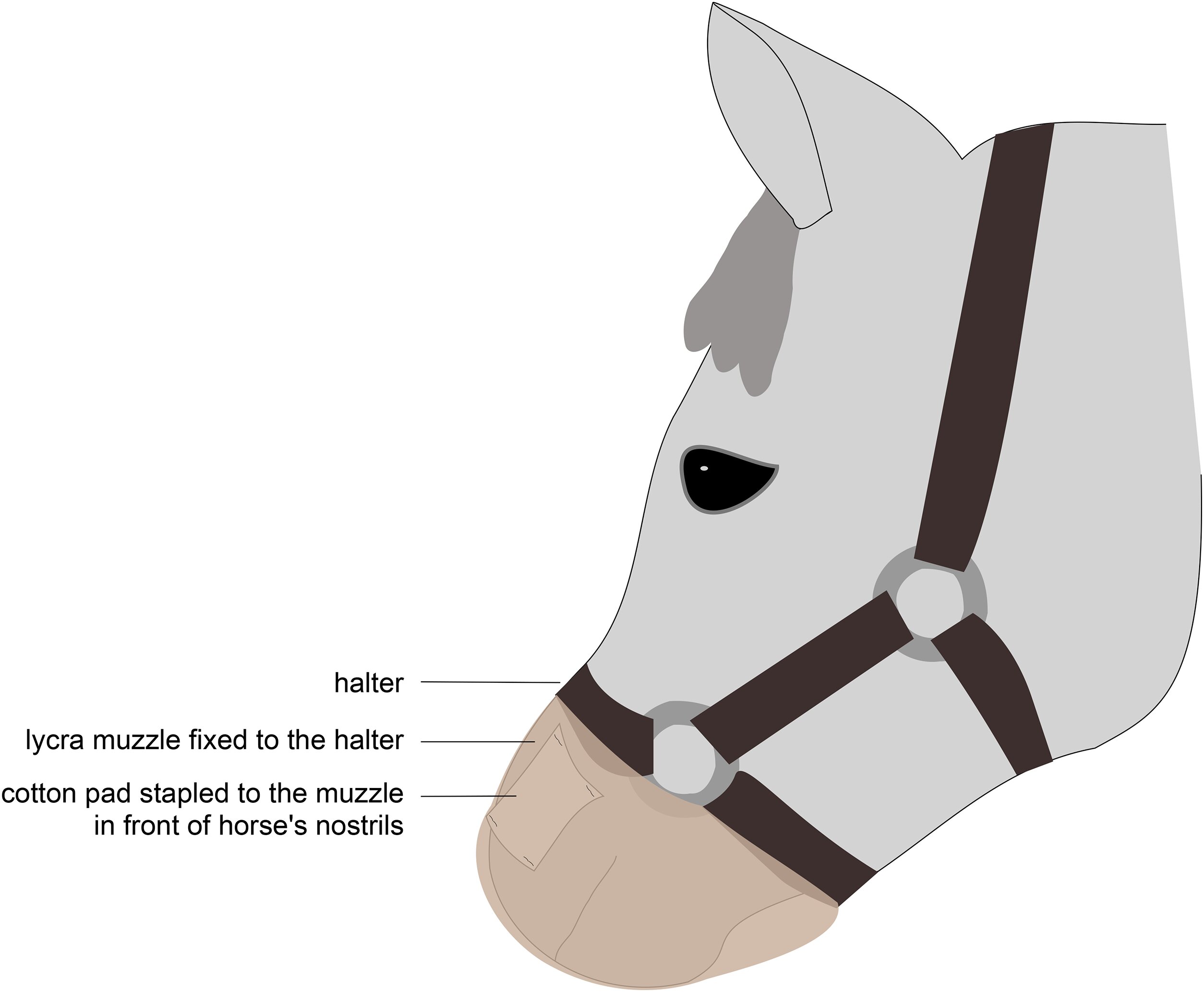
The next chapter of the experiment unfolded among 43 female Welsh horses. Each horse was fitted with a special Lycra muzzle, designed to hold the cotton pads close enough for the animal to smell them clearly. The horses were randomly assigned to one of three groups.
One group was exposed only to sweat collected during the fear-inducing horror movie. Another group smelled only sweat from the joyful, relaxed moments. A third group served as a control, wearing muzzles with clean pads that carried no human scent at all.
This careful setup meant that any changes in the horses’ reactions could be traced back to the scent itself. There were no humans acting frightened nearby. There were no dramatic movements or anxious voices. The horses could not see fear. If they responded differently, it would be because they smelled it.
Four Moments That Reveal a Reaction
With the scent samples in place, the horses went through four behavioral tests designed to reveal how they reacted to their environment and to people.
They were groomed, a familiar and typically calm interaction. An umbrella was suddenly opened, a moment meant to test their startle response. A human approached them, offering a chance for contact or avoidance. Finally, they were presented with a new object to explore, something unfamiliar that might invite curiosity or caution.
Throughout these moments, the researchers closely observed the horses’ behavior and monitored their heart rate, watching for physiological changes that might mirror emotional shifts.
What they saw depended strongly on what the horses were smelling.
When Fear Changes the Body
The horses exposed to sweat collected during moments of human fear behaved differently in clear and consistent ways. They were jumpier, reacting more strongly to sudden events like the opening umbrella. When faced with unfamiliar objects, they stared longer, a sign of heightened alertness or unease.
Their bodies told the same story. These horses showed higher heart rate spikes, revealing that their physiology was responding to something stressful in their environment.
Perhaps most striking was their reaction to people. Horses smelling fear sweat were less likely to touch or approach a human. Even though the human approaching them was not fearful in that moment, the scent alone seemed to carry a message that changed how safe or appealing that interaction felt.
The horses exposed to joyful sweat, and those in the control group with clean pads, did not show these heightened signs of stress and avoidance.
No Faces, No Gestures, Only Chemistry
One of the most important details of the study is what the horses did not have access to. They could not see fearful facial expressions. They could not read tense posture or nervous movements. There were no visual or behavioral clues from humans that might explain their reactions.
The researchers believe the horses were responding to chemical triggers in the sweat, known as chemosignals. These signals can carry information about emotional states without any conscious effort from the person producing them.
The scientists did not analyze the chemical composition of the sweat samples, so the exact substances involved remain unknown. Still, the behavioral and physiological responses of the horses strongly suggest that the message was there, floating invisibly in the air.
As the research team wrote, “These findings highlight the significance of chemosignals in interspecific interactions and provide insights into questions about the impact of domestication on emotional communication.”
Living Together, Communicating Silently
Horses are not strangers to humans. They are domesticated animals that have lived alongside people for thousands of years, working with us, carrying us, and responding to our guidance. This long shared history may have shaped their sensitivity to human cues, including those we do not even realize we are sending.
The idea that emotional communication can pass between species through scent alone adds a new layer to our understanding of human-animal relationships. It suggests that emotional awareness does not always require eyes or ears. Sometimes, it is written in chemistry.
This also raises deeper questions about how domestication may have influenced emotional communication. Have horses become especially attuned to human chemosignals because of their close association with us? Or is this sensitivity something more ancient, shared across many mammals? The study does not answer these questions, but it opens the door to them.
Why This Discovery Matters
Beyond its scientific curiosity, this research carries important implications for animal welfare and everyday human-horse interactions.
If a horse can detect fear through scent alone, then a handler’s emotional state matters more than previously understood. Even when people try to hide their anxiety, their bodies may still communicate it. This invisible transmission could influence how safe, calm, or threatening a situation feels to a horse.
The researchers note that “Practical implications include acknowledging the importance of handlers’ emotional state and its potential transmission through chemosignals during human-horse interactions.” In training, care, and daily handling, emotional awareness may be just as important as physical technique.
Understanding that horses can smell fear encourages a shift in perspective. It reminds us that calmness is not only something we display, but something we emit. By recognizing this silent channel of communication, humans may learn to create more supportive, less stressful environments for the animals in their care.
In the end, this study reveals something quietly profound. Long before words, before tools, before shared plans, there was scent. And even now, in modern stables and research labs, that ancient language is still being spoken, carried on the air between human and horse.
Study Details
Plotine Jardat et al, Human emotional odours influence horses’ behaviour and physiology, PLOS One (2026). DOI: 10.1371/journal.pone.0337948