Stars are born in silence and often die in violence. For millions or billions of years, they fuse hydrogen into helium in stable equilibrium, balancing gravity’s inward pull with the outward pressure of nuclear fusion. But no star can shine forever. Eventually, its fuel runs low. Its core changes. Its structure destabilizes. And the long, luminous life it once knew begins to unravel.
Yet death in the cosmos is not always dim or gentle. Some stars, even in their final stages, burn brighter than ever before. They swell into titanic red giants, pulse with unstable fury, erupt in dazzling explosions, or collapse into dense embers that glow with residual heat. They are dying, yet they shine with extraordinary intensity—sometimes more brilliantly than during their youth.
These are nine remarkable stars in various stages of stellar death that continue to shine brightly, reminding us that in the universe, endings can be spectacular.
1. Betelgeuse
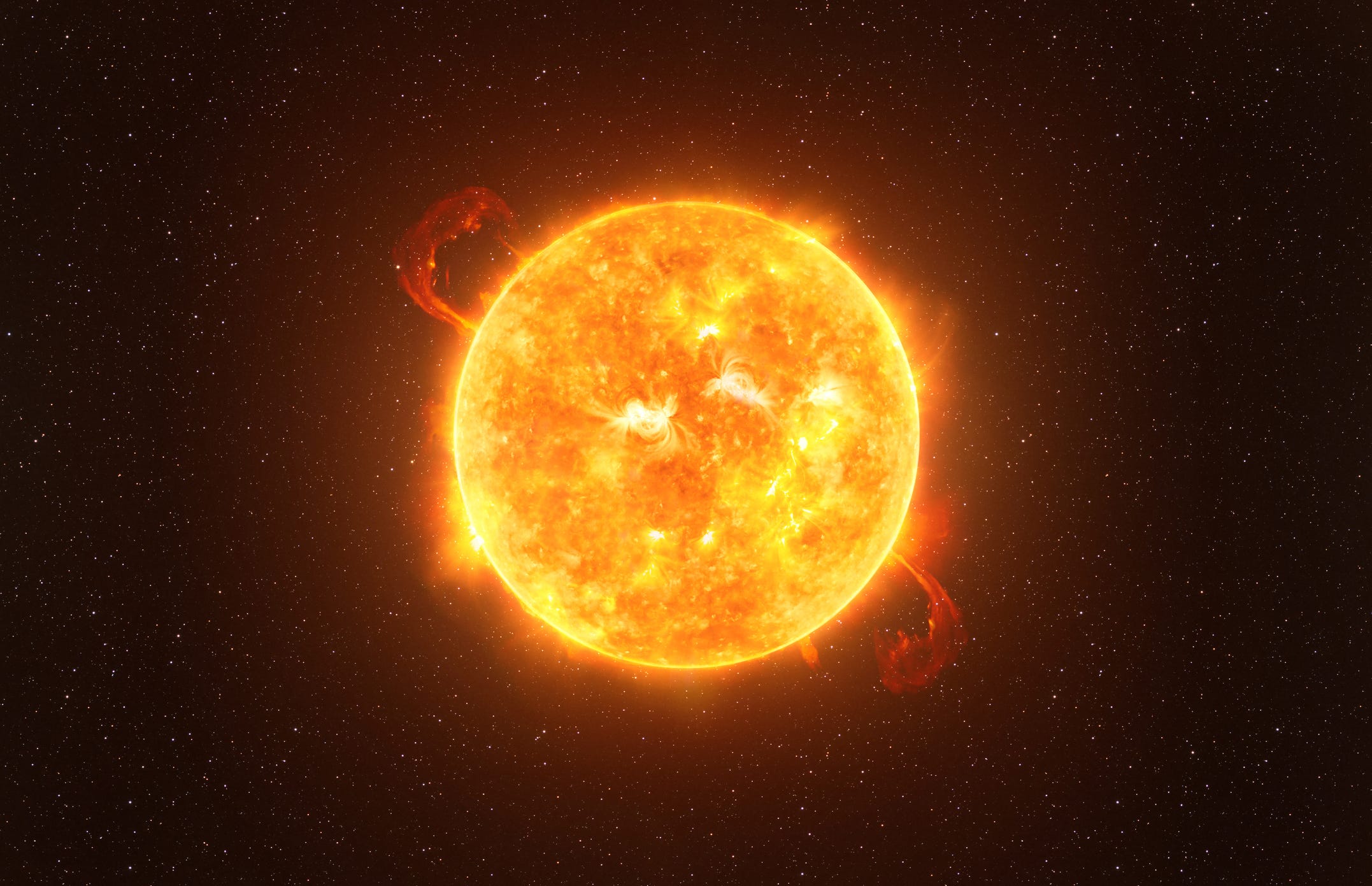
The red supergiant Betelgeuse, located in the constellation Orion, is one of the most recognizable stars in Earth’s sky. Its ruddy glow marks the shoulder of the celestial hunter. To the naked eye, it appears steady and eternal. But in cosmic terms, Betelgeuse is nearing the end of its life.
Betelgeuse is a massive star, estimated to be roughly 10 to 20 times the mass of the Sun. Massive stars live fast and die young. Unlike our Sun, which will shine for about 10 billion years, Betelgeuse will exhaust its nuclear fuel in only a few million years. It has already left the main sequence and expanded into a red supergiant phase, fusing heavier elements in its core.
As it burns through successive nuclear fuels—helium, carbon, oxygen, and possibly silicon—its internal structure becomes layered like an onion. Each stage grows shorter in duration. Eventually, its core will collapse under gravity, triggering a core-collapse supernova.
In late 2019 and early 2020, Betelgeuse dimmed dramatically, sparking global speculation that its explosion was imminent. Observations later showed that the dimming was likely caused by a massive ejection of material that formed a dust cloud, temporarily blocking some of its light. The event revealed how unstable and dynamic the star has become.
Despite being in its final evolutionary stage, Betelgeuse remains incredibly luminous—tens of thousands of times brighter than the Sun. When it does explode, it will briefly outshine an entire galaxy. For now, it continues to glow in our skies, a giant star quietly approaching a violent destiny.
2. Eta Carinae
Eta Carinae is not merely dying. It is unraveling in grand, chaotic fashion.
Located in the constellation Carina, this stellar system contains at least one extremely massive star, possibly over 100 times the mass of the Sun. Such extreme mass leads to instability. The star is classified as a luminous blue variable, a rare and volatile stage of stellar evolution characterized by dramatic eruptions.
In the 19th century, Eta Carinae underwent a colossal outburst known as the Great Eruption. For a time, it became the second-brightest star in the sky. Yet this was not a true supernova. The star survived, though it ejected an enormous amount of material into space. That material now forms the stunning Homunculus Nebula surrounding it.
Eta Carinae continues to shine intensely, radiating millions of times the Sun’s luminosity. It is believed to be in a late evolutionary stage, fusing heavier elements in its core. Its extreme mass means it will eventually collapse, likely producing a powerful supernova or possibly even a hypernova.
Some models suggest that such massive stars may produce gamma-ray bursts when they die, emitting narrow beams of intense radiation across the cosmos. If one were directed toward Earth, the consequences would be significant. Fortunately, Eta Carinae is not oriented in such a way.
For now, it remains one of the brightest and most unstable stars in our galaxy, a luminous giant living on borrowed time.
3. VY Canis Majoris
VY Canis Majoris is one of the largest known stars by radius. If placed at the center of our solar system, its outer layers would extend beyond the orbit of Jupiter.
This red hypergiant is nearing the end of its life. With a mass estimated around 17 to 25 times that of the Sun, it has expanded enormously after exhausting hydrogen in its core. The expansion has made it relatively cool at the surface, giving it a deep red appearance, but its total luminosity remains enormous—hundreds of thousands of times that of the Sun.
VY Canis Majoris is shedding mass at an extraordinary rate. Vast clouds of gas and dust surround it, expelled by powerful stellar winds. These ejections are signs of internal instability. The star is burning heavier elements in its core and edging closer to core collapse.
Despite losing material and approaching its explosive finale, VY Canis Majoris continues to blaze with immense brightness. Its size and instability suggest it will eventually explode as a supernova, enriching the surrounding interstellar medium with heavy elements forged in its interior.
Even in decay, it remains one of the galaxy’s most luminous beacons.
4. Antares
Antares, the heart of the constellation Scorpius, is another red supergiant nearing the end of its stellar journey. Its name means “rival of Mars,” a reference to its red color.
Antares is roughly 10 to 12 times the mass of the Sun and thousands of times more luminous. Like Betelgeuse, it has exhausted hydrogen in its core and expanded dramatically. Its outer layers are cool compared to its former main-sequence state, but its enormous size ensures it radiates immense energy.
The star shows signs of variability, with subtle brightness changes caused by pulsations and convection in its vast outer envelope. These pulsations reflect internal instabilities as fusion continues deeper within.
Eventually, Antares will undergo core collapse and explode as a supernova. For now, it continues to dominate its region of the sky, glowing fiercely as it approaches its final act.
5. R Sculptoris
R Sculptoris is an asymptotic giant branch star, representing a later stage in the life of a star similar in mass to our Sun. It has already passed through the red giant phase and is fusing helium and possibly heavier elements in shells around an inert core.
This star has shed significant material into space, forming a stunning spiral structure in surrounding gas. Observations show that a companion star may be shaping this pattern, indicating that stellar death can be influenced by binary interactions.
Though less massive than supergiants, R Sculptoris shines thousands of times brighter than the Sun. It is slowly losing its outer layers, which will eventually form a planetary nebula. The core will remain behind as a white dwarf.
R Sculptoris illustrates that even Sun-like stars end their lives with beauty and luminosity.
6. WR 104
WR 104 is a Wolf-Rayet star, an evolved, massive star that has lost its outer hydrogen layers. Wolf-Rayet stars are extremely hot and luminous, driven by powerful stellar winds that strip away mass.
WR 104 is part of a binary system. The interaction between the Wolf-Rayet star and its companion produces a striking pinwheel-shaped dust plume.
Wolf-Rayet stars represent a late evolutionary stage before supernova. They are fusing heavy elements in their cores and have already shed much of their outer envelopes.
WR 104 shines intensely despite its stripped-down state. Its eventual explosion could be dramatic. Some speculation once suggested it might produce a gamma-ray burst aimed toward Earth, but further analysis indicates that scenario is unlikely.
Still, WR 104 is undeniably a star nearing its end, blazing fiercely in its final chapter.
7. SN 1987A’s Progenitor
In 1987, astronomers observed a bright supernova in the Large Magellanic Cloud, designated SN 1987A. The progenitor star, Sanduleak -69° 202, had been a blue supergiant—an unusual precursor for a supernova.
Before its explosion, the star shone brightly, undergoing internal fusion of heavier elements. Its final collapse triggered a supernova visible to the naked eye.
Though the progenitor is gone, the remnant continues to shine as shock waves interact with surrounding material. The expanding debris glows as it slams into rings of gas ejected earlier in the star’s life.
SN 1987A demonstrates that dying stars can become even brighter in death than in life, briefly rivaling entire galaxies in luminosity.
8. Mira
Mira, in the constellation Cetus, is a pulsating red giant nearing the end of its life. It is a variable star, changing brightness over a period of about 11 months.
Mira has exhausted hydrogen in its core and is fusing helium in shells. Its outer layers expand and contract rhythmically, causing dramatic fluctuations in luminosity.
Despite being in a late evolutionary phase, Mira remains luminous, thousands of times brighter than the Sun at peak brightness. It is shedding material that will eventually form a planetary nebula.
Its pulsations are signs of internal instability, yet they also produce one of the sky’s most captivating cycles of brightening and fading.
9. Sirius B
Sirius B is not a giant but a white dwarf—the dense remnant of a once Sun-like star. It orbits Sirius A, the brightest star in Earth’s night sky.
Though small in size, roughly comparable to Earth, Sirius B packs a mass similar to the Sun. It shines not through fusion, but through residual thermal energy as it slowly cools.
White dwarfs represent the final stage for stars like our Sun. They no longer generate energy in their cores. Instead, they radiate leftover heat for billions of years.
Sirius B is a stellar corpse, yet it remains luminous and detectable. It reminds us that even after nuclear burning ends, stars can shine for eons.
The Brilliance of Cosmic Endings
Stars are not static points of light. They are dynamic engines of nuclear fusion, evolving through predictable yet dramatic stages. The most massive stars live short, explosive lives. Sun-like stars evolve more gently but still end in transformation.
Each of the stars described here is at a different stage of stellar death—red supergiant, hypergiant, Wolf-Rayet star, pulsating giant, or white dwarf. Yet all remain bright. Some are more luminous now than they were in youth. Some will explode in spectacular supernovae. Others will fade gradually into quiet embers.
Their brilliance is not a contradiction to their mortality. It is a consequence of it.
In their final acts, dying stars forge heavy elements—carbon, oxygen, iron—that become the building blocks of planets and life. Supernovae scatter these elements across space. White dwarfs cool slowly, preserving the memory of past fusion.
We are, in a profound sense, the children of dying stars.
As we gaze at Betelgeuse or Antares glowing red against the night sky, we are witnessing not just beauty but transformation. These stars are living out their last chapters with extraordinary luminosity.
They shine not in spite of death, but because of it.