There are moments in the cosmos when silence is shattered on a scale so vast that entire galaxies briefly bow to a single point of light. A star that has burned steadily for millions or billions of years suddenly detonates in a titanic release of energy. For days or weeks, it can outshine the combined brilliance of billions of neighboring stars. Shockwaves ripple outward. Heavy elements are forged. Space itself is seeded with the raw ingredients of future worlds.
This is a supernova.
Supernovas are not merely spectacular astronomical events. They are engines of creation and destruction, architects of cosmic evolution, and keys to understanding the structure and fate of the universe. They illuminate galaxies across billions of light-years and reveal secrets about dark energy. They shape the chemistry of planets and even make life possible.
Here are fifteen scientifically grounded, awe-inspiring facts about supernovas—the universe’s biggest explosions.
1. A Supernova Is the Explosive Death of a Star
A supernova marks the violent end of certain types of stars. But not all stars die this way. Our Sun, for example, is too small to explode as a supernova. Instead, it will gently shed its outer layers and become a white dwarf.
Supernovas occur under two main scenarios. In one case, a massive star—typically at least eight times the mass of the Sun—exhausts its nuclear fuel and undergoes a catastrophic core collapse. In another case, a white dwarf star in a binary system gains too much mass from a companion and ignites in a thermonuclear explosion.
Both pathways lead to an immense release of energy, but the underlying mechanisms are different. One is driven by gravitational collapse. The other is triggered by runaway nuclear fusion.
In both cases, the result is one of the most powerful explosions known in the universe.
2. Supernovas Can Outshine Entire Galaxies
For a brief period, a supernova can shine brighter than the galaxy that hosts it. The luminosity can exceed ten billion times that of the Sun.
When the supernova known as SN 1987A exploded in the Large Magellanic Cloud, it became visible to the naked eye from Earth despite being located about 168,000 light-years away. In distant galaxies, supernovas often become the brightest point of light in the sky, temporarily dominating their surroundings.
This extraordinary brightness makes them invaluable tools for astronomers. Type Ia supernovas, in particular, have nearly uniform peak brightness, allowing them to serve as “standard candles” for measuring cosmic distances.
Their brilliance is fleeting, but while it lasts, it can illuminate the structure of the universe itself.
3. There Are Different Types of Supernovas
Astronomers classify supernovas based on their spectral features and light curves. The two primary categories are Type I and Type II.
Type II supernovas occur when massive stars exhaust their nuclear fuel and their cores collapse under gravity. These explosions show hydrogen in their spectra, reflecting the star’s outer layers.
Type Ia supernovas occur in binary systems when a white dwarf accretes matter from a companion star. Once it reaches a critical mass—close to 1.4 times the mass of the Sun—it undergoes a thermonuclear runaway reaction, obliterating itself. Type Ia spectra lack hydrogen lines.
These differences are not cosmetic. They reflect distinct physical processes, and each type plays a different role in cosmic evolution.
4. Core-Collapse Supernovas Create Neutron Stars and Black Holes
When a massive star runs out of fuel, nuclear fusion can no longer support it against gravity. The core collapses in milliseconds, crushing protons and electrons together to form neutrons.
If the remaining core mass is within a certain range, the result is a neutron star—an object so dense that a teaspoon of its material would weigh billions of tons on Earth. If the core is even more massive, gravity overwhelms all resistance, and a black hole forms.
The collapse generates a shockwave that blasts the outer layers of the star into space. This explosive rebound is the visible supernova.
Thus, supernovas are birth events as much as death events. From their ashes emerge some of the most exotic objects in the universe.
5. Supernovas Forge the Heavy Elements
The calcium in your bones. The iron in your blood. The gold in jewelry. The uranium in Earth’s crust. These elements were forged in cosmic furnaces.
During a supernova, temperatures and pressures become so extreme that nuclear reactions produce elements heavier than iron. This process, known as rapid neutron capture or the r-process, builds atomic nuclei in fractions of a second.
Without supernovas, the universe would contain mostly hydrogen and helium. There would be no rocky planets, no complex chemistry, no life as we know it.
Every atom heavier than iron is a relic of a long-dead star’s explosion. In a very real sense, we are made of supernova debris.
6. The Explosion Releases More Energy Than the Sun Will Emit in Its Entire Lifetime
In mere seconds, a supernova can release as much energy as the Sun will produce over its entire 10-billion-year lifetime.
Most of this energy is emitted not as visible light, but as neutrinos—nearly massless particles that interact extremely weakly with matter. During the core collapse of a massive star, about 99 percent of the gravitational energy is carried away by neutrinos.
In 1987, neutrino detectors on Earth recorded a burst of neutrinos from SN 1987A, confirming theoretical predictions about core-collapse physics.
The visible explosion is only the glowing aftershock of an even more dramatic internal event.
7. Supernovas Shape Galaxies
Supernovas are not isolated spectacles. They influence entire galaxies.
The shockwaves from supernovas sweep through interstellar space, compressing gas clouds and triggering new waves of star formation. At the same time, they can disperse gas, regulating how quickly galaxies form new stars.
This feedback process is essential to galactic evolution. Without supernovas injecting energy into the interstellar medium, galaxies would evolve very differently.
In star-forming regions, supernovas act like cosmic gardeners—pruning and fertilizing the environment in equal measure.
8. A Nearby Supernova Could Threaten Earth
While supernovas are essential for life in the long run, a nearby explosion could be dangerous.
If a star within about 30 light-years of Earth were to explode as a supernova, the intense radiation could damage Earth’s ozone layer, increasing harmful ultraviolet radiation at the surface.
Fortunately, no known stars close enough to pose such a threat are expected to explode in the near future. The red supergiant Betelgeuse, often discussed as a potential future supernova, is about 550 light-years away—far enough to be spectacular but not harmful.
The universe is both creative and destructive, but on human timescales, we are relatively safe.
9. Supernova Remnants Glow for Thousands of Years
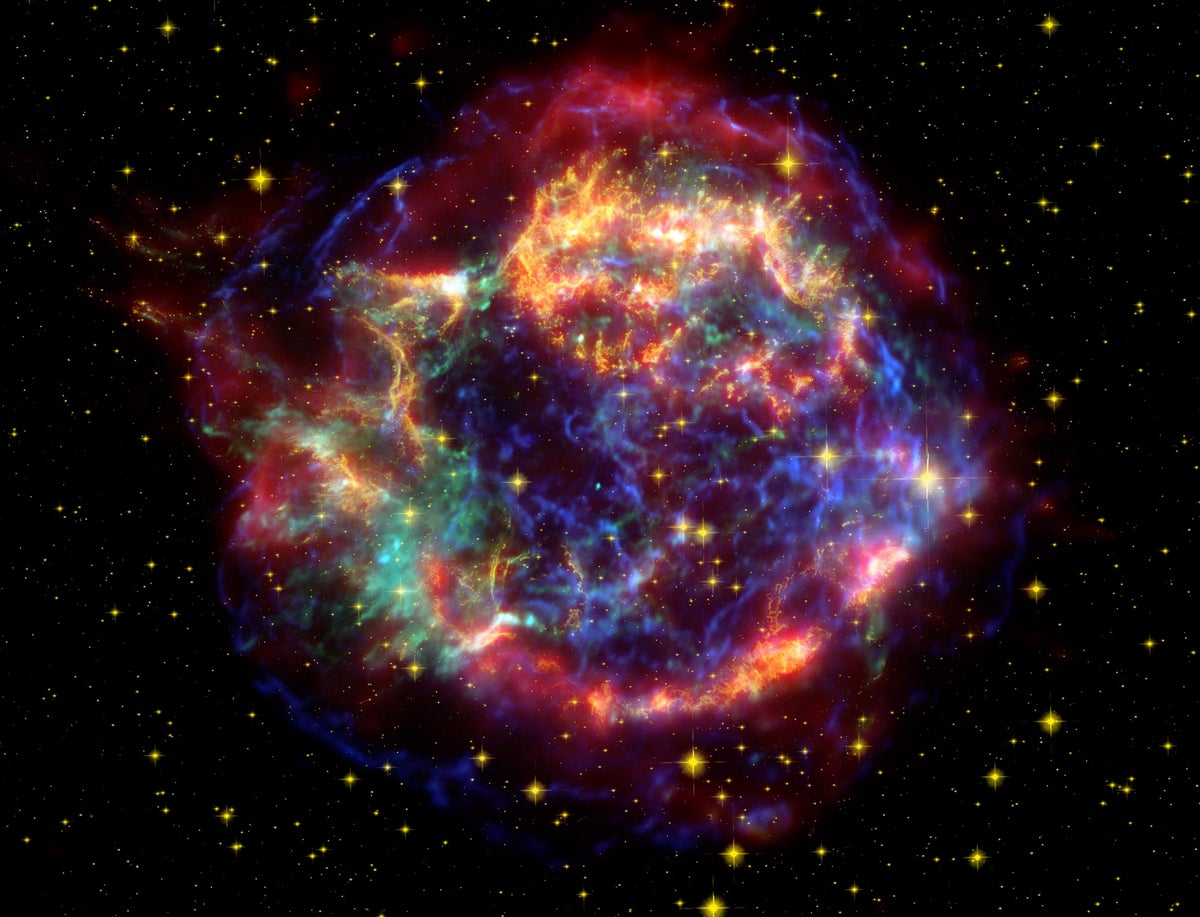
After the initial explosion fades, expanding shells of gas and dust continue to glow for millennia. These are known as supernova remnants.
The Crab Nebula, the remnant of a supernova observed in 1054 CE by astronomers in China and the Middle East, remains visible today. At its center lies a rapidly spinning neutron star known as a pulsar.
These remnants provide laboratories for studying shock physics, magnetic fields, and cosmic ray acceleration.
Long after the original flash disappears, the aftermath continues to shape the cosmos.
10. Type Ia Supernovas Revealed the Accelerating Universe
In the late 1990s, astronomers studying distant Type Ia supernovas discovered something astonishing: these supernovas were dimmer than expected, indicating that the universe’s expansion is accelerating.
This discovery led to the concept of dark energy, a mysterious force driving cosmic acceleration. It earned the 2011 Nobel Prize in Physics.
Without the predictable brightness of Type Ia supernovas, this revelation might have remained hidden.
Thus, exploding stars helped uncover one of the deepest mysteries in modern cosmology.
11. Supernovas Produce Cosmic Rays
Supernova remnants are believed to be major sources of cosmic rays—high-energy particles that travel through space at nearly the speed of light.
As shockwaves expand, they accelerate charged particles through magnetic fields, boosting them to enormous energies. Some of these particles eventually reach Earth, where they collide with atoms in the atmosphere.
Cosmic rays can affect atmospheric chemistry and even contribute to background radiation levels.
Supernovas are not just luminous events. They are particle accelerators on a galactic scale.
12. Some Supernovas Produce Gamma-Ray Bursts
Certain rare and extremely energetic supernovas are associated with long-duration gamma-ray bursts, the most powerful explosions observed in the universe.
Gamma-ray bursts release intense beams of radiation that can outshine entire galaxies for brief moments. They are thought to occur when rapidly rotating massive stars collapse into black holes, producing focused jets of energy.
If one of these jets were pointed directly at Earth from close range, it could have significant biological consequences. Fortunately, such alignments are exceedingly rare.
Even among supernovas, there are events of even greater ferocity.
13. Supernovas Help Scientists Measure the Age of Stars
The distribution of elements in stars provides clues about their formation history. Because supernovas enrich the interstellar medium with heavy elements, younger stars tend to contain higher “metallicity” than older stars.
By studying stellar compositions, astronomers can reconstruct the chemical evolution of galaxies.
Each supernova leaves behind a chemical signature that becomes part of future generations of stars and planets.
14. The First Supernovas Changed the Early Universe
The earliest stars in the universe were likely much more massive than most stars today. When they exploded as supernovas, they enriched the pristine cosmos with the first heavy elements.
Before these explosions, the universe consisted almost entirely of hydrogen and helium. The first supernovas made complex chemistry possible.
They transformed the universe from a simple elemental landscape into one capable of forming rocky planets and life.
In a sense, supernovas made complexity itself possible.
15. We Are Living in the Aftermath of Ancient Supernovas
Evidence suggests that supernovas have occurred relatively close to Earth in the distant past. Traces of radioactive isotopes such as iron-60 found in ocean sediments indicate that one or more supernovas exploded within a few hundred light-years of Earth millions of years ago.
These events did not cause mass extinctions but may have influenced Earth’s environment.
More profoundly, the atoms that make up Earth and every living organism were forged in ancient stellar explosions long before the Sun was born.
We are not merely observers of supernovas. We are their descendants.
The Cosmic Fire That Shapes Everything
Supernovas are endings and beginnings woven into a single, radiant moment. They are acts of destruction that enable creation. They are the reason galaxies sparkle with heavy elements and planets form with rocky surfaces. They are why life can arise at all.
When we look at a supernova through a telescope, we are witnessing the violent death of a star. But we are also seeing the process that made us possible.
The universe is not static. It is dynamic, explosive, evolving. And in its grandest explosions, we find both terror and beauty—proof that from unimaginable violence can come unimaginable possibility.
Somewhere in a distant galaxy, even now, a star is reaching the end of its life. In a moment that may take thousands of years to reach us, it will erupt in a blaze of brilliance.
And in that flash, the universe will once again remake itself.