We often think of our bodies as sleek, well-oiled machines, but the truth is far more chaotic. Beneath the surface of your skin, you are a walking, breathing biological miracle—and a bit of a weirdo. Every single day, your body performs a series of strange, almost alien-like maneuvers just to keep you alive and functioning. From shedding layers of yourself to literal self-digestion, the human experience is a constant parade of the bizarre.
Here are 10 of the strangest things your body does every single day, along with the fascinating science behind why they happen.
1. You Produce Enough Saliva to Fill Two Swimming Pools (Over a Lifetime)
Every day, your salivary glands work overtime, pumping out between one and two liters of spit. If you were to collect every drop over a standard human lifespan, you’d have enough to fill two Olympic-sized swimming pools.
The Why: Saliva isn’t just mouth water; it’s a complex chemical cocktail. It contains enzymes like amylase that begin breaking down carbohydrates the moment food touches your tongue. More importantly, it acts as a protective shield, neutralizing acids that would otherwise dissolve your tooth enamel and providing the lubrication necessary to swallow without choking. Without this constant “leakage,” you wouldn’t be able to taste, eat, or speak.
2. Your Brain Shrinks and Re-expands Every 24 Hours
As you go through your day, your brain actually loses volume. Studies using MRI scans have shown that the brain is at its largest in the morning and noticeably smaller by the evening.
The Why: This isn’t because you’re losing intelligence throughout the day. It’s primarily due to hydration and the movement of cerebrospinal fluid. During the night, while you sleep, your brain’s “glymphatic system” kicks into high gear, flushing out metabolic waste and toxins. This process involves a literal “washing” of the brain, which rehydrates the tissue and restores its volume for the next day.
3. You Shed About 500 Million Skin Cells
By the time you finish reading this article, you will have shed thousands of skin cells. In a single day, you lose roughly 500 million cells. In fact, about 50% of the dust in your home isn’t dirt from outside—it’s actually dead pieces of you.
The Why: Your skin is your primary defense against the world. To keep that barrier strong, your body undergoes a constant state of renewal called desquamation. New cells are born at the base of the epidermis and travel upward, flattening and dying as they reach the surface to form a tough, protective outer layer. Shedding the old cells ensures that pathogens and environmental pollutants don’t stay on your body for long.
4. Your Stomach Is Constantly Trying to Digest Itself
The hydrochloric acid in your stomach is incredibly potent—strong enough to dissolve metal. If you were to drop a piece of that acid on your carpet, it would burn a hole straight through. Yet, it sits inside you every day without causing a leak.
The Why: To prevent self-digestion, your stomach lining produces a thick, gooey layer of mucus that acts as a chemical-resistant buffer. However, the acid is so aggressive that this lining still takes a beating. To compensate, your stomach replaces its entire inner lining every three to four days. You are essentially growing a new stomach several times a month to stay ahead of your own digestive juices.
5. Your Eyes See the World Upside Down
Right now, the image of the screen you are looking at is hitting your retina upside down and backward. Because of the way light refracts through the convex lens of your eye, the physical data received by your biological “camera” is a flipped mess.
The Why: This is where the brain performs its most impressive trick. Your visual cortex takes that inverted data and instantly flips it right-side up. It also compensates for the “blind spot” in each eye (where the optic nerve connects) by hallucinating the missing information based on the surrounding colors and patterns. You don’t see reality; you see your brain’s highly edited version of it.
6. You Are Taller in the Morning Than at Night
If you measure yourself the moment you wake up and again right before bed, you will find that you have “shrunk” by about one to two centimeters (roughly half an inch).
The Why: This is due to the effects of gravity on your intervertebral discs. These discs are like gelatinous shock absorbers between the bones of your spine. Throughout the day, as you walk and sit, the weight of your body compresses these discs, squeezing out moisture. When you lie down to sleep, the pressure is relieved, and the discs rehydrate and expand back to their full size.
7. Your Heart Moves Enough Energy to Drive a Truck
Your heart is the most hardworking muscle in your body, beating about 100,000 times a day. The amount of physical energy created by that constant pumping is staggering. In a single day, your heart produces enough energy to drive a medium-sized truck for about 20 miles.
The Why: Your circulatory system is a massive highway spanning over 60,000 miles of vessels. To push blood—which is thicker than water—through those tiny capillaries and back up against gravity from your toes to your heart requires immense pressure. Your heart never takes a day off; if it stopped for even a few minutes, the specialized cells in your brain would begin to die from oxygen starvation.
8. You Have a “Second Brain” in Your Gut
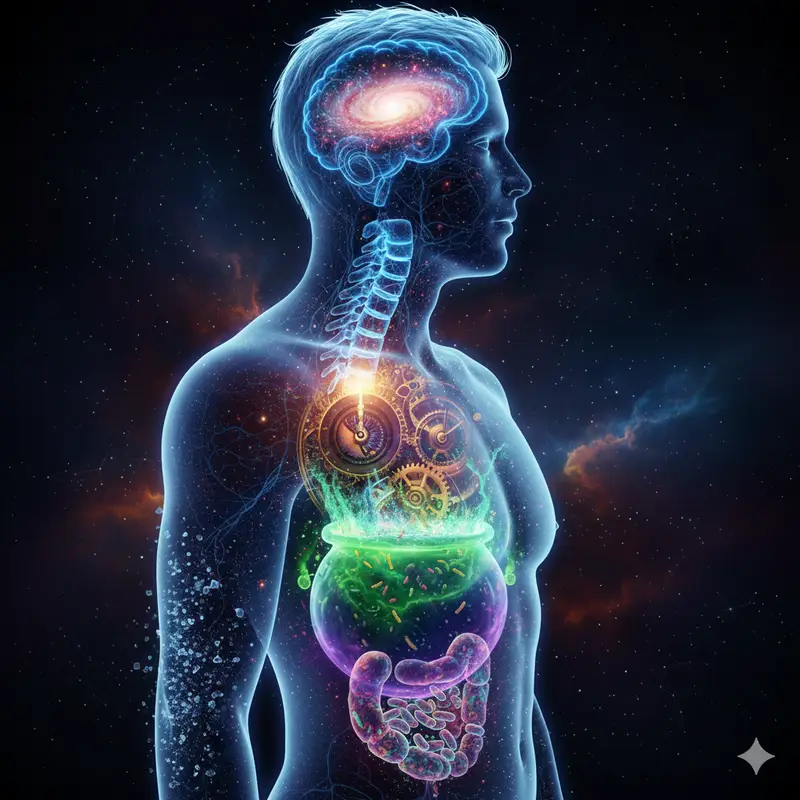
Have you ever had a “gut feeling” or “butterflies” in your stomach? That’s not just a metaphor. Your gastrointestinal tract is lined with the Enteric Nervous System (ENS), which consists of more than 100 million nerve cells—more than are found in either the spinal cord or the peripheral nervous system.
The Why: The ENS doesn’t handle complex thoughts like philosophy or math, but it communicates constantly with the brain in your head. It manages the incredibly complex task of digestion and alerts the brain if something is wrong. Scientists now believe this “second brain” plays a major role in our emotions and immune responses, explaining why stress often leads to digestive issues.
9. Your Nose “Resets” Its Dominance Every Few Hours
You might think you breathe through both nostrils equally, but for most of the day, one nostril is doing about 75% of the work while the other remains partially congested. Every few hours, they swap.
The Why: This is called the nasal cycle. It is controlled by the autonomic nervous system. By alternating the heavy lifting, your body ensures that one nostril stays moist and the cilia (tiny hairs) stay sensitive. Furthermore, different smells are picked up better at different airflows; some scents need a fast stream of air to be detected, while others need a slower flow. The nasal cycle ensures you can smell the full spectrum of the world around you.
10. Your Body Is Mostly Made of Non-Human Cells
Perhaps the most bizarre fact of all is that “you” are not entirely “you.” For every human cell in your body, there is at least one bacterial cell living on or inside you. You are a walking ecosystem of trillions of microbes, collectively known as the microbiome.
The Why: We couldn’t survive without our microbial hitchhikers. These bacteria help us digest fiber, produce essential vitamins (like B12 and K), and train our immune systems to distinguish between “friend” and “foe.” You aren’t just an individual; you are a highly organized biological colony, a vessel for a massive community of microscopic life that keeps the whole system running.
The human body is far more than the sum of its parts. It is a theatre of the strange, performing these ten bizarre feats—and thousands more—without you ever having to ask. It shrinks, it melts, it flips the world over, and it regenerates, all in the span of a single day.