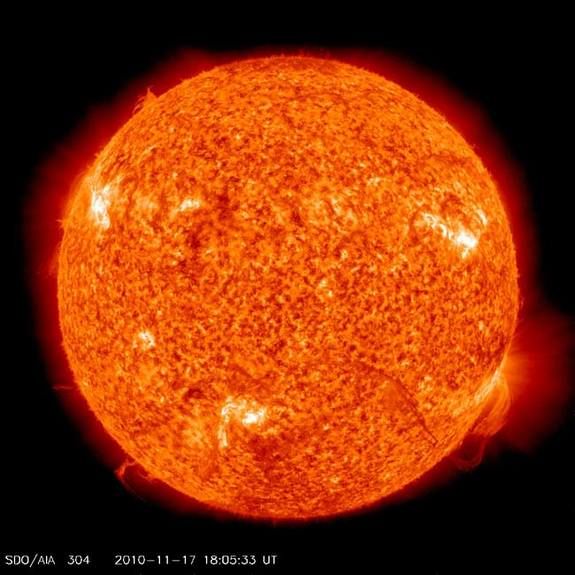
Every morning, sunlight spills across Earth, illuminating landscapes, warming oceans, and sustaining life in countless visible and invisible ways. Its presence feels constant, dependable, almost eternal. Yet the brilliant star that makes life possible was not always there. It had a beginning—a dramatic and violent birth shaped by cosmic forces operating across unimaginable distances and timescales.
To understand how the Sun was born is to tell a story that stretches far beyond Earth. It is a story of collapsing clouds of gas, swirling cosmic dust, rising temperatures, nuclear ignition, and the formation of an entire planetary system. It is also a story that connects our existence to processes unfolding across the universe even today, in distant stellar nurseries where new stars are still emerging from darkness.
The birth of the Sun was not an isolated event. It was part of a grand cosmic cycle in which stars form, evolve, and eventually die, enriching space with the material that will give rise to future generations of stars and planets. Our Solar System is one chapter in that ongoing cosmic transformation.
Understanding this fiery origin requires us to look deep into interstellar space, where the ingredients of stars first gather. It also requires us to explore the physics of gravity, energy, and nuclear fusion—the forces that transformed a cold cloud of gas into a blazing star.
The Universe Before the Sun Existed
Before the Sun formed, the region of space now occupied by our Solar System looked very different. There were no planets, no asteroids, no structured orbits—only a vast and diffuse cloud of gas and microscopic dust drifting through the galaxy.
This cloud was part of the interstellar medium, the thin material that fills the space between stars. Although extremely sparse by earthly standards, these clouds can stretch across many light-years and contain enormous total mass. They are composed mostly of hydrogen, the simplest and most abundant element in the universe, along with helium and traces of heavier elements produced by earlier generations of stars.
These clouds are not uniform. Some regions are denser and colder than others. In especially dense pockets—called molecular clouds—temperatures can drop so low that atoms combine into molecules. These cold, dark regions are the birthplaces of stars.
Astronomers have observed many such stellar nurseries across the Milky Way. One of the most famous is the Orion Nebula, a glowing cloud where hundreds of young stars are forming at this very moment. By studying such regions, scientists gain insight into processes that occurred long before our Sun existed.
The Trigger That Began Collapse
A cloud of gas and dust can remain stable for millions of years, balanced between internal pressure pushing outward and gravity pulling inward. For star formation to begin, this balance must be disturbed.
The exact trigger that initiated the Sun’s birth is not known with certainty, but astronomers have strong clues. One widely supported possibility is that a nearby supernova explosion—a massive star ending its life in a violent burst—sent shock waves through space. When such a shock wave passes through a molecular cloud, it can compress parts of the cloud, increasing density and tipping the balance in favor of gravitational collapse.
As gravity gained dominance, the dense region that would become our Solar System began to contract. This marked the true beginning of the Sun’s formation.
Gravity’s Relentless Pull
Once gravitational collapse began, it accelerated. As particles in the cloud moved closer together, gravitational attraction grew stronger, drawing in more material and increasing density further. The cloud did not collapse evenly. Instead, it fragmented and spun.
Rotation played a crucial role. Even a tiny initial rotation becomes amplified as a collapsing cloud shrinks, much like a spinning ice skater pulling in their arms. Conservation of angular momentum forces the material to rotate faster and flatten into a disk.
At the center of this rotating disk, mass accumulated rapidly. The core became denser and hotter as gravitational energy converted into thermal energy. What began as a cold, dark cloud was transforming into a glowing embryonic star.
The Birth of a Protostar
As collapse continued, the central region became so dense that it formed what astronomers call a protostar—a developing star not yet powered by nuclear fusion but already radiating energy from gravitational contraction.
During this stage, the forming Sun was surrounded by a vast rotating disk of gas and dust. This structure, known as a protoplanetary disk, would later give rise to planets, moons, asteroids, and comets.
Inside the protostar, pressure and temperature rose steadily. The material at the center became incredibly compressed. The journey toward true stardom had begun, but a critical threshold still lay ahead.
Rising Temperatures and the Threshold of Fusion
For a star to shine in the way we recognize, its core must reach temperatures high enough to trigger nuclear fusion. Fusion is the process by which atomic nuclei combine to form heavier nuclei, releasing enormous energy in the process.
In the forming Sun, hydrogen nuclei were being squeezed ever closer together. But atomic nuclei carry positive electric charge, causing them to repel one another. Only extreme temperature and pressure can overcome this repulsion.
As gravitational collapse intensified, the core temperature climbed into the millions of degrees. When it reached roughly ten million degrees Celsius, hydrogen nuclei began to fuse into helium.
At that moment, the Sun truly ignited.
The Moment the Sun Became a Star
Nuclear fusion transformed the Sun from a protostar into a main-sequence star—a stable, self-sustaining source of light and heat. Fusion released immense energy, producing radiation that pushed outward against gravity.
This outward pressure balanced the inward pull of gravity, creating a stable equilibrium. The Sun had reached hydrostatic balance, the defining condition of a mature star.
The birth of the Sun was complete, but the surrounding disk of material was still evolving. Within it, the rest of the Solar System was beginning to take shape.
The Formation of Planets From the Solar Disk
The disk of gas and dust surrounding the young Sun contained countless tiny particles colliding, sticking together, and growing larger. Through a process known as accretion, microscopic grains became pebbles, pebbles became rocks, and rocks merged into planetesimals—small planetary building blocks.
Over millions of years, gravitational interactions caused planetesimals to merge into larger bodies. Some became rocky inner planets. Others, forming farther from the Sun, accumulated vast envelopes of gas to become giant planets.
This was not a gentle process. Collisions were frequent and often violent. Entire worlds merged or shattered. The structure of the Solar System gradually emerged from this chaotic environment.
Clearing the Neighborhood
As nuclear fusion stabilized the Sun, it began producing powerful streams of charged particles known as solar wind. This energetic outflow swept away much of the remaining gas in the protoplanetary disk.
With the lighter material dispersed, planetary formation slowed. The Solar System’s architecture—its arrangement of planets and smaller bodies—was largely set.
What remained was a young star surrounded by a family of newly formed worlds, including the one on which we now live.
Evidence Written in Ancient Matter
Scientists cannot travel back in time to witness the Sun’s birth, but evidence of its early history remains preserved in ancient materials. Meteorites—fragments of early Solar System debris—contain chemical signatures that reveal conditions present during planetary formation.
Radiometric dating of these materials shows that the Solar System formed about 4.6 billion years ago. This age provides a timeline for the Sun’s birth and early evolution.
The presence of certain isotopes also suggests that nearby supernova activity influenced the early Solar System, supporting the idea that stellar explosions helped trigger collapse.
Observing Star Birth Across the Galaxy
Modern astronomy allows scientists to observe star formation happening today in distant regions of space. Powerful observatories such as the NASA mission platforms and telescopes provide detailed images of stellar nurseries.
The Hubble Space Telescope revealed dramatic structures within star-forming regions—pillars of gas, glowing jets, and dense cores where new stars emerge.
More recently, the James Webb Space Telescope has provided unprecedented views into dusty regions where visible light cannot penetrate. Its infrared instruments allow astronomers to see protostars still hidden within their natal clouds.
By studying these regions, scientists reconstruct the stages through which our own Sun once passed.
The Role of Nuclear Physics in Stellar Birth
Understanding the Sun’s formation requires knowledge of nuclear physics. Fusion reactions convert mass into energy according to principles first clarified by Albert Einstein. His insight that mass and energy are interchangeable explains how tiny amounts of matter can release enormous energy in stellar cores.
The balance between gravitational compression and fusion energy determines a star’s size, brightness, and lifespan. For the Sun, this balance has provided remarkable stability over billions of years.
The Sun’s Place in the Milky Way
Our Solar System formed within the vast structure of the Milky Way, a galaxy containing hundreds of billions of stars. Star formation has occurred repeatedly throughout its history.
The Sun is one among many generations of stars. Earlier stars lived and died, forging heavier elements in their cores and scattering them through supernova explosions. These elements became part of the cloud from which our Solar System formed.
This means the atoms in Earth—and in our own bodies—were created in ancient stars long before the Sun existed.
The Life Ahead of a Star
Although the Sun’s birth was dramatic, its long stable phase is equally remarkable. Stars like the Sun spend billions of years steadily converting hydrogen into helium. This stable period provides the energy necessary for planetary climates and biological evolution.
The Sun is currently about halfway through this phase. Its fiery birth set in motion a long and stable existence that has allowed life to emerge on Earth.
Cosmic Perspective and Human Understanding
The story of the Sun’s birth reveals something profound about humanity’s relationship with the universe. We live within a system shaped by processes that operate across immense scales of time and space. The light that warms our world originates in nuclear reactions that began billions of years ago.
The astronomer Carl Sagan famously emphasized that understanding our cosmic origins connects us to the universe in a deeply meaningful way. The story of the Sun’s birth is also the story of our own origins.
A Continuing Cycle of Creation
Stars continue to form across the galaxy. New solar systems are emerging in distant clouds even now. The processes that created our Sun are not unique—they are part of an ongoing cosmic cycle.
When stars eventually die, they enrich space with new material. From that material, future stars and planets will form. The universe continually renews itself.
The Fiery Beginning That Made Life Possible
The birth of the Sun was an event of extraordinary violence and transformation. A cold cloud collapsed, heated, ignited, and became a star whose light would shape an entire planetary system.
Without that collapse, without nuclear ignition, without the clearing of the solar disk, Earth would not exist. Life would not exist. The daily sunrise that feels so ordinary is the visible expression of processes that began billions of years ago in a dark and silent region of interstellar space.
The Sun’s birth was not merely an astronomical event. It was the beginning of the environment that would eventually give rise to oceans, continents, atmosphere, and living organisms capable of asking how it all began.
The fiery origin of our Solar System is therefore not just a scientific story—it is the origin story of everything familiar, illuminated each day by the star that once formed from collapsing cosmic dust and ignited into brilliance.