For as long as humans have looked at the sky, speed has symbolized freedom. From the first tentative hops of early aircraft to the thunderous ascent of rockets, flight has always been a story of defying limits. Today, the idea of crossing the Atlantic Ocean in under an hour feels almost mythical, like science fiction whispered into reality. Yet this vision rests not on fantasy, but on physics—specifically, on the extraordinary and unforgiving realm of hypersonic flight.
Hypersonic flight represents one of the most ambitious frontiers in aerospace science. It challenges our understanding of aerodynamics, materials, propulsion, and even time itself. To imagine breakfast in New York and lunch in London is to imagine a world reshaped by speed, where distance loses its traditional meaning. But behind this dream lies a fierce struggle with nature, as aircraft push into regimes where air behaves less like a gentle fluid and more like a violent, reactive force.
Understanding hypersonic flight is not simply about going faster. It is about confronting the physical limits of motion through the atmosphere and learning how to survive—and control—the extreme conditions that arise when speed approaches the edge of possibility.
What Hypersonic Really Means
In aviation, speed is measured relative to the speed of sound, described by the Mach number. When an aircraft exceeds five times the speed of sound, it enters the hypersonic regime. At these speeds, an aircraft would travel more than a mile every second. Crossing the Atlantic, which currently takes around seven hours on a commercial jet, could theoretically be reduced to less than sixty minutes.
But hypersonic speed is not merely a faster version of supersonic flight. It represents a fundamentally different physical environment. Air no longer flows smoothly over the aircraft’s surface. Instead, it compresses violently, heats to extreme temperatures, and undergoes chemical changes. Molecules vibrate, dissociate, and even ionize, transforming the surrounding air into a plasma-like state.
In this regime, traditional aerodynamic assumptions fail. Lift, drag, heating, and stability behave in unfamiliar ways. Hypersonic flight is not just aviation pushed harder; it is a new domain of physics.
The Promise of a One-Hour Atlantic Crossing
The emotional pull of hypersonic travel is undeniable. The Atlantic Ocean has long symbolized separation—between continents, cultures, and histories. Shrinking that distance to under an hour would redefine global connectivity. Business, diplomacy, science, and personal relationships would all be transformed by the ability to traverse oceans almost as easily as cities.
This vision echoes earlier revolutions in transportation. The steamship collapsed weeks into days. The jet aircraft collapsed days into hours. Hypersonic flight promises to collapse hours into minutes. Each leap in speed has altered how humanity perceives the world, making it feel smaller, more immediate, and more interconnected.
Yet the dream of hypersonic passenger travel is not driven only by convenience. It represents a deeper human urge: to conquer time through understanding, to use physics as a tool to bend geography to our will.
The Physics of Extreme Speed
At hypersonic velocities, air behaves in ways that defy everyday intuition. As an aircraft slices through the atmosphere, it compresses the air in front of it so violently that temperatures can soar to thousands of degrees. This heating is not caused primarily by friction, as commonly believed, but by compression. The air molecules are forced so close together that their energy skyrockets.
This intense heating creates one of the greatest challenges in hypersonic flight. The aircraft’s surface must endure temperatures comparable to those experienced during atmospheric reentry. Metals can soften, deform, or melt. Even advanced alloys struggle to survive sustained exposure to such extremes.
At the same time, shock waves form and cling tightly to the aircraft’s body. Unlike the detached shock waves seen in supersonic flight, hypersonic shock layers are thin and intense, trapping heat close to the surface. The aircraft essentially flies inside a cocoon of superheated air.
The physics does not stop there. At hypersonic speeds, the air’s chemical composition changes. Oxygen and nitrogen molecules break apart. Electrons are stripped from atoms. These processes absorb and release energy, altering heat transfer and pressure in complex ways. The air itself becomes an active participant in the flight, no longer a passive medium.
Aerodynamics in the Hypersonic Regime
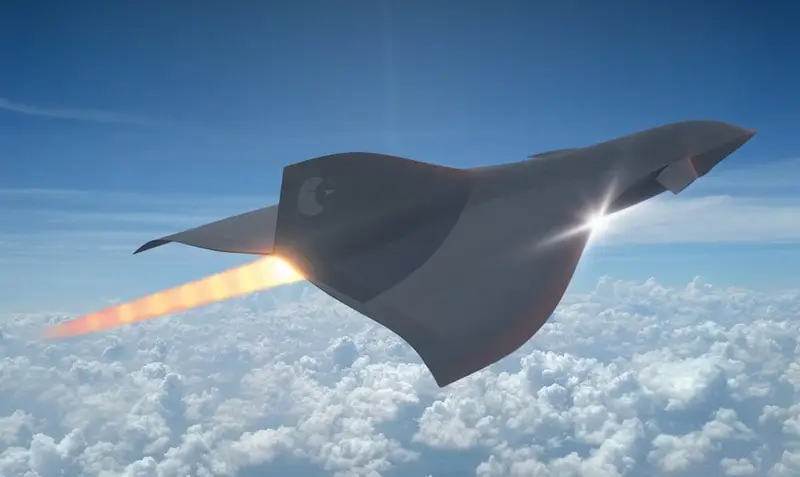
Lift, the force that keeps an aircraft aloft, behaves differently at hypersonic speeds. Traditional wings designed for subsonic or supersonic flight become inefficient or unstable. Hypersonic vehicles often rely on their entire body to generate lift, using flattened shapes that skim the atmosphere rather than slicing through it.
These designs blur the line between aircraft and spacecraft. Some hypersonic concepts resemble slender wedges or lifting bodies, optimized to manage shock waves and distribute heat. Every angle, curve, and surface is dictated by physics, leaving little room for aesthetic compromise.
Control is another profound challenge. At extreme speeds, even small changes in angle or force can produce dramatic effects. The air is so energetic that tiny imperfections can trigger instabilities. Maintaining stable, controlled flight requires unprecedented precision in design, materials, and guidance systems.
Propulsion Beyond Conventional Engines
Perhaps the most daunting obstacle to hypersonic flight lies in propulsion. Traditional jet engines rely on rotating compressors and turbines, which cannot function at hypersonic speeds. The air enters the engine too fast and too hot for moving parts to survive.
To overcome this, researchers have turned to radically different concepts, most notably the scramjet, or supersonic combustion ramjet. In a scramjet, the incoming air is compressed by the vehicle’s forward motion rather than by mechanical components. Fuel is injected into this high-speed airflow and ignited, producing thrust while the air continues moving supersonically through the engine.
Scramjets are elegant in theory and brutal in practice. Combustion must occur in milliseconds, within an airflow moving faster than a rifle bullet. Mixing fuel and air, igniting it reliably, and extracting useful thrust under these conditions is one of the most difficult problems in engineering.
Moreover, scramjets cannot operate from a standstill. They require the vehicle to already be traveling at high supersonic speeds before they can function. This necessitates complex launch systems or combined propulsion approaches, further complicating the path to practical hypersonic travel.
Heat: The Ever-Present Enemy
If speed is the promise of hypersonic flight, heat is its constant threat. The thermal loads experienced by a hypersonic vehicle are extreme, relentless, and uneven. Leading edges, nose cones, and engine inlets bear the brunt of the heating, facing temperatures that can exceed the melting point of conventional materials.
Managing this heat requires a combination of advanced materials, clever geometry, and sometimes active cooling. High-temperature ceramics, carbon composites, and novel alloys are being developed to withstand conditions that would destroy ordinary aircraft.
Some concepts involve allowing certain parts of the vehicle to heat up and radiate energy away, while others use fuel as a coolant, circulating it through channels in the structure before combustion. These strategies push materials science to its limits, demanding reliability in an environment where failure is not an option.
The emotional weight of this challenge cannot be overstated. Hypersonic flight forces engineers to accept that nature will not compromise. The laws of thermodynamics are absolute, and every solution must respect them.
Guidance, Navigation, and Control at Hypersonic Speeds
Flying at hypersonic speed compresses not only distance but time. Decisions that might take seconds in conventional flight must be made in fractions of a second. The vehicle travels so fast that small errors can quickly become catastrophic.
Guidance and control systems must operate with extraordinary speed and accuracy. Sensors must function in extreme temperatures and ionized air, which can interfere with communications and signals. Traditional radio links may be disrupted by the plasma surrounding the vehicle, creating periods of blackout.
Autonomous systems play a crucial role in addressing these challenges. Human reaction times are simply too slow for real-time control at hypersonic velocities. Instead, onboard computers must interpret data, predict conditions, and execute adjustments almost instantaneously.
This reliance on automation raises profound questions about trust, responsibility, and safety. Hypersonic flight demands not only technological mastery but also confidence in systems that operate at the edge of human oversight.
The Legacy of Supersonic and Spaceflight
The dream of hypersonic passenger travel does not emerge in isolation. It builds on decades of experience with supersonic aircraft and space vehicles. Supersonic transport demonstrated both the allure and the difficulties of high-speed travel, revealing issues of efficiency, cost, and environmental impact.
Spaceflight, particularly atmospheric reentry, has provided invaluable insights into hypersonic physics. Spacecraft returning from orbit experience hypersonic conditions as they plunge through the atmosphere. The lessons learned from heat shields, shock wave behavior, and material performance inform modern hypersonic research.
Yet there is a crucial difference. Reentry vehicles are designed for brief exposure to hypersonic conditions, while a hypersonic airliner would need to endure sustained flight at these speeds. This distinction magnifies every challenge, turning short-term survival into long-term reliability.
Environmental and Ethical Dimensions
Crossing the Atlantic in under an hour would be a marvel, but it also raises serious environmental questions. Hypersonic flight requires enormous amounts of energy. The fuel consumption per passenger could be significantly higher than that of conventional aircraft, depending on design and efficiency.
Additionally, hypersonic vehicles would operate at high altitudes, potentially affecting atmospheric chemistry. The intense heat and exhaust products could interact with sensitive layers of the atmosphere in ways that are not yet fully understood.
Noise is another concern. The shock waves generated by hypersonic flight would be intense, raising questions about sonic booms and their impact on communities and ecosystems.
These issues force society to confront a familiar dilemma: how to balance technological progress with environmental responsibility. Hypersonic flight is not just a scientific challenge but a moral one, requiring careful consideration of its broader consequences.
The Human Experience of Hypersonic Travel
Beyond physics and engineering lies the human experience. What would it feel like to travel at hypersonic speed? Acceleration forces, cabin environment, and psychological effects must all be considered.
Passengers would need to endure rapid acceleration and deceleration, potentially experiencing forces far greater than those of conventional flight. Cabin design would need to manage these forces while maintaining comfort and safety.
There is also the emotional aspect of such travel. The sense of time distortion, of leaving one continent and arriving at another almost immediately, could reshape how people perceive distance and presence. The world might feel both smaller and more intense, with consequences for culture, work, and personal relationships.
Hypersonic travel would not merely move bodies faster; it would alter rhythms of life.
Scientific Accuracy and the Limits of Reality
It is important to ground the vision of hypersonic Atlantic travel in scientific reality. While physics does not forbid such speeds, it imposes strict constraints. Every gain in speed brings exponential increases in complexity, cost, and risk.
The laws of aerodynamics, thermodynamics, and materials science do not bend to ambition. They must be satisfied, respected, and sometimes endured. This is why hypersonic flight has advanced slowly, despite decades of research.
Yet history shows that persistent engagement with physical limits can yield breakthroughs. What once seemed impossible often becomes routine when understanding deepens and technology matures.
Hypersonic Flight and the Nature of Progress
The pursuit of hypersonic flight reveals something profound about humanity’s relationship with physics. We do not merely observe the laws of nature; we negotiate with them. We learn their boundaries, test their flexibility, and design within their constraints.
This process is neither smooth nor guaranteed. It involves failure, uncertainty, and immense investment. But it also produces knowledge that extends far beyond any single application. Advances in hypersonic research ripple outward, influencing materials science, computational modeling, energy systems, and even fundamental physics.
In this sense, the dream of crossing the Atlantic in under an hour is not just about speed. It is about exploration—of nature’s extremes and of our own capacity to understand and adapt.
The Road Ahead
Hypersonic flight stands at a crossroads between aspiration and reality. The physics is known in principle but difficult in practice. The engineering challenges are formidable, and the societal implications are complex.
Yet the vision persists because it speaks to something deeply human. It speaks to the desire to overcome distance, to master time, and to push beyond what seems possible. It reflects the same impulse that drove the first sailors across oceans and the first astronauts beyond Earth.
Whether hypersonic passenger travel becomes a common reality or remains a specialized achievement, its pursuit enriches our understanding of the universe. It reminds us that physics is not an abstract discipline confined to equations and laboratories. It is a living dialogue between human imagination and the laws that govern existence.
In the end, hypersonic flight is a story about limits—how close we can come to them, how wisely we can approach them, and what we learn along the way. Crossing the Atlantic in under an hour may one day be routine, or it may remain a symbol of ultimate speed. Either way, the journey toward that goal deepens our understanding of both the universe and ourselves.