There is something almost unsettling about the number 13.8 billion years. It is so large that it resists imagination. It dwarfs human history, which barely spans a few thousand years. It overwhelms the age of civilizations, mountains, even the Earth itself. And yet, modern science states with remarkable confidence that the universe is about 13.8 billion years old. This is not a poetic guess, nor a philosophical metaphor. It is a measured conclusion, drawn from light that has traveled across space for billions of years, from the faint afterglow of the universe’s birth, and from the subtle expansion of space itself.
The age of the universe is not something we know because someone once wrote it down or because it feels intuitively right. We know it because the universe carries its own memory. It has left behind traces of its beginnings, and physics has given us the tools to read them. Understanding how we arrived at this number is a story of curiosity, patience, error, and profound human ingenuity. It is also a story about how deeply connected we are to the cosmos, because in learning the universe’s age, we are learning our own cosmic history.
When the Universe Seemed Eternal
For most of human history, the idea that the universe had an age would have seemed strange. Ancient cultures often imagined the cosmos as eternal, cycling endlessly or existing without beginning or end. Even early scientists, influenced by philosophical traditions, assumed that the universe was static and unchanging on the largest scales. Stars were thought to be fixed points on a celestial sphere, and the cosmos itself was seen as timeless.
This view persisted well into the early twentieth century. When Albert Einstein developed his theory of general relativity, the equations suggested that the universe should either be expanding or contracting. Yet Einstein, like many of his contemporaries, believed in a static universe. To preserve this idea, he introduced an additional term to his equations, later called the cosmological constant, to hold the universe in balance.
At that time, the question was not “How old is the universe?” but “Has the universe always existed?” The idea that the cosmos might have a beginning was philosophically uncomfortable and scientifically unproven. That would soon change, not through abstract thought alone, but through observation.
The Discovery That Space Is Expanding
The first crack in the idea of an eternal, unchanging universe came from the study of distant galaxies. In the 1920s, astronomers began measuring the light from galaxies far beyond the Milky Way. They noticed something strange. The light from these galaxies was shifted toward the red end of the spectrum, a phenomenon known as redshift.
Redshift can occur when an object moves away from us, stretching the light waves it emits. When Edwin Hubble analyzed these redshifts, he found a startling pattern: the farther away a galaxy is, the faster it appears to be moving away from us. This relationship, now known as Hubble’s law, revealed that space itself is expanding.
This discovery transformed cosmology. If the universe is expanding today, then in the past it must have been smaller. If we follow that expansion backward in time, the universe becomes denser and hotter. Eventually, this reasoning leads to a moment when all matter and energy were compressed into an extremely hot, dense state. This was the first hint that the universe had a beginning.
Expansion turned the age of the universe from a philosophical question into a measurable one. If scientists could determine how fast the universe is expanding and how that expansion has changed over time, they could calculate how long it has been expanding. That duration would correspond to the universe’s age.
Turning Expansion Into a Cosmic Clock
The expansion of the universe provides a natural clock, but reading it is not straightforward. The simplest idea is to take the current expansion rate and run it backward to a time when the distance between galaxies was zero. This basic approach gives an estimate known as the Hubble time.
However, the universe’s expansion has not been constant. Gravity slows expansion by pulling matter together, while other factors can speed it up. To accurately determine the universe’s age, scientists must understand not just how fast the universe is expanding now, but how that expansion has evolved over billions of years.
This requires a theory of gravity that applies on cosmic scales. General relativity provides that framework. By combining observations of expansion with Einstein’s equations, cosmologists can model the universe’s history and calculate its age. But expansion alone is not enough. Independent lines of evidence are needed to confirm and refine the estimate.
The Big Bang and the Idea of a Beginning
As evidence for expansion accumulated, the idea of a cosmic beginning gained strength. The theory that emerged to describe this beginning is known as the Big Bang. Despite its name, it was not an explosion in space but an expansion of space itself. Matter and energy were already everywhere, but space was extremely compact and then began to stretch.
The Big Bang theory does not describe the absolute beginning of everything, but it does describe the earliest moments we can meaningfully talk about using known physics. In those early moments, the universe was unimaginably hot and dense. As it expanded, it cooled, allowing particles to form, then atoms, then stars and galaxies.
If the Big Bang really happened, it should have left behind observable evidence. And it did, in several profound ways. Each of these pieces of evidence helps pin down the age of the universe with increasing precision.
The Afterglow of Creation: Cosmic Microwave Background
One of the most powerful tools for determining the universe’s age comes from a faint, nearly uniform glow that fills all of space. This glow is known as the cosmic microwave background, often described as the afterglow of the Big Bang.
In the early universe, matter and radiation were tightly coupled in a hot, opaque plasma. Light could not travel freely because it was constantly scattered by charged particles. As the universe expanded and cooled, it eventually reached a point where electrons and protons could combine to form neutral atoms. At that moment, light was finally free to travel through space.
The light released at that time has been traveling ever since, stretched by the expansion of the universe into microwave wavelengths. When scientists observe this radiation today, they are seeing the universe as it was roughly 380,000 years after the Big Bang. This is not an estimate pulled from thin air; it comes from detailed physics describing how atoms form and how light interacts with matter.
The cosmic microwave background is incredibly uniform, but it contains tiny fluctuations in temperature. These fluctuations encode information about the universe’s composition, geometry, and expansion history. By analyzing them, cosmologists can extract precise values for key parameters, including the universe’s age.
Reading the Universe’s Oldest Light
The cosmic microwave background is not just old light; it is a snapshot of the infant universe. The pattern of its temperature variations depends on how fast the universe was expanding, how much matter it contained, and how space itself is shaped.
When scientists fit models of the universe to these observed patterns, they find a consistent result. The universe is about 13.8 billion years old. This number emerges from the physics of expansion, gravity, and radiation, all working together.
What makes this result so compelling is its precision. Measurements of the cosmic microwave background have become increasingly accurate over time, thanks to space-based observatories designed to observe this radiation with extraordinary sensitivity. The age of the universe is now known to within a tiny margin of error on cosmic scales.
This is one of the rare moments in science where a question as vast as the age of the universe has an answer that is both precise and deeply rooted in observation.
The Chemical Memory of the Cosmos
Another powerful way to estimate the universe’s age comes from its chemical composition. In the first few minutes after the Big Bang, the universe was hot enough for nuclear reactions to occur. During this brief period, known as primordial nucleosynthesis, the first atomic nuclei formed.
The physics governing these reactions is well understood. Given the conditions of temperature and density in the early universe, scientists can predict how much hydrogen, helium, and small amounts of other light elements should have formed. These predictions depend on the universe’s expansion rate at that time.
When astronomers measure the abundance of these elements in ancient gas clouds and old stars, they find remarkable agreement with Big Bang predictions. This agreement reinforces the idea of a hot, dense early universe and constrains models of cosmic expansion.
While this method does not directly measure the universe’s age in years, it supports the same cosmological framework used to calculate that age. It is another independent line of evidence pointing to a universe that began billions of years ago and evolved in a predictable way.
Stars as Cosmic Timekeepers
Long before cosmologists could study the cosmic microwave background, astronomers looked to stars to estimate the universe’s age. Stars shine by converting nuclear fuel into energy. The rate at which they burn this fuel depends on their mass and composition. Over time, stars evolve in ways that are well understood through stellar physics.
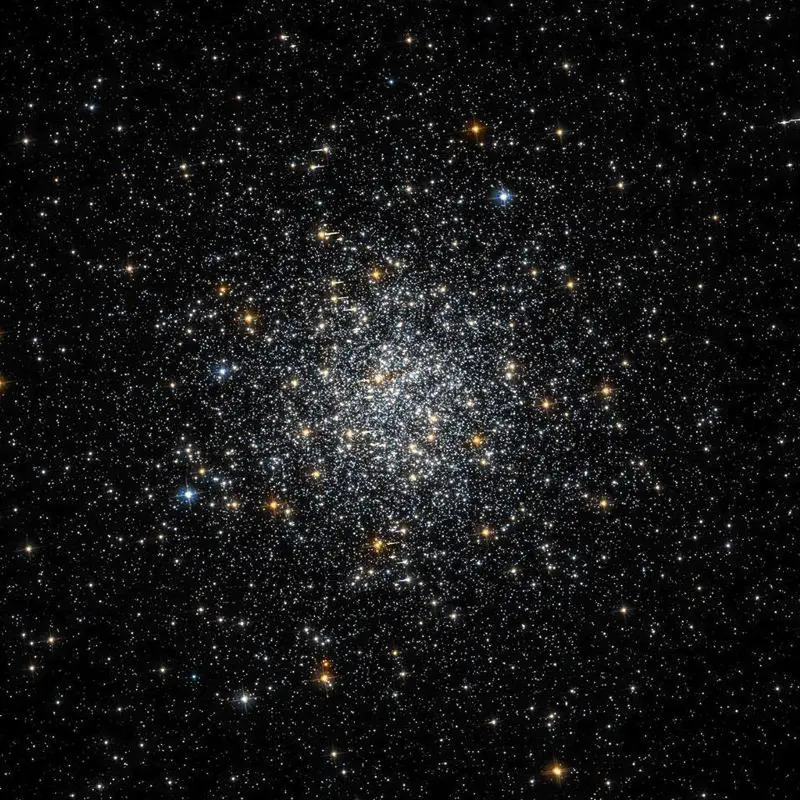
The oldest stars are found in dense clusters and in the halo of our galaxy. By studying these stars, astronomers can estimate how long they have been shining. The oldest stars are slightly younger than the universe itself, since stars could only form after the first structures emerged.
When scientists calculate the ages of these ancient stars, they find values around 12 to 13 billion years. This sets a lower limit on the universe’s age. The universe must be older than its oldest stars. When combined with cosmological measurements, these stellar ages align beautifully with the 13.8 billion-year figure.
There is something emotionally powerful about this connection. By studying the light of ancient stars, we are peering back into the early chapters of cosmic history, reading time not from clocks, but from nuclear reactions that began long before Earth existed.
Galaxies and the Growth of Structure
The universe did not always look the way it does today. In its early stages, matter was distributed more smoothly. Over time, gravity amplified tiny variations, leading to the formation of galaxies, clusters, and vast cosmic structures.
By observing galaxies at different distances, astronomers are effectively looking at different epochs in cosmic history. Light from distant galaxies has taken billions of years to reach us, meaning we see them as they were long ago. This allows scientists to study how galaxies evolve over time.
Models of structure formation depend on the universe’s age and expansion history. When these models are tested against observations, they consistently point to a universe that is about 13.8 billion years old. A younger universe would not have had enough time to form the structures we see. An older universe would produce patterns that do not match observations.
Once again, the age of the universe emerges not from a single measurement, but from a network of evidence, all pointing to the same conclusion.
The Role of Dark Energy and Cosmic Acceleration
One of the most surprising discoveries in modern cosmology is that the universe’s expansion is accelerating. Observations of distant exploding stars revealed that galaxies are not just moving apart, but doing so at an increasing rate.
This acceleration is attributed to a mysterious component called dark energy. While its nature remains unknown, its effects are measurable. Dark energy influences how the expansion rate changes over time, which in turn affects calculations of the universe’s age.
When cosmologists include dark energy in their models, the result is a universe that has been expanding for about 13.8 billion years. Without dark energy, the age estimate would be different and would conflict with other observations.
The inclusion of dark energy shows how sensitive the universe’s age is to its underlying physics. It also highlights how far cosmology has come, moving from simple expansion models to a detailed understanding of cosmic dynamics.
Why We Trust the Number 13.8 Billion
Scientific confidence does not come from certainty in a philosophical sense. It comes from convergence. The age of the universe is supported by multiple, independent methods that rely on different physics and different observations.
Expansion measurements, cosmic background radiation, stellar ages, elemental abundances, and the growth of cosmic structure all tell the same story. Each method has its own uncertainties and assumptions, yet they converge on the same age. This convergence is what gives scientists confidence.
If these methods disagreed significantly, cosmologists would question their models. Instead, the agreement is one of the great triumphs of modern science. It suggests that our understanding of the universe, while incomplete, is fundamentally on the right track.
The Emotional Weight of Cosmic Time
Knowing the age of the universe is not just an intellectual achievement. It carries emotional weight. It places human existence within a vast temporal landscape. Every atom in our bodies has a history that stretches back billions of years. The carbon in our cells was forged in stars that lived and died long before the Sun was born.
When we say the universe is 13.8 billion years old, we are saying that there was a time when there were no stars, no galaxies, no planets, and no life. We are also saying that, given enough time, complexity emerged. From simple particles came atoms, from atoms came stars, and from stars came the conditions for life.
This perspective can feel humbling, even overwhelming. But it can also be deeply affirming. It shows that we are not outsiders in the universe. We are a natural outcome of its evolution, shaped by the same laws that govern galaxies and light.
What We Still Do Not Know
Despite the precision of the 13.8 billion-year figure, mysteries remain. We do not know what happened at the very beginning of the Big Bang, or whether the concept of time itself applies in the same way at that moment. Our current theories break down at extreme conditions, and a deeper theory is needed to fully describe the universe’s origin.
It is also possible that future discoveries will refine the universe’s age slightly. Science is always open to revision. But any changes are likely to be small, not dramatic. The core picture of a universe that began billions of years ago and has been expanding ever since is firmly established.
Uncertainty does not weaken this story. It enriches it. It reminds us that knowledge is a journey, not a destination.
The Universe as a Story Still Unfolding
The age of the universe is not just a number. It is a narrative framework that connects the past, present, and future. It tells us how long the cosmos has been evolving and hints at how it might continue to change.
When we look up at the night sky, we are seeing light that began its journey millions or billions of years ago. Every observation is a form of time travel, a glimpse into earlier chapters of cosmic history. Physics allows us to assemble these glimpses into a coherent story, one that stretches back 13.8 billion years to a hot, dense beginning.
That story is not finished. New observations, new theories, and new questions will continue to refine our understanding. But the fact that we can even ask how old the universe is, and answer with confidence, is a testament to the power of human curiosity.
We are a species that learned to read the universe’s memory, written in light and space. And in doing so, we discovered not only how old the universe is, but how deeply we belong to it.