For centuries, the story of human origins seemed simple. Modern humans evolved in Africa, spread across the planet, and replaced earlier forms of humans that once lived in Europe and Asia. In this narrative, ancient relatives such as the Neanderthals appeared as evolutionary dead ends—mysterious creatures who vanished when our own species arrived.
But science has a way of rewriting the stories we think we know. Over the past two decades, discoveries in genetics and archaeology have revealed something remarkable: the boundary between ancient human species was not as rigid as once believed. The people who walked out of Africa tens of thousands of years ago did not merely encounter other human groups. They met them, lived beside them, and sometimes formed families with them.
Today, hidden within the DNA of billions of people around the world, there are fragments of genetic material inherited from Neanderthals. These fragments are tiny pieces of a long-forgotten encounter between two human species who once shared the same landscapes. Every person of non-African ancestry carries a small trace of this ancient connection.
The discovery that humans and Neanderthals interbred has transformed our understanding of evolution, identity, and what it means to be human. It tells a story not just of extinction, but of mingling, adaptation, and survival. It reveals that our species is not a perfectly isolated branch of the evolutionary tree, but part of a tangled web of ancient relationships.
To understand how this happened—and what it means—we must travel back in time to the Ice Age world where modern humans and Neanderthals first met.
The World of the Neanderthals
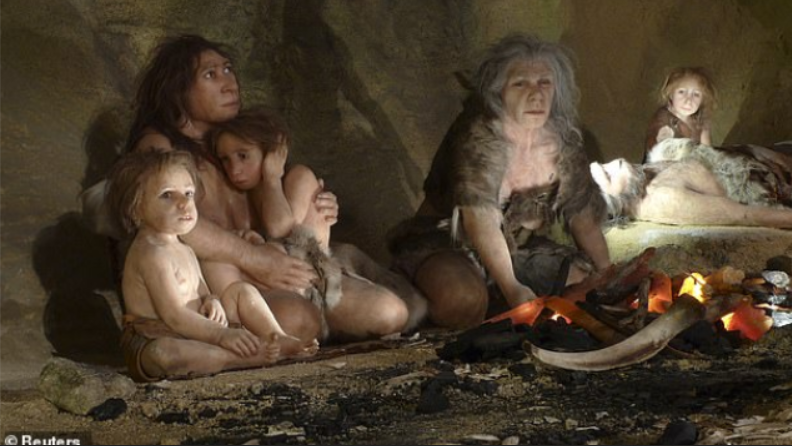
Long before modern humans spread across Europe and western Asia, another group of humans thrived there. Neanderthals lived across a vast region that stretched from the Atlantic coasts of Europe to the mountains of Central Asia. They survived through harsh glacial cycles, hunting large animals and adapting to cold environments that would challenge even modern people.
Neanderthals were not primitive cave beasts, as popular culture once portrayed them. They were skilled toolmakers who created sophisticated stone tools and used fire. Archaeological evidence suggests they cared for injured members of their communities and buried their dead. Some sites hint that they may have used pigments and ornaments, suggesting forms of symbolic behavior.
Physically, Neanderthals were built for survival in cold climates. Their bodies were shorter and more muscular than those of modern humans. Their bones were thick, their limbs powerful, and their chests broad. Their faces had distinctive features, including a prominent brow ridge and a large nose, which may have helped warm cold air before it entered their lungs.
Neanderthals also possessed large brains—on average slightly larger than those of modern humans. Brain size alone does not determine intelligence, but it suggests that they had complex cognitive abilities. They were capable hunters who worked cooperatively and adapted to a wide range of environments.
For hundreds of thousands of years, Neanderthals dominated the landscapes of Europe and western Asia. Then, around sixty to seventy thousand years ago, a new kind of human began to arrive.
The Arrival of Modern Humans
Modern humans evolved in Africa roughly three hundred thousand years ago. Over tens of thousands of years, our ancestors developed new technologies, complex social structures, and symbolic forms of communication. Eventually, groups of modern humans began migrating out of Africa and spreading into new territories.
When these migrants moved into the Middle East and later into Europe and Asia, they entered lands that were already home to Neanderthals. For thousands of years, the two groups shared the same continents. Archaeological evidence shows that they sometimes occupied nearby regions and even used similar hunting grounds.
For a long time, scientists believed that when modern humans encountered Neanderthals, they simply replaced them. According to this theory, Neanderthals gradually disappeared as modern humans spread across their territories.
But this explanation left unanswered questions. If Neanderthals and modern humans lived side by side for thousands of years, was it really possible that they never interacted closely? Did they never form families? Did their lives remain completely separate?
The answers would emerge not from fossils alone, but from a revolutionary field of science: ancient DNA.
Unlocking the Genetic Past
For most of scientific history, DNA from ancient human relatives seemed impossible to obtain. Genetic material degrades over time, breaking into fragments that are easily contaminated by modern DNA. But advances in molecular biology eventually made it possible to extract and analyze DNA from ancient bones.
In the early twenty-first century, researchers succeeded in sequencing the genome of a Neanderthal from fossils found in Croatia. This breakthrough allowed scientists to compare Neanderthal DNA with the genomes of living humans.
The results were astonishing.
People of European and Asian ancestry shared segments of DNA that were clearly inherited from Neanderthals. These segments were absent in most populations from sub-Saharan Africa. The pattern suggested that interbreeding occurred after modern humans left Africa but before they spread widely across Eurasia.
In other words, when modern humans encountered Neanderthals in the ancient world, the two groups sometimes had children together.
This discovery overturned decades of assumptions about human evolution. It showed that the boundaries between human species were more flexible than scientists once thought. Instead of a simple replacement, the history of our species involved contact, mixture, and shared ancestry.
How Much Neanderthal DNA Do Humans Have?
The amount of Neanderthal DNA in modern humans is surprisingly small yet significant. Most people of European and Asian descent carry between one and two percent Neanderthal DNA in their genomes. Individually, each person has only small fragments, but when researchers combine the genomes of many individuals, they can reconstruct a large portion of the Neanderthal genetic code.
People with African ancestry typically have little or no Neanderthal DNA, because their ancestors remained in Africa during the period when interbreeding occurred. However, some African populations today possess small traces of Neanderthal ancestry due to later migrations and gene flow between continents.
Although one or two percent might sound tiny, the human genome contains billions of genetic letters. Even a small percentage represents thousands of inherited genes and regulatory elements that influence how our bodies function.
These ancient genetic fragments have been passed down for tens of thousands of years, surviving through countless generations.
Where and When Interbreeding Happened
Genetic evidence suggests that the first major interbreeding events occurred roughly fifty to sixty thousand years ago. This period corresponds to the time when modern humans first moved into the Middle East, where Neanderthals had lived for hundreds of thousands of years.
In this region, the two populations overlapped geographically. Climate shifts during the Ice Age sometimes pushed both groups into the same refuges, increasing the chances of interaction.
Later, as modern humans spread across Europe and Asia, additional episodes of interbreeding may have occurred. The genetic patterns seen today suggest that these encounters were not extremely common, but they happened often enough to leave a lasting mark in the human genome.
These encounters were not necessarily peaceful or harmonious. The ancient world was harsh, and competition for resources could have created tensions. Yet the existence of Neanderthal DNA in modern humans proves that relationships between individuals sometimes crossed species boundaries.
Some of those relationships produced children who carried the genes of both populations.
The Genetic Legacy of Neanderthals
The Neanderthal genes that survive in modern humans are not random fragments. Many have been preserved because they offered advantages to our ancestors as they adapted to new environments outside Africa.
For example, some Neanderthal genes influence the immune system. When modern humans entered Eurasia, they encountered new pathogens and diseases that Neanderthals had already faced for thousands of years. Inheriting immune-related genes from Neanderthals may have helped early humans resist unfamiliar infections.
Other Neanderthal genetic variants affect skin and hair traits. These adaptations may have helped early humans cope with colder climates and lower levels of sunlight in northern regions.
There are also Neanderthal genes that influence metabolism, sleep patterns, and how the body processes fats and sugars. These genetic traits once helped our ancestors survive in Ice Age environments where food sources fluctuated and winters were long.
In this sense, Neanderthal DNA acted as a shortcut for adaptation. Instead of evolving entirely new genetic solutions, modern humans sometimes borrowed successful traits from the people who had already mastered those environments.
The Complex Effects of Ancient Genes
Not all Neanderthal genetic contributions are beneficial. Some inherited variants are associated with increased risk of certain modern diseases. For instance, particular Neanderthal gene segments have been linked to conditions such as type 2 diabetes, lupus, and Crohn’s disease.
These effects illustrate how evolution operates in changing environments. A gene that was helpful tens of thousands of years ago may become less useful—or even harmful—in modern lifestyles.
One striking example involves genes related to immune responses. While these genes once helped fight infections, in modern societies they can sometimes trigger excessive inflammation, contributing to autoimmune disorders.
Scientists have also discovered that Neanderthal DNA influences aspects of human biology ranging from skin sensitivity to pain perception. Even subtle traits such as sleep cycles may be shaped partly by these ancient genetic fragments.
Our bodies therefore carry echoes of an ancient partnership that still shapes how we live today.
The Mystery of Hybrid Children
When two different human species produce children, the biological outcome is not always straightforward. Some hybrid offspring may be healthy and fertile, while others may experience reduced fertility or health challenges.
Genetic research suggests that some Neanderthal genes were gradually removed from the human genome over time because they interfered with reproduction or development. These incompatible genes were less likely to be passed on to future generations.
Interestingly, scientists have found that Neanderthal DNA is especially rare on the human X chromosome and in genes related to male fertility. This pattern hints that male hybrids may have had lower fertility rates, which could have limited the spread of certain genetic combinations.
Even so, enough hybrid children survived and reproduced to ensure that some Neanderthal genes remained in the human population.
Each surviving fragment of Neanderthal DNA is a reminder that at least some of those ancient families thrived.
The Disappearance of the Neanderthals
Neanderthals disappeared from the fossil record around forty thousand years ago. The reasons for their extinction remain one of the most intriguing mysteries in human evolution.
Several factors may have contributed. Climate changes during the Ice Age created unstable environments that challenged many species. Modern humans may have competed with Neanderthals for food and territory. Differences in population size could also have played a role, since Neanderthal communities appear to have been smaller and more isolated.
Disease transmission between populations may have added further stress. When two groups with different immune histories interact, new pathogens can spread rapidly.
Yet the discovery of Neanderthal DNA complicates the idea of simple extinction. Neanderthals did not vanish entirely. Part of their genetic heritage lives on within modern humans.
In a sense, Neanderthals did not disappear—they were absorbed into the growing human population.
Discoveries Beyond Neanderthals
The story becomes even more fascinating when scientists look beyond Neanderthals. Genetic studies have revealed that modern humans also interbred with another mysterious human group known as the Denisovans.
Denisovans were first identified through DNA extracted from a tiny bone fragment found in Siberia. Like Neanderthals, they were a distinct branch of ancient humans who shared a common ancestor with modern humans hundreds of thousands of years ago.
Today, people in parts of Asia and Oceania carry Denisovan DNA. Some of these genes helped populations adapt to extreme environments. For example, a Denisovan gene variant allows certain Tibetan populations to survive at high altitudes with low oxygen levels.
These discoveries reveal that human evolution was not a straight line but a network of interactions among multiple human groups.
Our species did not emerge in isolation. Instead, it formed through encounters with several branches of the human family tree.
What This Means for the Idea of “Human”
The discovery of interbreeding between modern humans and Neanderthals challenges traditional definitions of species. In biology, species are often defined as groups that cannot produce fertile offspring with each other. Yet humans and Neanderthals clearly produced children who contributed genes to future generations.
This suggests that the boundary between these groups was more flexible than strict definitions imply. Neanderthals were not completely separate from us; they were close relatives who shared much of our biology and behavior.
Understanding this relationship encourages a broader view of humanity’s past. Instead of imagining a single pure lineage, scientists now see our origins as a complex tapestry woven from multiple human populations.
Each thread represents migrations, encounters, and shared experiences that shaped the people alive today.
The Emotional Impact of the Discovery
For many people, the idea of carrying Neanderthal DNA is deeply fascinating. It connects modern individuals with a distant past that once seemed lost forever.
Within our cells are traces of people who lived in Ice Age valleys, hunted mammoths, and survived brutal winters. Their genetic legacy continues to influence how our bodies function today.
This realization changes how we view human history. Instead of seeing Neanderthals as completely separate beings, we can see them as distant relatives whose lives intersected with our own ancestors.
Their world was different from ours, yet not entirely alien. They walked the same landscapes, breathed the same air, and experienced many of the same challenges of survival.
Their story is, in part, our story.
The Future of Ancient DNA Research
The study of ancient DNA is still in its early stages. Each year, new discoveries refine our understanding of how ancient human populations interacted.
Improved techniques allow scientists to extract genetic material from older and more degraded fossils than ever before. This opens the possibility of discovering unknown human groups that once lived alongside our ancestors.
Researchers are also investigating how Neanderthal genes influence modern health and biology. By understanding these genetic effects, scientists may gain insights into diseases, immunity, and adaptation.
The more we learn, the clearer it becomes that the human story is far more complex and interconnected than once imagined.
The Hidden Echo in Our Cells
When people hear that they carry Neanderthal DNA, the idea can feel surprising or even unsettling. Yet it is also a reminder of the deep connections that unite all humans across time.
Our species is not the product of a single isolated lineage. We are the result of countless journeys, encounters, and shared histories.
Inside every genome lies a record of those ancient meetings. Some occurred in cold valleys where modern humans first entered Neanderthal lands. Others may have taken place in caves, forests, or open plains where two human groups discovered that they were not entirely strangers.
Their children carried genes from both worlds.
Those genes survived ice ages, migrations, and the rise of civilizations.
And today, tens of thousands of years later, they still exist—quietly shaping the biology of the people reading this very story.