The idea of rising vertically from a city street and gliding above traffic has haunted human imagination for more than a century. From Leonardo da Vinci’s sketches to the Jetsons’ animated skyline, flight has symbolized freedom from geography, congestion, and gravity itself. Electric Vertical Takeoff and Landing aircraft, commonly called eVTOLs, are the most recent and serious attempt to turn this dream into an engineering reality. They promise quiet, efficient, and potentially affordable aerial transportation within cities, often described in popular language as “flying taxis.” Yet behind the futuristic imagery lies a dense web of physics, engineering trade-offs, certification challenges, and infrastructural constraints that shape what eVTOLs can truly become.
Understanding eVTOLs requires stepping away from marketing slogans and into the domain of aerodynamics, energy storage, control theory, materials science, and systems engineering. These aircraft are not magic, nor are they science fiction. They are carefully optimized machines operating close to the limits imposed by physics. Their future depends not on imagination alone, but on whether engineering reality can support the operational promises made on their behalf.
What Exactly Is an eVTOL?
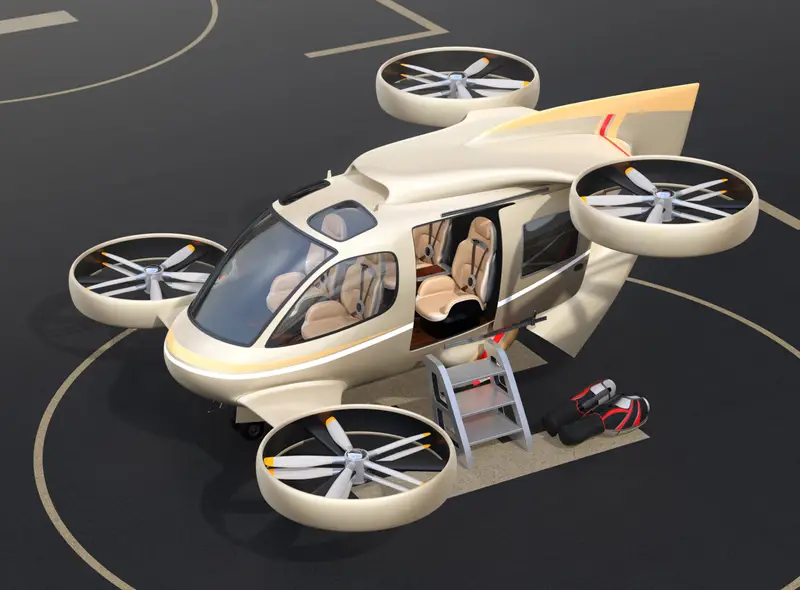
An eVTOL is an aircraft capable of vertical takeoff and landing that uses electric propulsion as its primary source of thrust. Unlike conventional helicopters, which rely on large, mechanically complex rotor systems driven by combustion engines, eVTOLs typically employ multiple electrically driven rotors or propellers distributed across the airframe. The electricity is usually stored in onboard batteries, although hybrid configurations have been explored.
The defining characteristics of eVTOLs are not novelty but constraint. Vertical takeoff requires producing thrust equal to or greater than the aircraft’s weight, a demanding requirement that consumes large amounts of power. Forward flight, on the other hand, is far more energy-efficient because lift can be generated aerodynamically by wings rather than purely by thrust. Most eVTOL designs therefore attempt to combine vertical lift for takeoff and landing with wing-borne flight during cruise.
This dual requirement shapes every design decision. The number and placement of rotors, the size and shape of wings, the structure of the airframe, and the control systems must all work together across very different flight regimes. An eVTOL is not merely an electric helicopter, nor is it a small airplane with extra motors. It is a hybrid machine born from compromise.
The Physics of Vertical Flight
Vertical flight is brutally honest in its demands. To hover, an aircraft must push air downward with enough momentum to counteract its weight. This process is governed by momentum theory, which shows that the power required to hover is inversely proportional to the area over which thrust is applied. In simple terms, pushing a large mass of air slowly is more efficient than pushing a small mass of air rapidly.
This is why helicopters have large rotors and why drones with small propellers consume significant power when hovering. eVTOL designers confront this reality directly. Distributed electric propulsion allows multiple rotors to spread thrust over a larger area, improving hover efficiency compared to a single small rotor. However, adding rotors increases structural weight, electrical complexity, and potential points of failure.
Electric motors themselves are highly efficient, often exceeding 90 percent efficiency in converting electrical energy into mechanical motion. The limitation is not the motor but the energy source. Batteries have far lower energy density than liquid fuels. This single fact shapes the entire eVTOL landscape more than any other technological consideration.
Batteries and the Tyranny of Energy Density
At the heart of the eVTOL challenge lies a fundamental mismatch between what vertical flight demands and what current battery technology can provide. Energy density, typically measured in watt-hours per kilogram, determines how much energy can be stored for a given weight. Jet fuel contains orders of magnitude more usable energy per kilogram than today’s lithium-ion batteries.
This does not mean eVTOLs are impossible, but it does impose strict limits on range, payload, and endurance. Every kilogram of battery added to increase range reduces the payload available for passengers. Every minute spent hovering during takeoff or landing consumes a disproportionate fraction of total energy. The result is that most realistic eVTOL missions are short, typically on the order of tens of kilometers rather than hundreds.
Thermal management further complicates the picture. High power draw during vertical flight generates heat in batteries and motors. Efficient cooling systems are essential to prevent degradation or failure, yet cooling hardware adds weight and complexity. Battery performance also degrades with repeated fast charging, raising questions about lifecycle costs and long-term reliability.
Despite rapid progress in battery technology, no revolutionary breakthrough has yet overturned these constraints. eVTOL designers therefore operate under a regime of careful optimization, squeezing performance from incremental improvements rather than waiting for a miracle battery.
Aerodynamics in Transition
One of the defining features of many eVTOL designs is the transition between vertical and horizontal flight. This phase is aerodynamically complex and often the most challenging part of the flight envelope. During transition, the aircraft must smoothly shift from thrust-based lift to wing-based lift while maintaining stability and control.
Tiltrotor and tiltwing configurations rotate propellers or entire wings from a vertical orientation to a horizontal one. This approach allows the same propellers to be used for both lift and cruise propulsion, reducing weight. However, tilting mechanisms introduce mechanical complexity and failure modes that must be carefully managed.
Lift-plus-cruise designs separate vertical lift rotors from forward propulsion. Vertical rotors are used only during takeoff and landing, while a dedicated propeller provides thrust in cruise. This simplifies some aspects of control but adds dead weight in the form of lift rotors that contribute nothing during cruise.
Aerodynamic efficiency during cruise is critical because it determines how far the aircraft can fly on limited battery energy. Wing design, drag reduction, and propeller efficiency all play central roles. Even small improvements in aerodynamic performance can translate into meaningful gains in range and operational flexibility.
Control Systems and the Software Challenge
Unlike traditional aircraft, many eVTOLs rely heavily on advanced control systems and software to remain stable and fly safely. Distributed propulsion allows rapid adjustment of thrust across multiple motors, enabling fine-grained control of attitude and position. This is particularly valuable during hover and low-speed flight, where aerodynamic control surfaces are less effective.
The reliance on software introduces both opportunities and risks. On one hand, digital flight control systems can compensate for disturbances, manage transitions, and reduce pilot workload. On the other hand, software must be certified to extremely high safety standards. Aviation certification authorities require rigorous verification to ensure that control algorithms behave predictably under all conditions, including sensor failures and unexpected disturbances.
Redundancy is a key principle. eVTOL designs typically include multiple independent power and control pathways so that the failure of a single component does not lead to catastrophic loss of control. Electric propulsion lends itself well to redundancy, as multiple motors can continue operating even if one fails. However, redundancy adds weight and complexity, reinforcing the theme of trade-offs.
Noise: The Hidden Constraint
One of the most attractive promises of eVTOLs is reduced noise compared to helicopters. Electric motors themselves are quiet, lacking the combustion noise of traditional engines. However, aerodynamic noise from propellers interacting with air remains a significant challenge, especially during takeoff and landing.
Noise perception is not determined solely by loudness but by frequency, duration, and context. A sound that is acceptable in an industrial area may be deeply intrusive in a residential neighborhood. eVTOLs operating in urban environments must therefore meet stringent noise targets to gain public acceptance.
Design strategies include using multiple smaller rotors, optimizing blade shapes, and carefully controlling rotational speeds. Distributed propulsion allows thrust to be shared among many rotors, reducing the noise generated by each. Nonetheless, achieving genuinely unobtrusive operation remains difficult, particularly when vehicles operate frequently and close to the ground.
Noise is not merely an engineering issue but a social one. Even technically quiet aircraft may face resistance if communities perceive them as intrusive or inequitable. This reality shapes where and how eVTOLs can realistically operate.
Safety and Certification
Aviation safety standards are among the strictest in any industry, and for good reason. Introducing a new class of aircraft into dense urban airspace raises legitimate concerns about risk. Certification authorities such as the FAA and EASA require evidence that eVTOLs meet or exceed existing safety benchmarks.
This process is slow, methodical, and expensive. Designers must demonstrate not only that the aircraft can fly, but that it can tolerate failures, operate safely in adverse weather, and be maintained reliably over its service life. Crashworthiness, fire safety, and emergency procedures are all scrutinized.
One of the advantages of eVTOLs is the potential for simplified mechanical systems. Electric motors have fewer moving parts than combustion engines, reducing some maintenance burdens. However, high-voltage electrical systems and battery packs introduce new hazards, particularly related to thermal runaway and fire.
Public trust will ultimately depend not on theoretical safety analyses but on operational experience. A single high-profile accident could significantly slow adoption, regardless of statistical safety performance.
Infrastructure and Urban Integration
An eVTOL does not exist in isolation. It requires infrastructure on the ground, often referred to as vertiports, for takeoff, landing, charging, and passenger handling. Designing and integrating this infrastructure into existing urban environments presents its own challenges.
Vertiports must balance accessibility with safety. They need sufficient space for operations, clear approach paths, and robust electrical connections for charging. Fast charging places heavy demands on local power grids, potentially requiring upgrades or energy storage solutions.
Urban airspace management is another critical issue. Cities already contain complex patterns of helicopter traffic, drones, and restricted zones. Introducing large numbers of eVTOLs requires coordination, communication, and regulation to prevent congestion and conflicts. Automated traffic management systems are often proposed, but their implementation at scale remains unproven.
The success of eVTOLs therefore depends as much on urban planning and policy as on engineering. Without thoughtful integration, even the most capable aircraft may find limited use.
Economics and the Reality of Cost
The popular image of flying taxis suggests widespread, affordable access. In reality, the economics of eVTOLs are finely balanced. Aircraft development costs are high, certification is expensive, and infrastructure investment is substantial. Operating costs depend on battery replacement, maintenance, energy prices, and utilization rates.
Electric propulsion offers potential savings in energy and maintenance compared to combustion engines. However, battery replacement costs can be significant, especially if fast charging accelerates degradation. High utilization is essential to amortize capital costs, yet high utilization increases wear and operational complexity.
Early eVTOL services are therefore likely to target premium markets, such as airport transfers or high-value routes, rather than mass transportation. Over time, costs may decrease as technology matures and production scales up, but there is no guarantee that eVTOLs will ever become as affordable as ground-based public transport.
Economic realism tempers the more utopian visions of urban air mobility. eVTOLs may become a valuable niche solution rather than a universal one.
Autonomy and the Question of Pilots
Many eVTOL concepts envision autonomous or highly automated operation. Removing the pilot reduces weight, increases payload capacity, and potentially lowers operating costs. It also raises profound technical, regulatory, and ethical questions.
Fully autonomous flight in complex urban environments is an unsolved problem. While automation already plays a major role in commercial aviation, pilots remain essential for handling unexpected situations. Extending autonomy to passenger-carrying aircraft requires extremely robust perception, decision-making, and fail-safe systems.
Regulators are cautious, and rightly so. Incremental approaches, such as single-pilot or remotely supervised operations, are more plausible in the near term. Public acceptance also plays a role. Passengers may be hesitant to board a pilotless aircraft, regardless of statistical safety assurances.
Autonomy is therefore not a simple technological switch but a gradual evolution intertwined with trust and governance.
Environmental Impact Beyond Emissions
eVTOLs are often promoted as environmentally friendly due to their lack of direct emissions. This claim is partially true but incomplete. The environmental impact of eVTOLs depends on how electricity is generated, how batteries are manufactured and recycled, and how aircraft are used.
If powered by renewable energy, eVTOLs can significantly reduce greenhouse gas emissions compared to fossil-fuel-based helicopters. However, battery production involves resource extraction and energy-intensive processes. Lifecycle assessments are essential to evaluate true environmental benefits.
Noise pollution, visual impact, and land use also factor into environmental considerations. A city filled with airborne vehicles may reduce road congestion but introduce new forms of disruption. Environmental responsibility requires holistic analysis rather than narrow metrics.
The Engineering Reality Behind the Vision
Strip away the glossy renderings and futuristic branding, and eVTOLs emerge as what they truly are: carefully engineered compromises operating within tight physical limits. They are neither miraculous nor trivial. They represent a convergence of electric propulsion, advanced materials, digital control, and aerodynamics, applied to a problem humanity has long dreamed of solving.
Their success depends on aligning engineering reality with operational expectations. Short-range, high-frequency missions in controlled environments are well suited to eVTOL capabilities. Long-distance travel, heavy payloads, and all-weather operations remain challenging.
This realism does not diminish their significance. On the contrary, it highlights the ingenuity required to make them work at all. Each design choice reflects deep engagement with physics and a willingness to accept trade-offs rather than deny them.
A Measured Future for Flying Taxis
The future of eVTOLs is unlikely to resemble either dystopian skies clogged with aircraft or utopian visions of universal aerial freedom. Instead, it will probably unfold gradually, shaped by technical progress, regulatory caution, and societal negotiation.
eVTOLs may become a new layer of transportation, complementing rather than replacing existing modes. They may serve specific routes where speed, flexibility, and point-to-point travel justify their costs. Over time, improvements in batteries, materials, and automation could expand their role, but always within the boundaries set by physics.
The story of eVTOLs is ultimately a story about engineering humility. It reminds us that innovation is not about defying nature but about understanding it deeply enough to work within its constraints. Flying taxis are not fantasies made real by optimism alone. They are machines forged from equations, experiments, and compromises, carrying forward an ancient human desire with modern scientific discipline.
In that sense, eVTOLs are less about escaping gravity than about learning, once again, how to live intelligently under its unyielding pull.