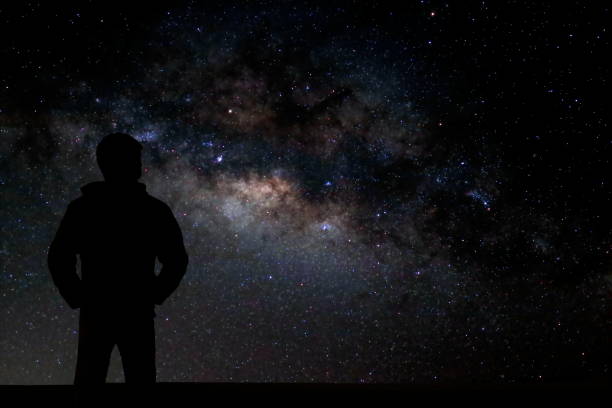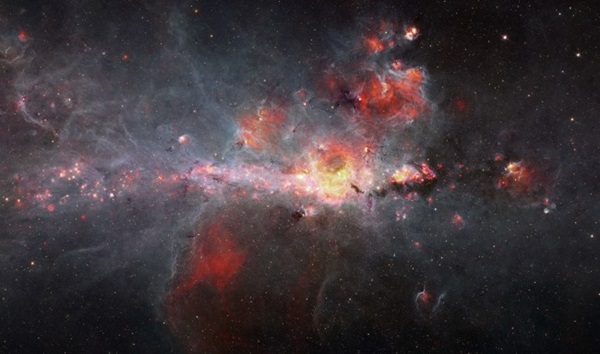
The universe has a past, a present, and—according to modern cosmology—a future. While the night sky often feels timeless, physics tells a different story: the cosmos is evolving, expanding, and slowly changing in ways that point toward possible endings. Among these possibilities, the Big Freeze stands as the most widely discussed and scientifically grounded scenario for the ultimate fate of the universe. It is not an explosive apocalypse or a dramatic collapse, but a gradual fading—a long, silent cooling that stretches across unimaginable spans of time.
The Big Freeze, also known as heat death, describes a future in which the universe expands forever, growing colder, darker, and more dilute until it can no longer sustain the processes that give rise to structure, energy flow, or life. It is a concept rooted deeply in physics, particularly in thermodynamics and cosmology, and it carries both scientific rigor and emotional weight. To understand the Big Freeze is to confront the long-term destiny of everything that exists.
The Expanding Universe and the Seeds of the Big Freeze
The idea of the Big Freeze begins with one of the most important discoveries in modern science: the universe is expanding. Observations show that distant galaxies are moving away from one another, with space itself stretching over time. This expansion was first inferred in the early twentieth century and later supported by extensive astronomical evidence, including the redshift of light from distant galaxies.
Crucially, the expansion of the universe is not slowing down. Instead, it appears to be accelerating, driven by a mysterious component known as dark energy. While the nature of dark energy remains unknown, its effect is clear: it causes space to expand at an ever-increasing rate. If this expansion continues indefinitely, the universe will never recollapse. Instead, it will grow larger, emptier, and colder.
This endless expansion is the foundation of the Big Freeze. As galaxies move farther apart, interactions between them become increasingly rare. Energy spreads out over an ever-growing volume of space, and the universe gradually loses the ability to maintain organized, energy-rich systems.
Thermodynamics and the Meaning of Heat Death
At the heart of the Big Freeze lies the second law of thermodynamics, one of the most fundamental principles in all of physics. This law states that in an isolated system, entropy—a measure of disorder or energy dispersal—tends to increase over time. Energy naturally flows from concentrated, ordered states to more spread-out, disordered ones.
The universe, on the largest scales, behaves like an isolated system. Over cosmic time, energy differences even out. Hot objects cool, stars burn through their fuel, and structured systems slowly decay. The term “heat death” does not mean that everything becomes hot; rather, it means that temperature differences disappear. When all regions of the universe reach nearly the same extremely low temperature, no useful work can be done, because work depends on energy gradients.
In this final thermodynamic state, physical processes that rely on energy flow—such as chemical reactions, biological metabolism, and even stellar fusion—become impossible. The universe does not end in fire or collapse, but in equilibrium: a cold, dark, nearly featureless expanse.
The Long Twilight of Stars
Stars are among the most important actors in the cosmic story, and their fate plays a central role in the Big Freeze. Stars shine by converting nuclear energy into light and heat, a process that depends on finite fuel supplies. Over time, stars exhaust their nuclear fuel and evolve into remnants such as white dwarfs, neutron stars, or black holes.
In the distant future, long after the last new stars have formed, existing stars will continue to burn out one by one. Massive stars will end quickly on cosmic timescales, while smaller stars can shine for trillions of years. Yet even the longest-lived stars are not eternal. Eventually, the universe will enter an era where no stars remain actively shining.
Without stars, galaxies lose their defining sources of light and heat. What remains are stellar remnants drifting through space, occasionally interacting but increasingly isolated as expansion pulls everything apart. The night sky, if any observers could still exist, would grow darker with each passing epoch.
The Decline of Galaxies and Cosmic Structure
Galaxies are bound together by gravity, but they are not immune to the effects of cosmic expansion on the largest scales. While gravity can hold individual galaxies and galaxy clusters together, it cannot overcome the accelerated expansion of space between widely separated structures.
Over immense timescales, galaxies beyond our local gravitational neighborhood will recede beyond any possible horizon of observation. Light from distant galaxies will no longer reach one another, effectively isolating cosmic regions. Each island of matter becomes a lonely pocket in an ever-expanding ocean of space.
This gradual isolation contributes to the Big Freeze by limiting interactions that could otherwise generate energy or complexity. Collisions between galaxies become rarer, star formation slows and eventually stops, and the universe transitions from a vibrant, interconnected web into a sparse collection of fading remnants.
Black Holes and the Slow Leak of Time
Even black holes, often imagined as eternal objects, are not immune to the long-term trends that define the Big Freeze. According to quantum physics, black holes emit an extremely weak form of radiation, now known as Hawking radiation. This process causes black holes to lose mass very slowly over time.
For stellar-mass and supermassive black holes, this evaporation occurs on timescales far longer than the current age of the universe—so long that they stretch the meaning of time itself. Yet in the context of the Big Freeze, even these titans eventually fade away. As black holes evaporate, they release their remaining energy into the surrounding space, contributing further to the overall increase in entropy.
The disappearance of black holes marks one of the final stages of cosmic evolution. After they are gone, the universe is left with only low-energy particles, thinly spread across vast distances, approaching a state of near-perfect thermodynamic equilibrium.
Temperature, Cooling, and the Fate of Energy
As the universe expands, its average temperature decreases. This cooling is a direct consequence of energy being spread over a larger volume of space. The cosmic background radiation, a relic of the early universe, continues to lose energy as its wavelength stretches with expansion.
Over trillions upon trillions of years, temperatures approach absolute zero, though they never fully reach it. In this frigid environment, motion slows, reactions cease, and the universe becomes increasingly inert. Energy still exists, but it is no longer available in usable forms.
This aspect of the Big Freeze highlights a subtle but profound point: the universe does not run out of energy; it runs out of usable energy. The distinction is central to thermodynamics and underscores why the Big Freeze is sometimes described as the death of activity rather than the death of existence.
Time Without Events
One of the most haunting implications of the Big Freeze is the idea of time continuing without meaningful events. Physics does not require the universe to end for activity to cease. Instead, processes simply slow to the point where change becomes vanishingly rare.
In such a universe, clocks—if they could still exist—would tick on, but nothing new would happen. No stars would ignite, no planets would warm, no complex structures would form. The passage of time becomes almost irrelevant, stripped of the events that give it significance.
This vision challenges human intuitions about endings. The Big Freeze is not a moment but a process, not a catastrophe but a fading. Its emotional impact lies precisely in its quietness: the universe grows old, tired, and still.
Life and the Limits of Survival
Life, as understood through physics and biology, depends on energy flow and low-entropy conditions. Organisms maintain order by exchanging energy with their environment, relying on temperature differences, chemical gradients, or radiation from stars.
As the universe moves toward the Big Freeze, these conditions gradually disappear. Habitable environments become rarer as stars fade and planets cool. Eventually, there is no available energy source sufficient to sustain metabolism, information processing, or reproduction.
While speculative ideas about exotic forms of life or extreme adaptation exist, the fundamental constraints imposed by thermodynamics remain. In a universe approaching heat death, the window for life closes—not abruptly, but inexorably. This realization gives the Big Freeze a deeply emotional dimension, linking cosmic destiny to existential reflection.
The Big Freeze Compared to Other Cosmic Endings
The Big Freeze is one of several proposed scenarios for the ultimate fate of the universe. Others include the Big Crunch, in which expansion reverses and the universe collapses back on itself, and the Big Rip, where accelerated expansion becomes so extreme that it tears apart all structures.
Current observations strongly favor the Big Freeze over these alternatives. Measurements of cosmic expansion, the distribution of matter, and the influence of dark energy all point toward an ever-expanding universe rather than one destined to collapse or violently disintegrate.
What distinguishes the Big Freeze is its consistency with known physics and its absence of dramatic singular events. It is not a speculative catastrophe but a logical extension of well-established principles applied over immense timescales.
The Emotional Weight of Cosmic Loneliness
Beyond equations and models, the Big Freeze carries a powerful emotional resonance. It confronts humanity with the idea that the universe has a finite period of creativity and warmth, after which it settles into silence. This vision can evoke sadness, awe, or even existential anxiety.
Yet it can also inspire a sense of preciousness. The era in which stars shine, galaxies collide, and life exists is not eternal. It is a special chapter in cosmic history. Understanding the Big Freeze emphasizes how rare and fleeting complexity may be, encouraging deeper appreciation of the present universe.
Physics does not assign meaning or value, but it provides context. The Big Freeze frames existence as something temporary but remarkable, shaped by laws that allow structure to emerge and persist for a time before fading away.
What the Big Freeze Teaches Us About Physics
The concept of the Big Freeze is a powerful demonstration of how different areas of physics come together. Cosmology explains the expansion of the universe, thermodynamics governs the flow and degradation of energy, and quantum physics shapes the long-term fate of matter and black holes.
This synthesis highlights the strength of physics as a unified science. The same laws that describe everyday phenomena also determine the ultimate destiny of the cosmos. There is no separate set of rules for the end of time—only the steady, relentless application of principles that operate everywhere and always.
In this sense, the Big Freeze is not an exotic idea but a natural consequence of physics taken seriously on the largest scales.
Uncertainty and the Open Future of Cosmology
Despite the strong theoretical and observational support for the Big Freeze, it remains a prediction, not a certainty. Our understanding of dark energy is incomplete, and future discoveries could alter the picture. New physics, unknown interactions, or deeper insights into spacetime could change how the universe evolves over extreme timescales.
Science remains open to revision, and cosmology is a field shaped by ongoing observation and theoretical exploration. The Big Freeze represents the best explanation given current evidence, but it is held with the humility that characterizes scientific knowledge.
This openness is itself a source of intellectual vitality. The future of the universe remains a question, not a closed book, inviting continued inquiry and imagination.
Living in a Universe That Will Freeze
Knowing that the universe may end in a Big Freeze does not diminish the significance of life or understanding. If anything, it heightens it. Physics shows that complexity and consciousness arise under specific conditions that will not last forever. This makes their existence all the more extraordinary.
The Big Freeze encourages reflection on time, value, and responsibility. It reminds us that the universe’s ability to support structure and life is temporary, but also that this temporary window is vast by human standards. There is room for exploration, creativity, and meaning within it.
From this perspective, the Big Freeze is not merely an ending, but a backdrop against which the richness of the present universe stands out more sharply.
Conclusion: A Silent Future, a Luminous Present
The Big Freeze is the story of a universe that expands forever, slowly losing its warmth, structure, and activity. Rooted in the laws of thermodynamics and supported by modern cosmology, it offers a scientifically grounded vision of the far future: a cosmos approaching equilibrium, where change becomes rare and energy lies uniformly spread.
Yet this vision is not solely bleak. It reveals the elegance and consistency of physical law, the deep connections between energy, time, and structure, and the remarkable nature of the cosmic era we inhabit. The universe today is alive with motion, light, and possibility precisely because it has not yet reached that final, frozen state.
To understand the Big Freeze is to look far beyond human timescales and confront the ultimate implications of physics. In doing so, we gain not despair, but perspective—a deeper appreciation of a universe that, for now, still shines.