How will the universe end? This question sits at the far boundary of human curiosity, where science meets imagination and evidence confronts uncertainty. Unlike questions about the past, which can often be answered by observing remnants and records, questions about the universe’s ultimate fate demand that we project known physical laws across unimaginable spans of time. The Big Freeze and the Big Crunch represent two of the most influential and emotionally contrasting scenarios that cosmology has proposed. One envisions a universe that grows ever colder and darker, thinning into silence. The other imagines a cosmos that reverses course, collapsing inward toward a final, catastrophic end.
Both ideas are rooted in serious scientific reasoning. Both emerge from the same fundamental framework: modern cosmology, built on Einstein’s theory of general relativity, astronomical observations, and the discovery that the universe is expanding. Yet the two endings paint profoundly different pictures of cosmic destiny. To understand them is to explore not only how the universe might end, but why physicists think these possibilities exist at all.
The Expanding Universe: The Starting Point
Any discussion of the universe’s end must begin with its expansion. In the early twentieth century, astronomers discovered that distant galaxies are moving away from us, with farther galaxies receding faster. This observation revealed that space itself is expanding, carrying galaxies along with it. The universe is not a static arena but a dynamic, evolving system.
The expansion implies that the universe was once denser and hotter than it is today. This realization led to the Big Bang model, which describes the universe’s early state as extremely hot, compact, and energetic. Over billions of years, cosmic expansion has cooled the universe, allowing matter to form atoms, stars, galaxies, and eventually planets and life.
The crucial question for the universe’s future is whether this expansion will continue forever, slow down gradually, or eventually reverse. The answer depends on the contents of the universe and the laws governing space and time.
Gravity Versus Expansion
At the heart of the Big Freeze and Big Crunch scenarios lies a competition between expansion and gravity. Gravity is the force that pulls matter together. On small scales, it dominates easily, forming planets, stars, and galaxies. On cosmic scales, however, expansion works against gravity, stretching space and increasing the distance between structures.
In the early universe, gravity strongly influenced the expansion rate because matter and energy were densely packed. As the universe expanded and became more dilute, gravity’s collective pull weakened. Whether gravity can eventually halt and reverse expansion depends on how much matter and energy the universe contains and on the properties of space itself.
For much of the twentieth century, cosmologists debated whether the universe contained enough matter to eventually stop expanding. If gravity were strong enough, expansion would slow, stop, and reverse into a cosmic collapse: the Big Crunch. If gravity were too weak, expansion would continue forever, leading toward the Big Freeze.
The Big Crunch: A Universe That Falls Back on Itself
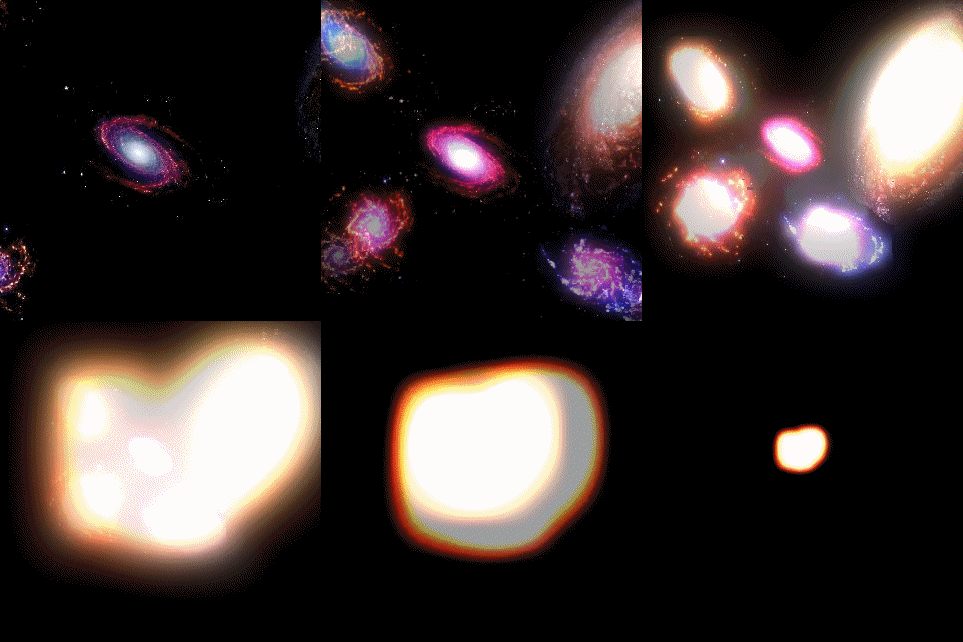
The Big Crunch is the dramatic counterpart to the Big Bang. In this scenario, the expansion of the universe gradually slows under the influence of gravity until it comes to a halt. After that moment, known as the turnaround, the universe begins to contract. Galaxies would move closer together, temperatures would rise, and cosmic structures would be crushed inward as space itself shrinks.
As contraction accelerates, stars would collide more frequently, radiation would intensify, and the universe would grow hotter and denser. Eventually, all matter and energy could be compressed into an extremely small, hot state, perhaps similar in density to the conditions at the beginning of the universe. The laws of physics as we know them would likely break down near this final state, leaving open questions about what, if anything, might follow.
The emotional power of the Big Crunch lies in its symmetry. It suggests a universe with a finite lifespan, one that begins in a bang and ends in a crunch. This cyclical intuition resonates with ancient ideas of cosmic rebirth, although modern physics does not guarantee that a new universe would emerge afterward.
Conditions Required for a Big Crunch
For the Big Crunch to occur, gravity must ultimately overpower expansion. This requires the universe to have a sufficiently high average density of matter and energy. In cosmological terms, this is often described using the concept of critical density, which marks the dividing line between different cosmic fates.
If the universe’s density were greater than this critical value, gravity would eventually halt expansion and cause contraction. In early cosmological models, matter was assumed to be the dominant contributor to this density. Astronomers searched for enough visible and invisible matter to tip the balance toward collapse.
However, observations increasingly suggested that ordinary matter, even when combined with dark matter, might not be sufficient to cause a Big Crunch. This realization opened the door to other possibilities and shifted attention toward a mysterious new component of the universe.
Dark Energy and the Changing Picture
In the late twentieth century, astronomers made a startling discovery: the expansion of the universe is not slowing down but accelerating. This acceleration implies the presence of a form of energy that counteracts gravity on large scales. This component, called dark energy, appears to be associated with space itself rather than with matter.
Dark energy fundamentally altered predictions about the universe’s fate. If dark energy remains constant or grows stronger over time, it will continue to drive expansion indefinitely, making a Big Crunch extremely unlikely. Instead, the universe would drift toward a colder, emptier future.
The discovery of dark energy did not merely favor one ending over another; it transformed cosmology. It revealed that the universe’s fate is controlled not just by matter and gravity, but by the properties of space itself. This insight deepened the mystery and raised new questions about the nature of reality.
The Big Freeze: A Universe That Slowly Fades
The Big Freeze, also known as heat death, describes a future in which the universe continues expanding forever. As expansion proceeds, galaxies move farther apart, and interactions between them become increasingly rare. Stars exhaust their nuclear fuel, and new star formation gradually declines as gas supplies are depleted or dispersed.
Over extremely long timescales, existing stars will burn out, leaving behind remnants such as white dwarfs, neutron stars, and black holes. Even these objects are not eternal. Through processes predicted by physics, they would eventually lose energy and decay, contributing to an increasingly uniform and cold cosmic environment.
In the far future envisioned by the Big Freeze, the universe approaches a state of maximum entropy. Energy becomes evenly distributed, leaving no gradients to power physical processes. Time continues to pass, but meaningful change all but disappears.
Entropy and the Arrow of Time
The Big Freeze is closely linked to the second law of thermodynamics, which states that entropy tends to increase over time in an isolated system. Entropy can be understood as a measure of disorder or, more precisely, of how spread out energy is.
In the early universe, energy was relatively concentrated, allowing complex structures to form. As the universe expands and evolves, energy becomes more evenly distributed. Stars shine by creating local decreases in entropy, but they do so at the cost of increasing entropy elsewhere. Over cosmic timescales, the overall trend is toward equilibrium.
The Big Freeze represents the ultimate consequence of this trend. It is a future where the arrow of time, defined by increasing entropy, reaches its limit. This gives the scenario a haunting emotional quality: a universe that does not end in fire or collapse, but in silence and stillness.
Life in a Freezing Universe
From a human perspective, the Big Freeze raises profound questions about the persistence of complexity and life. Life depends on energy gradients, such as the difference between a star’s heat and the cold of space. As these gradients diminish, the conditions required for life become harder to sustain.
Long before the universe reaches its final frozen state, galaxies beyond our local group will disappear from view, carried beyond the observable horizon by expansion. Civilizations, if they exist in the distant future, would inhabit an increasingly isolated cosmos.
Yet the Big Freeze is not an abrupt ending. It unfolds over timescales so vast that they defy everyday comprehension. This gradual nature makes it both less dramatic and more emotionally unsettling than a sudden collapse. The universe does not die; it slowly forgets how to change.
Comparing the Emotional Narratives
The Big Crunch and the Big Freeze tell very different cosmic stories. The Big Crunch is violent and finite, an ending that mirrors a beginning. It suggests closure, perhaps even renewal. The Big Freeze is quiet and endless, a story without a final moment, only an asymptotic approach to emptiness.
These emotional differences do not influence the science, but they shape how humans relate to these ideas. The Big Crunch feels like a dramatic conclusion, while the Big Freeze feels like a slow fading away. Both challenge our intuitions about time, purpose, and permanence.
Physics does not choose between these endings based on emotional appeal. Instead, it relies on evidence and theory. Yet acknowledging the emotional dimension helps explain why these scenarios capture the imagination so powerfully.
Observational Evidence and the Current Consensus
Modern observations strongly suggest that the universe is dominated by dark energy and that its expansion is accelerating. Measurements of distant supernovae, the cosmic microwave background, and large-scale structure all point toward a universe that will continue expanding for the foreseeable future.
Under current models, these observations favor a Big Freeze–like ending over a Big Crunch. If dark energy remains similar to its present form, gravity will never regain enough influence to reverse expansion. The universe’s fate would then be a long, cold decline rather than a catastrophic collapse.
However, scientific honesty demands caution. Dark energy is not well understood, and its properties could change over time. While current evidence points away from a Big Crunch, cosmology remains an evolving field.
Could the Big Crunch Return?
Although the Big Crunch is currently disfavored, it is not entirely ruled out. Some theoretical models allow dark energy to weaken or change sign in the distant future. If that were to happen, expansion could slow and eventually reverse.
Other models propose cyclic universes in which periods of expansion and contraction repeat. In such ideas, the Big Crunch is not the final end but a transition. While these models are speculative, they highlight the fact that cosmology is constrained by observation but enriched by theoretical exploration.
The possibility, however remote, that the universe could someday collapse reminds us that cosmic destiny is not yet written in stone. The universe still holds surprises.
The Role of Time Scales
One reason discussions of cosmic endings feel abstract is the immense timescales involved. The universe is about 13.8 billion years old, yet the Big Freeze would unfold over periods many orders of magnitude longer. Even the potential onset of a Big Crunch, if it were to occur, would be unimaginably distant.
These timescales dwarf human history and even the expected lifespan of stars. They force us to stretch our sense of time beyond intuitive limits. In doing so, physics encourages a broader perspective on existence, one that places human concerns within a vast cosmic timeline.
Understanding these scales does not diminish the significance of the present. Instead, it highlights the remarkable fact that conscious beings exist at a time when the universe is structured, luminous, and dynamic.
What the Universe’s End Teaches Us
The study of cosmic endings is not merely an exercise in prediction. It deepens our understanding of fundamental physics, from gravity and thermodynamics to the nature of space and energy. By asking how the universe might end, physicists test the limits of their theories and refine their models.
These inquiries also reveal the power of scientific reasoning. From faint patterns in ancient light to precise measurements of distant explosions, humanity has pieced together a coherent picture of cosmic evolution. The ability to even contemplate the universe’s end is a testament to this intellectual achievement.
Emotionally, these scenarios invite reflection on impermanence. They remind us that change is universal and that no structure, however vast, is eternal. This realization can be unsettling, but it can also be liberating.
Beyond Freeze and Crunch
While the Big Freeze and Big Crunch are among the most discussed endings, they are not the only possibilities. Other scenarios, such as a universe torn apart by accelerating expansion or transformed by quantum processes, exist within theoretical physics. Their exploration underscores that cosmology remains an open and dynamic field.
What unites all these scenarios is the recognition that the universe has a history and a future shaped by physical laws. Whether that future is cold, hot, finite, or endless depends on the deep properties of reality.
Conclusion: Facing the Cosmic Future
The Big Freeze and the Big Crunch represent two contrasting visions of how the universe might end. One is a slow fading into darkness, governed by entropy and expansion. The other is a dramatic collapse, driven by gravity’s triumph over cosmic growth. Current evidence favors the Big Freeze, but the ultimate fate of the universe remains tied to mysteries not yet fully understood.
In contemplating these endings, physics does more than predict. It invites us to confront the scale, beauty, and fragility of the cosmos. The universe’s end, whatever form it takes, lies far beyond any human lifetime. Yet thinking about it enriches our understanding of the present, reminding us that we exist during a fleeting but extraordinary chapter in the universe’s long story.