In November of 1922, beneath the burning desert sun of Egypt’s Valley of the Kings, a quiet moment unfolded that would soon echo around the world. Archaeologist Howard Carter knelt before a sealed doorway that had remained hidden for more than three thousand years. The flickering light of a candle illuminated ancient dust and carved symbols, whispering of a past long buried beneath sand and silence.
When Carter finally peered through a small opening in the tomb, his patron Lord Carnarvon famously asked if he could see anything. Carter’s response became one of the most celebrated lines in archaeological history.
“Yes, wonderful things.”
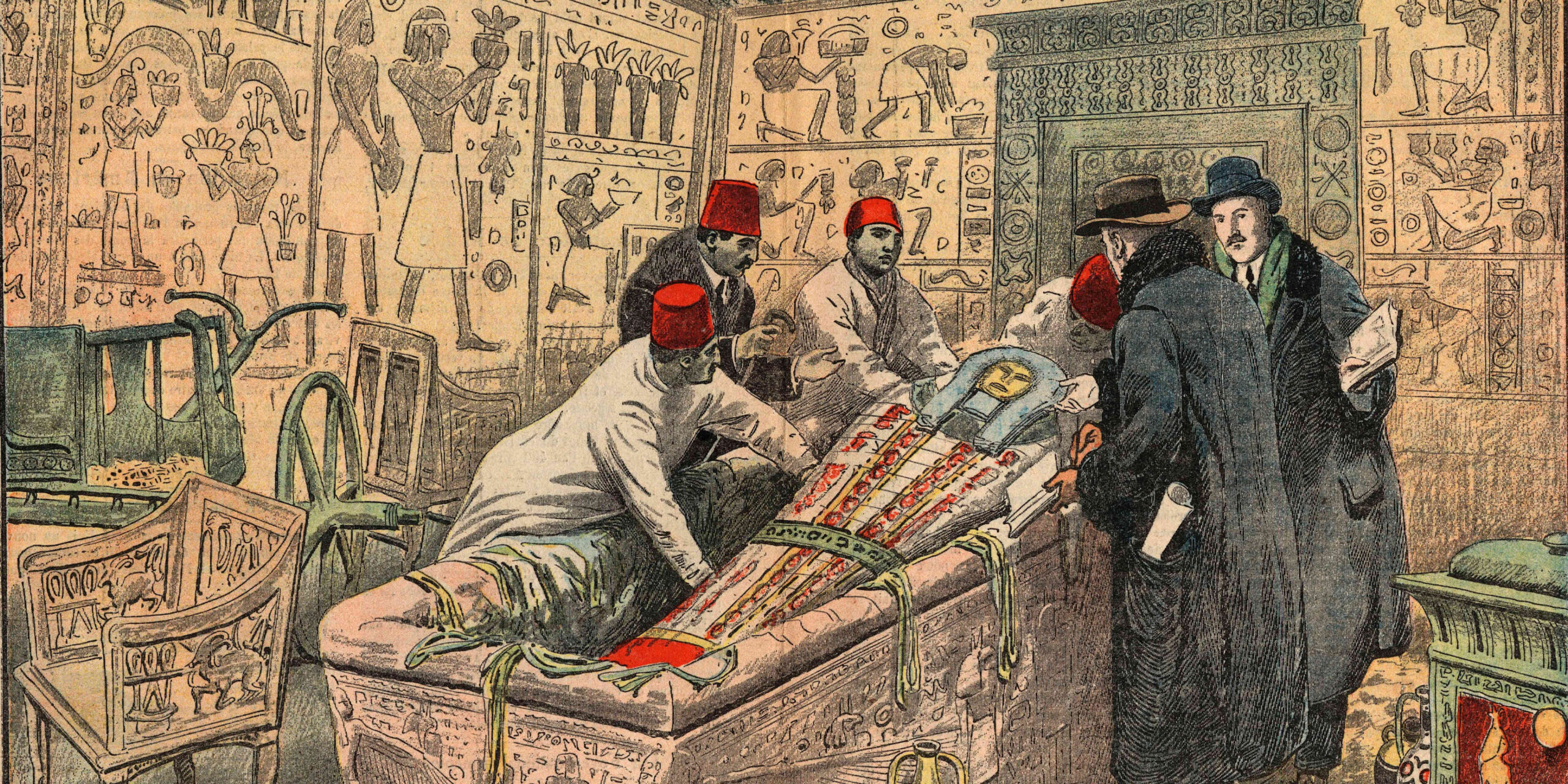
Behind that doorway lay the nearly intact tomb of the young pharaoh Tutankhamun. Golden chariots, jeweled statues, intricate furniture, ceremonial weapons, and a magnificent golden coffin surrounded the preserved body of a king who had died in the 14th century BCE. The discovery was astonishing. It was one of the greatest archaeological finds ever made.
Yet alongside the excitement and wonder, another story began to spread—one darker and far more mysterious. Within months of the tomb’s opening, rumors circulated that those involved in the excavation were falling ill or dying under strange circumstances.
Newspapers began speaking of a “Pharaoh’s Curse.”
According to legend, anyone who disturbed the tomb of Tutankhamun would suffer terrible consequences. Misfortune, illness, and sudden death would follow those who dared to violate the resting place of the ancient king.
The world was captivated. Was this simply coincidence and sensational journalism, or had something ancient and supernatural truly been unleashed in the desert sands of Egypt?
The story of the Curse of Tutankhamun would become one of the most famous mysteries of the twentieth century.
Tutankhamun: The Forgotten Pharaoh
To understand the legend of the curse, one must first understand the man at its center.
Tutankhamun lived during Egypt’s New Kingdom period, around 1332 to 1323 BCE. He became pharaoh at an incredibly young age, probably around eight or nine years old. His reign lasted only about a decade, and for most of his life he ruled under the guidance of powerful advisors.
He is often remembered as the “boy king,” not because of his achievements but because of how young he was when he ascended the throne.
Tutankhamun’s father was likely Akhenaten, one of the most controversial rulers in Egyptian history. Akhenaten had attempted a radical religious revolution, abandoning the traditional Egyptian gods and promoting the worship of a single deity called Aten, represented by the sun disk.
This religious transformation disrupted centuries of tradition and angered many priests and officials.
After Akhenaten’s death, Egypt began slowly returning to its old religious beliefs. Tutankhamun played a symbolic role in restoring traditional worship, particularly that of the powerful god Amun. His name itself reflects this shift. Originally named Tutankhaten, meaning “Living Image of Aten,” he later changed his name to Tutankhamun, meaning “Living Image of Amun.”
Despite these changes, Tutankhamun’s reign was relatively quiet and short. When he died around the age of nineteen, he was buried quickly in a modest tomb in the Valley of the Kings.
For centuries, his name faded into obscurity.
Ironically, it was this obscurity that helped preserve his tomb. Unlike many other pharaohs, whose tombs were looted by grave robbers over millennia, Tutankhamun’s burial chamber remained mostly untouched.
Until the twentieth century.
The Long Search for the Lost Tomb
By the early 1900s, the Valley of the Kings had already been extensively explored. Many archaeologists believed that nothing significant remained hidden there.
Howard Carter disagreed.
Carter was a determined British archaeologist who had spent years studying ancient Egyptian art and excavation techniques. His work was funded by George Herbert, the 5th Earl of Carnarvon, an English aristocrat fascinated by Egyptology.
For nearly a decade, Carter searched the valley with little success. Excavation was expensive, and Lord Carnarvon grew increasingly frustrated with the lack of discoveries.
By 1922, Carnarvon was ready to withdraw his funding. Carter persuaded him to finance one final season of excavation.
It turned out to be the most important decision of his life.
On November 4, 1922, workers uncovered the first step of a stone staircase buried beneath the sand. As the steps were cleared, they led down to a sealed doorway stamped with royal seals.
Carter knew immediately that this might be the entrance to an intact royal tomb.
Within weeks, he opened the doorway and discovered chambers filled with extraordinary treasures.
The tomb of Tutankhamun had been found.
The Treasures of the Boy King
What Carter discovered inside the tomb astonished the world.
The burial chambers contained more than five thousand objects. These included elaborate golden beds, ceremonial chariots, jeweled daggers, statues of gods and guardians, and ornate furniture crafted with breathtaking detail.
At the center of the tomb lay the king himself, protected by multiple layers of coffins and shrines.
The innermost coffin was made of solid gold and weighed more than one hundred kilograms. The pharaoh’s face was covered by the now-famous golden funerary mask, one of the most iconic artifacts in world history.
Every object in the tomb had been placed there for the king’s journey into the afterlife.
Ancient Egyptians believed that death was not the end but the beginning of another existence. The tomb served as a gateway to eternity, filled with everything the pharaoh might need in the next world.
For archaeologists, the discovery was unparalleled. Never before had such a complete royal burial been uncovered.
For the public, it was magical.
And for journalists, it was the beginning of a legend.
The First Death That Sparked the Curse
In April 1923, only a few months after the tomb was opened, Lord Carnarvon died in Cairo.
He had been bitten by a mosquito on his cheek. While shaving, he accidentally cut the bite, causing an infection. The wound became inflamed and developed into septicemia, a serious bloodstream infection.
Within days, Carnarvon died.
At the time, antibiotics did not yet exist, and infections could easily become fatal.
But the circumstances surrounding his death seemed strangely dramatic. According to some reports, the lights in Cairo briefly went out at the moment of his death. Another rumor claimed that his dog in England howled and died at exactly the same time.
These stories were likely exaggerations or inventions, but they captured the public imagination.
Newspapers around the world began reporting that the “Curse of the Pharaoh” had claimed its first victim.
The legend was born.
The Myth of the Pharaoh’s Curse
The idea of cursed tombs was not new.
Ancient Egyptian burial sites sometimes contained inscriptions warning grave robbers of punishment by the gods. These warnings were meant to discourage theft and protect the sacred resting places of the dead.
However, no such curse was found in Tutankhamun’s tomb.
Despite this, journalists eagerly embraced the idea. Stories about ancient magic and supernatural revenge sold newspapers.
Soon, every illness or death connected to the excavation was interpreted as evidence of the curse.
Even unrelated tragedies were linked to the tomb.
The narrative was irresistible: a young king disturbed after three thousand years, striking back at those who invaded his eternal rest.
Examining the Deaths
Over the years following the discovery, several individuals associated with the tomb did die.
But a closer look at these deaths reveals a different story.
Howard Carter himself lived until 1939, dying at the age of sixty-four. Many members of the excavation team lived long lives. Several archaeologists and workers survived for decades after the tomb’s opening.
In fact, most of the people who entered the tomb did not die unusually early.
Statistical analyses conducted later showed that individuals involved in the excavation lived roughly the same lifespan as others of similar age and background.
The supposed “curse” did not produce a pattern of premature deaths.
Instead, the legend was fueled by selective storytelling. When someone connected to the tomb died, it became news. When others lived normal lives, it attracted little attention.
The Power of Media Sensation
The 1920s were a time of fascination with the mysterious.
Spiritualism, séances, and belief in supernatural forces were widespread. Many people believed it was possible to communicate with the dead.
At the same time, the discovery of Tutankhamun’s tomb generated enormous global interest. Newspapers competed fiercely for dramatic stories.
The curse narrative fit perfectly.
Sensational headlines appeared in newspapers across Europe and America. Writers described ancient spells, mystical guardians, and supernatural revenge.
Some authors even claimed that Carter himself had discovered an inscription warning intruders of death.
No such inscription existed.
Yet the myth grew stronger with each retelling.
Scientific Explanations for the Legend
Over time, scientists proposed several possible explanations for why some individuals connected to the tomb became ill.
One idea involved ancient bacteria or fungi inside the sealed chambers. Tombs that had remained closed for thousands of years could contain spores that might cause respiratory illness when inhaled.
Certain fungi, such as Aspergillus species, can produce toxins harmful to humans.
However, there is little evidence that such microbes caused widespread illness among the excavation team. Most participants experienced no serious health problems.
Another possibility involves the harsh conditions of early twentieth-century travel and medicine. Infections that are easily treated today were often fatal in the 1920s.
Lord Carnarvon’s death from an infected mosquito bite, for example, was tragic but medically understandable.
Ultimately, no scientific evidence supports the idea of a supernatural curse.
The Psychological Dimension
Human psychology plays a powerful role in shaping belief.
When people expect something mysterious or dangerous, they may interpret ordinary events as evidence of supernatural forces.
The discovery of Tutankhamun’s tomb occurred in an atmosphere already filled with excitement and tension. Rumors spread easily among workers and observers.
If someone became ill or suffered an accident, it was easy to attribute it to the curse.
This phenomenon is sometimes called confirmation bias. People notice events that support their beliefs while ignoring those that contradict them.
In the case of Tutankhamun’s tomb, the curse narrative thrived because it was dramatic and emotionally compelling.
Reality was far less sensational.
The Legacy of Tutankhamun
Despite the myth of the curse, the discovery of Tutankhamun’s tomb transformed our understanding of ancient Egypt.
The artifacts revealed extraordinary craftsmanship and provided insight into royal life during the New Kingdom.
The golden mask became one of the most recognizable objects in world history.
Scientific studies of Tutankhamun’s mummy have also revealed details about his life and health. Modern CT scans suggest that he may have suffered from genetic disorders due to royal inbreeding. Evidence of malaria parasites has also been found in his remains.
These findings offer a glimpse into the challenges faced by the young pharaoh during his short life.
Today, Tutankhamun is one of the most famous figures of the ancient world—far more famous than he was during his own reign.
Ironically, it was not his achievements but the discovery of his tomb that granted him immortality in modern culture.
Fact Versus Supernatural Fiction
The story of the Curse of Tutankhamun occupies a strange space between history and legend.
On one hand, the events surrounding the tomb’s discovery are well documented. Archaeological records, photographs, and artifacts provide clear evidence of what happened.
On the other hand, the curse narrative emerged from rumor, media sensationalism, and human fascination with the supernatural.
When examined carefully, the evidence strongly suggests that the curse is a myth.
No ancient inscription in the tomb warns intruders of death. Most individuals involved in the excavation lived long lives. The deaths that did occur can be explained by natural causes.
Yet the legend refuses to disappear.
Stories of curses appeal to something deep within human imagination. They remind us that ancient places feel mysterious and powerful, even in an age of science.
The Tomb in the Modern World
Today, Tutankhamun’s tomb remains one of the most visited archaeological sites in Egypt.
Tourists descend the same staircase discovered by Howard Carter more than a century ago. They enter chambers that once lay hidden for thousands of years.
The treasures of the tomb are preserved in museums, where millions of people admire the artistry of ancient Egyptian civilization.
Modern archaeology continues to study the artifacts with advanced technologies, uncovering new information about the boy king and his world.
Yet even now, whispers of the curse linger.
Visitors sometimes speak of strange feelings inside the tomb. Guides occasionally recount the old stories for dramatic effect.
The legend survives because it adds a layer of mystery to an already remarkable discovery.
Why the Curse Endures
The endurance of the Curse of Tutankhamun reveals something profound about human nature.
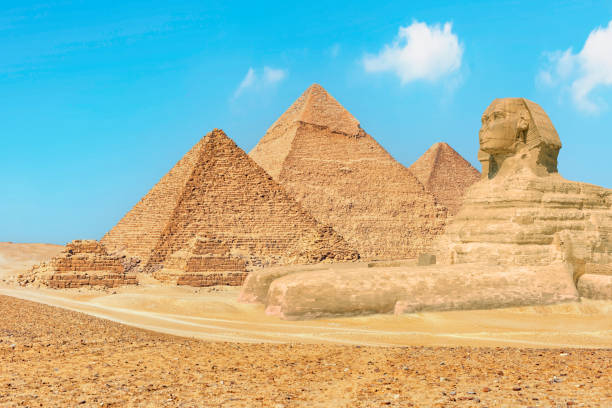
People are drawn to stories that blend history with mystery. Ancient Egypt, with its monumental pyramids, hieroglyphic writing, and elaborate burial rituals, already feels distant and magical.
The idea of a curse transforms an archaeological discovery into a dramatic narrative about revenge from beyond the grave.
Even when evidence disproves the supernatural explanation, the story remains powerful.
In a sense, the curse itself has become part of the tomb’s cultural legacy.
The Real Wonder of Tutankhamun
The greatest wonder of Tutankhamun’s tomb is not a supernatural curse.
It is the extraordinary survival of a moment in ancient history.
Inside that tomb, objects remained untouched for more than three thousand years. They carried the fingerprints of artisans, the beliefs of priests, and the hopes of a civilization that believed deeply in the afterlife.
Through archaeology and science, those silent objects began to speak again.
They told us about a young king, a powerful kingdom, and a culture that built monuments meant to last forever.
The real story is not about death and curses.
It is about discovery.
The Final Verdict
After more than a century of investigation, historians and scientists agree that the Curse of Tutankhamun is a myth.
There is no evidence of supernatural forces striking down those who opened the tomb.
Instead, the legend grew from coincidence, rumor, and the storytelling power of the media.
Yet the myth has become inseparable from the history of the tomb itself.
The world will likely continue to tell the story of the cursed pharaoh, just as it continues to marvel at the golden mask and the treasures of the boy king.
In the end, the Curse of Tutankhamun reveals something deeper than ancient magic.
It shows how humans interpret mystery, how imagination shapes history, and how a single discovery in the Egyptian desert captured the imagination of the entire world.
And perhaps that is the most fascinating mystery of all.