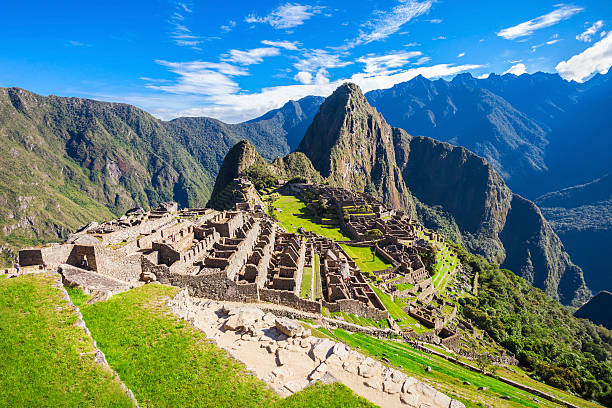
High in the misty Andes Mountains of South America, where clouds drift across jagged peaks and emerald forests cling to steep slopes, stands one of the most astonishing archaeological sites on Earth: Machu Picchu.
For centuries, this city of stone remained hidden from the outside world, perched on a mountain ridge more than 2,400 meters above sea level. Its terraces cascade down the mountainside like giant steps carved into the Earth. Its temples align with the Sun and stars. Its precisely fitted stones appear almost impossibly perfect.
To stand in Machu Picchu is to feel time bending around you. It is not merely a ruin; it is a puzzle, a masterpiece of engineering, and a silent witness to one of the most remarkable civilizations in human history.
Built by the Inca in the 15th century and abandoned only about a century later, the site continues to inspire scientists, historians, and travelers alike. Even today, Machu Picchu still guards many secrets.
Here are fifteen mind-blowing facts about this legendary city that reveal just how extraordinary it truly is.
1. Machu Picchu Was Never Discovered by the Spanish
When Spanish conquistadors conquered the Inca Empire in the 16th century, they destroyed or looted many of the empire’s great cities. Temples were dismantled. Gold was melted down. Sacred places were erased.
Yet Machu Picchu escaped their attention.
Hidden high in the Andes and surrounded by dense jungle-covered mountains, the city remained unknown to the Spanish invaders. No colonial records describe its location or destruction. While nearby communities likely knew of its existence, it never became part of Spanish maps or colonial administration.
Because of this remarkable absence, Machu Picchu survived largely intact. Temples, terraces, stairways, and houses remained standing, protected by geography and silence.
The world outside the Andes did not learn of Machu Picchu until 1911, when the American historian and explorer Hiram Bingham arrived at the site with the help of local farmers.
The city had been hidden in plain sight for nearly four centuries.
2. The City Was Likely Built for an Inca Emperor
Archaeologists believe Machu Picchu was constructed during the reign of the Inca emperor Pachacuti in the mid-15th century.
Pachacuti was one of the most powerful rulers in Inca history. Under his leadership, the Inca Empire expanded dramatically, stretching across large portions of western South America.
Machu Picchu was likely a royal estate built for the emperor and his elite court. Such estates served several purposes. They were retreats where rulers could escape the capital, perform religious ceremonies, manage agricultural experiments, and demonstrate imperial power through monumental architecture.
The location itself was symbolic. The site sits between sacred mountains and overlooks the winding Urubamba River valley below. In Inca cosmology, mountains were considered powerful spiritual beings called “apus.”
By building his estate here, Pachacuti placed himself in the heart of a sacred landscape.
3. The Stones Fit Together Without Mortar
One of the most astonishing features of Machu Picchu is its stonework.
The buildings were constructed using a technique known as ashlar masonry, in which stones are cut so precisely that they fit together without mortar. Some blocks weigh several tons, yet they align so tightly that even a knife blade cannot fit between them.
This precision required immense skill. Workers shaped stones using harder rocks as hammer tools, gradually smoothing surfaces until they interlocked perfectly.
Why go to such effort?
The answer lies partly in earthquakes. The Andes Mountains sit in a highly active seismic zone. Mortar-based structures often crack during earthquakes, but tightly fitted stones can shift slightly and then settle back into place.
This flexibility allowed many of Machu Picchu’s buildings to survive centuries of seismic activity.
In other words, the Inca engineered earthquake-resistant architecture long before modern engineering principles were formally developed.
4. The City Has an Advanced Water Management System
Machu Picchu’s survival depended on careful management of water.
The site receives heavy rainfall during the wet season, which could easily trigger landslides or flooding. Yet the Inca designed an incredibly sophisticated drainage and water distribution system.
Spring water from the mountain was channeled into a series of stone fountains that flowed through the city. Residents could collect fresh drinking water from these fountains.
At the same time, engineers built underground drainage layers beneath plazas and terraces. These layers consist of gravel and sand that allow rainwater to filter safely into the ground.
Modern engineers studying the site estimate that nearly 60 percent of Machu Picchu’s construction lies beneath the surface in drainage and foundation work.
Without this invisible infrastructure, the city would have collapsed long ago.
5. The Agricultural Terraces Prevent Landslides
The famous terraces of Machu Picchu are more than beautiful—they are brilliant engineering solutions.
Each terrace contains multiple layers. At the bottom are large stones for drainage. Above that lies gravel, then sand, and finally fertile topsoil. This structure prevents water from accumulating and destabilizing the slope.
The terraces also create flat areas for agriculture in an otherwise steep mountain environment.
Crops such as maize and potatoes could be grown here, supporting the city’s inhabitants. The terraces also reduced erosion and protected the mountain from landslides.
Even today, centuries after they were built, these terraces remain stable and functional.
6. The City Was Carefully Aligned With the Sun
Astronomy played a central role in Inca culture, and Machu Picchu reflects this cosmic awareness.
One of the most famous structures at the site is the Intihuatana stone, often interpreted as a ritual astronomical device. The name roughly translates to “hitching post of the Sun.”
During the equinoxes, the Sun stands almost directly above this carved stone, casting minimal shadow.
Other buildings are aligned with the sunrise during the June and December solstices. The Temple of the Sun, for example, contains windows positioned so that sunlight illuminates specific interior stones on important astronomical dates.
These alignments allowed priests and astronomers to track seasonal cycles essential for agriculture and ritual life.
Machu Picchu was not just a city. It was also a cosmic observatory.
7. It Was Abandoned Less Than 100 Years After It Was Built
Despite the immense effort required to construct Machu Picchu, the city was occupied for only about a century.
Most scholars believe it was abandoned in the mid-16th century, around the time the Spanish conquest destabilized the Inca Empire.
However, there is little evidence of violent destruction at the site. Instead, residents appear to have gradually left, possibly due to political upheaval or the collapse of imperial authority.
Without the administrative and economic structures of the empire, maintaining such a remote estate may have become impractical.
Nature slowly reclaimed the city. Jungle vegetation covered stairways and terraces, hiding them from the outside world.
For centuries, Machu Picchu slept beneath vines and moss.
8. The Inca Built a Road Network Reaching the Site
Machu Picchu was not isolated. It was connected to the vast Inca road system known as the Qhapaq Ñan.
This network stretched for more than 40,000 kilometers across mountains, deserts, and forests, linking cities and administrative centers throughout the empire.
Stone-paved paths, staircases, and suspension bridges allowed messengers called chasquis to travel rapidly across long distances.
Today, the famous Inca Trail follows part of this ancient network, leading hikers through mountain passes and cloud forests before arriving at Machu Picchu’s Sun Gate.
Walking this trail offers a glimpse into the logistical genius of the Inca civilization.
9. The City Contains More Than 150 Buildings
Though often described as a “lost city,” Machu Picchu was actually a carefully planned complex.
Archaeologists have identified more than 150 structures at the site. These include temples, houses, storehouses, plazas, stairways, and ceremonial spaces.
The city was divided into different sectors, including agricultural areas and urban zones.
Residential buildings housed nobles, priests, and workers. Storehouses held food and supplies. Religious structures hosted rituals dedicated to the Sun, mountains, and other sacred forces.
The layout reveals a highly organized society where architecture reflected social hierarchy and spiritual beliefs.
10. Llamas Still Roam the Ruins
One of the most charming sights at Machu Picchu today is the presence of llamas wandering peacefully among the ancient stones.
These animals were domesticated by Andean civilizations thousands of years ago and played a vital role in Inca life. They served as pack animals, sources of wool, and symbols of wealth.
While the llamas seen today are primarily maintained for conservation and tourism purposes, they offer a living connection to the past.
Watching them graze along the terraces feels like stepping into a living history.
11. The Site Was Almost Destroyed by Tourism
When Machu Picchu gained international fame in the 20th century, tourism increased dramatically.
Millions of visitors now travel to Peru each year to see the site. While tourism supports the local economy, it also places stress on the fragile ruins and surrounding ecosystem.
Heavy foot traffic can erode stone pathways and destabilize terraces. Increased development threatens the delicate balance of the mountain environment.
To protect the site, Peruvian authorities have introduced strict visitor limits, designated walking routes, and conservation programs.
Preserving Machu Picchu requires balancing access with protection.
12. The Stones Were Moved Without Wheels or Iron Tools
The Inca civilization did not use iron tools or wheeled vehicles.
Yet they transported enormous stones across steep mountainsides to build Machu Picchu.
Archaeologists believe workers used ramps, rollers, and teams of laborers to move the stones. Skilled stonecutters shaped each block using stone hammers and abrasives.
This achievement required extraordinary coordination, engineering knowledge, and manpower.
The result was architecture that remains astonishing even by modern standards.
13. Machu Picchu Is Located in a Biodiversity Hotspot
The region surrounding Machu Picchu lies within the Andean cloud forest, one of the most biologically diverse ecosystems on Earth.
Hundreds of species of orchids grow here. Rare animals such as spectacled bears, hummingbirds, and butterflies inhabit the forests.
The combination of tropical and high-altitude environments creates unique ecological conditions.
Thus Machu Picchu is not only an archaeological treasure but also an ecological one.
The city exists within a living landscape rich with life.
14. It Became a Global Symbol of Ancient Ingenuity
In 1983, Machu Picchu was designated a UNESCO World Heritage Site. In 2007, it was voted one of the New Seven Wonders of the World.
Today it stands as one of the most recognizable archaeological sites on the planet.
Scholars study it to understand Inca engineering, architecture, astronomy, and environmental management. Travelers visit it to experience its breathtaking beauty and mysterious atmosphere.
For many people, Machu Picchu represents the genius of ancient civilizations and the enduring relationship between humans and nature.
15. Machu Picchu Still Holds Secrets
Despite more than a century of research, Machu Picchu continues to surprise scientists.
New technologies such as ground-penetrating radar, drones, and 3D mapping reveal previously hidden features. Researchers continue to study its construction methods, social structure, and religious significance.
Questions remain about its precise purpose, the identities of its inhabitants, and the rituals performed within its temples.
Every stone, stairway, and terrace is part of an unfinished story.
Machu Picchu reminds us that history is never completely known. There are always deeper layers waiting to be uncovered.
The Enduring Mystery of the Mountain City
Standing atop its ridge in the Andes, Machu Picchu feels almost unreal.
Clouds drift through the ruins. Mountains rise like guardians around the city. The wind whispers through stone doorways built half a millennium ago.
It is a place where human creativity met the raw power of nature and produced something extraordinary.
The Inca civilization did not leave behind written records like many other ancient cultures. Their history lives primarily in architecture, landscape, and oral tradition.
Machu Picchu is one of the most powerful voices from that past.
It tells us that long before modern technology, human societies possessed profound knowledge of engineering, astronomy, agriculture, and environmental harmony.
And it reminds us that even the greatest achievements can vanish into silence—waiting for the moment when the world is ready to rediscover them.