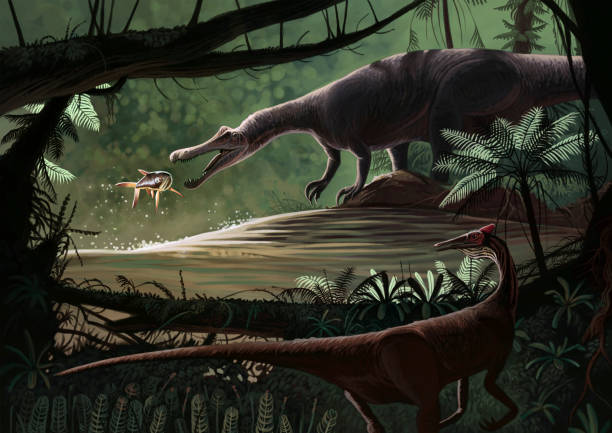
More than ninety million years ago, during the Late Cretaceous period, vast landscapes stretched across what is now Patagonia in southern South America. Rivers carved through wide plains, forests of conifers and flowering plants dotted the land, and enormous dinosaurs roamed across a warm, ancient world. Among these giants lived one of the most formidable predators that ever walked the Earth: Giganotosaurus.
Its name means “giant southern lizard,” and it was not given lightly. When paleontologists first uncovered its bones in Argentina in the 1990s, they realized they were looking at the remains of a carnivorous dinosaur of extraordinary size. Immediately, comparisons began to form in the public imagination. Could this predator rival the famous Tyrannosaurus rex of North America?
The discovery of Giganotosaurus reshaped the story of large theropod dinosaurs. It showed that massive apex predators evolved independently on different continents, each adapted to its own environment and prey. Giganotosaurus was not simply a southern version of T. rex. It belonged to a different family, lived millions of years earlier, and hunted in ecosystems that looked very different from the ones known in North America.
To understand Giganotosaurus is to explore a lost world—one filled with gigantic herbivores, fierce predators, and landscapes that existed long before humans ever appeared. It is also a story about scientific discovery, about the thrill of finding bones buried deep in rock, and about how each fossil helps rebuild the past piece by piece.
Discovery in the Windswept Plains of Patagonia
The story of Giganotosaurus begins in 1993 in the Patagonian region of Argentina. Patagonia is famous among paleontologists for its rich fossil beds, where ancient sediments preserve the remains of dinosaurs from the Cretaceous period. These rocks, shaped by rivers and volcanic activity millions of years ago, have revealed some of the largest creatures that ever walked on land.
A local fossil enthusiast named Rubén Darío Carolini discovered the first bones of the dinosaur while exploring near the town of Villa El Chocón in the Neuquén Province. What he found was not just a fragment or a single tooth, but parts of an enormous skeleton embedded in rock.
Professional paleontologists soon joined the excavation. Among them were the Argentine scientists Rodolfo Coria and Leonardo Salgado, who carefully studied the bones and recognized their significance. In 1995 they formally described the new species and gave it the scientific name Giganotosaurus carolinii, honoring Carolini for the discovery.
The skeleton was incomplete but remarkably well preserved. Parts of the skull, spine, hips, and limbs were recovered, providing enough evidence to reconstruct the overall size and anatomy of the animal. Even in its incomplete state, the fossil revealed a predator of staggering scale.
The discovery quickly captured global attention. At the time, it appeared that Giganotosaurus might have been longer than Tyrannosaurus rex, sparking debates among scientists and excitement among dinosaur enthusiasts around the world.
The World of the Late Cretaceous Patagonia
To truly understand Giganotosaurus, one must imagine the environment in which it lived. During the Late Cretaceous period, roughly ninety-eight to ninety-five million years ago, South America was already separated from Africa and drifting slowly away from other continents.
The climate in Patagonia during this time was warmer than today. Seasonal rivers flowed across broad floodplains, creating fertile ecosystems rich with plant life. Forests of conifers, ferns, and early flowering plants formed habitats for a diverse range of dinosaurs.
Enormous herbivorous dinosaurs dominated the landscape. Among them were titanosaurs—long-necked giants that could reach lengths of more than thirty meters. These massive plant-eaters were the largest animals ever to walk on land, and they provided an abundant food source for large predators.
Smaller herbivores also lived in these ecosystems, along with crocodile-like reptiles, turtles, fish, and flying pterosaurs overhead. The food web was complex, with predators and prey constantly shaping the balance of life.
At the top of this food chain stood Giganotosaurus, one of the most powerful hunters in its environment.
Anatomy of a Giant Predator
Giganotosaurus was a member of the theropod dinosaurs, a group of bipedal carnivores that included many famous species. Like other theropods, it walked on two powerful hind legs, balanced by a long tail, with shorter forelimbs used for grasping or stabilization.
Estimates of its size vary slightly depending on the reconstruction, but most paleontologists agree that Giganotosaurus measured around twelve to thirteen meters in length. This made it one of the longest known carnivorous dinosaurs.
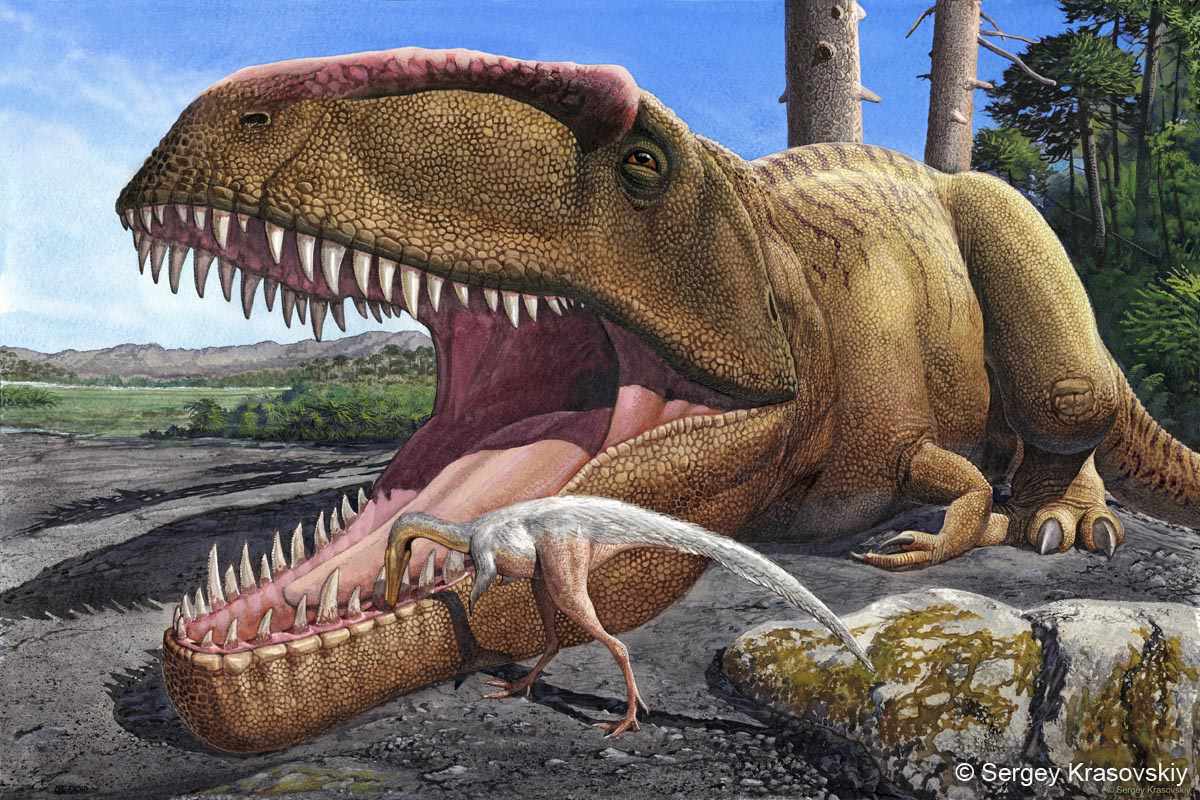
Its skull alone was enormous, measuring more than 1.5 meters in length. The jaws were lined with sharp, serrated teeth designed for slicing flesh. These teeth were not thick and bone-crushing like those of Tyrannosaurus rex. Instead, they were blade-like, suggesting a different feeding strategy focused on cutting rather than crushing.
The body of Giganotosaurus was relatively slender compared to the heavy build of T. rex. Its legs were long and strong, indicating it may have been capable of relatively fast movement for such a large animal.
The tail was stiff and muscular, acting as a counterbalance that allowed the animal to maintain stability while running or turning. The arms were short but not as reduced as those of Tyrannosaurus rex, and they likely ended in three clawed fingers.
Altogether, the anatomy of Giganotosaurus suggests a predator built for speed and slicing attacks rather than brute crushing power.
The Skull and Bite
One of the most fascinating aspects of Giganotosaurus is its skull structure. The skull was long and relatively low, with large openings that reduced weight while maintaining strength. These openings, called fenestrae, were common in theropod dinosaurs and allowed room for powerful jaw muscles.
The teeth of Giganotosaurus were long, curved, and serrated along the edges like steak knives. This design allowed the dinosaur to cut deeply into flesh with each bite.
Unlike Tyrannosaurus rex, which had an extremely powerful bite capable of crushing bone, Giganotosaurus likely relied on repeated slashing bites. Each bite would tear large chunks of flesh from its prey, causing severe blood loss.
This feeding strategy may have been especially effective against the enormous sauropods that lived in the same environment. Instead of attempting to kill such massive animals with a single bite, Giganotosaurus may have attacked repeatedly, weakening its prey over time.
The skull also had ridges and rough textures above the eyes and along the snout, possibly supporting keratin coverings similar to those seen in modern reptiles.
Movement and Hunting Ability
Despite its enormous size, Giganotosaurus was likely an active hunter. Its leg bones suggest strong muscles capable of supporting powerful strides.
Biomechanical studies indicate that while it was not a sprinter like smaller theropods, it could probably move faster than many of the giant herbivores it hunted.
The balance provided by its long tail allowed it to maintain agility while pursuing prey. Its body proportions suggest it was more lightly built than Tyrannosaurus rex, which may have allowed for greater mobility.
There is ongoing debate among paleontologists about whether Giganotosaurus hunted alone or in groups. Some fossil discoveries of related species suggest the possibility of pack behavior, but direct evidence for coordinated hunting remains uncertain.
If group hunting did occur, it would have allowed multiple predators to attack extremely large prey such as titanosaurs. Several individuals working together could inflict multiple wounds, exhausting the prey and eventually bringing it down.
Even if it hunted alone, Giganotosaurus would still have been an extraordinarily dangerous predator in its ecosystem.
Comparing Giganotosaurus and Tyrannosaurus rex
The comparison between Giganotosaurus and Tyrannosaurus rex is inevitable. Both were enormous theropod predators that lived during the Cretaceous period, and both have become icons of prehistoric life.
However, these dinosaurs lived in different parts of the world and at different times. Giganotosaurus lived roughly ninety-five million years ago in South America, while Tyrannosaurus rex lived about sixty-six million years ago in North America.
This means they were separated by nearly thirty million years of evolutionary history.
Their body structures were also quite different. Tyrannosaurus rex had a much more massive skull and an incredibly powerful bite capable of crushing bone. Giganotosaurus had a longer, lighter skull adapted for slicing attacks.
T. rex had extremely small forelimbs with only two fingers, while Giganotosaurus retained three fingers.
Their evolutionary families were also distinct. Tyrannosaurus belonged to the tyrannosaurids, while Giganotosaurus belonged to the carcharodontosaurids, a group of large predators known for their shark-like teeth.
These differences show that giant predators evolved multiple times in different ecosystems, each adapting to its environment in unique ways.
The Carcharodontosaurid Family
Giganotosaurus was part of a larger family of carnivorous dinosaurs known as carcharodontosaurids. The name means “shark-toothed lizards,” referring to the serrated teeth that resemble those of large predatory sharks.
Members of this family were among the largest land predators ever to exist. They lived across several continents during the Cretaceous period, including Africa, South America, and parts of Europe.
One of the most famous relatives of Giganotosaurus is Carcharodontosaurus, discovered in North Africa. Another is Mapusaurus, which lived in the same general region as Giganotosaurus in Patagonia.
These dinosaurs shared many anatomical features, including long skulls, blade-like teeth, and relatively slender builds compared to tyrannosaurids.
The existence of these related species shows that carcharodontosaurids were widespread and highly successful predators before their eventual extinction.
Prey in a Land of Giants
The prey of Giganotosaurus likely included some of the largest dinosaurs that ever lived. Patagonia during the Late Cretaceous was home to massive sauropods, including titanosaurs that could weigh tens of tons.
One such herbivore was Argentinosaurus, often considered one of the largest dinosaurs known. Although it is uncertain whether Giganotosaurus hunted fully grown individuals of such enormous species, juveniles or weaker adults could have been potential targets.
Other herbivores in the ecosystem included medium-sized dinosaurs that would have been easier prey.
The presence of such gigantic plant-eaters shaped the evolution of large predators. In ecosystems where prey animals were enormous, predators also evolved larger bodies and stronger hunting strategies.
Giganotosaurus was part of this evolutionary arms race, adapting to survive in a world dominated by giants.
Growth and Life History
Like many dinosaurs, Giganotosaurus likely grew rapidly during its early years. Bone studies of theropods show that many species experienced fast growth rates, reaching large sizes within a few decades.
Young Giganotosaurus would have been smaller and more agile than adults. This difference in size may have allowed juveniles to hunt smaller prey while avoiding competition with fully grown individuals.
As the dinosaur matured, its hunting strategies and prey choices likely changed.
The lifespan of Giganotosaurus is not known precisely, but comparisons with related species suggest that it may have lived for several decades if it survived the dangers of its environment.
Life in the Cretaceous world was challenging. Injuries, disease, competition with other predators, and environmental changes all posed threats.
Only a small fraction of individuals would have reached full adulthood.
Fossil Evidence and Scientific Reconstruction
Our understanding of Giganotosaurus comes entirely from fossils. Bones preserved in rock provide clues about the animal’s shape, size, and biology.
Paleontologists carefully excavate these fossils, often using delicate tools to avoid damaging the fragile remains. Once removed from the ground, the bones are cleaned, studied, and sometimes reconstructed.
Comparisons with related species help scientists fill in missing parts of the skeleton. Modern technology, including CT scanning and computer modeling, allows researchers to analyze fossil structures in greater detail than ever before.
These methods can reveal muscle attachment points, growth patterns, and even the forces involved in biting and movement.
Although fossils never provide a complete picture, each discovery adds new pieces to the puzzle.
Giganotosaurus in Popular Culture
Since its discovery, Giganotosaurus has captured the imagination of the public. It appears in documentaries, books, and digital reconstructions that bring prehistoric worlds to life.
Its rivalry with Tyrannosaurus rex has become a popular theme, often exaggerated in fictional battles between the two predators.
While these portrayals are entertaining, real science focuses more on understanding each animal within its own ecological context.
Giganotosaurus did not need to compete with Tyrannosaurus rex to prove its significance. It was already one of the most impressive predators in Earth’s history.
The Continuing Mystery of Giant Predators
Even after decades of research, many questions about Giganotosaurus remain unanswered. Scientists continue to debate aspects of its behavior, hunting strategies, and ecological role.
New fossil discoveries in South America may eventually reveal more complete skeletons or even evidence of social behavior.
Each new find has the potential to refine our understanding of this extraordinary dinosaur.
Paleontology is a constantly evolving science. As technology improves and new fossils are discovered, our picture of ancient life becomes clearer.
The Legacy of Giganotosaurus
Giganotosaurus represents more than just a giant predator. It symbolizes the diversity and complexity of prehistoric ecosystems.
Its discovery reminds us that Earth’s past was filled with creatures as strange and magnificent as any imagined in fiction.
The windswept plains of Patagonia once echoed with the footsteps of dinosaurs, and among them walked one of the most formidable hunters the planet has ever seen.
Through fossils and scientific study, the story of Giganotosaurus continues to unfold. Each bone, each fragment of ancient rock, helps reveal the life of a creature that ruled its world millions of years before humans appeared.
In that distant age, under a different sky and across ancient landscapes, Giganotosaurus stood as a true titan of the dinosaur age—a predator whose legacy still inspires awe today.