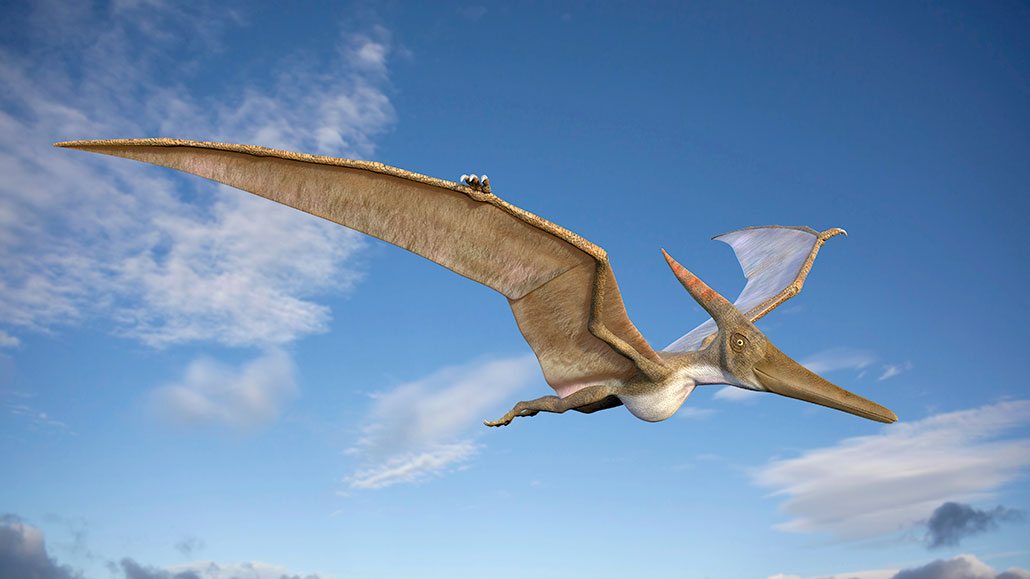
Imagine standing on a warm shoreline during the Late Cretaceous period. The air smells of salt and vegetation, and strange cries echo across the sky. Suddenly, a shadow passes overhead. You look up and see something almost unbelievable: a flying reptile with a wingspan wider than a small airplane gliding silently above the landscape.
This is not a bird. It is not a bat. It belongs to a much older lineage of flight—the pterosaurs.
For more than 150 million years, these remarkable reptiles ruled the skies of the prehistoric world. Some were small, delicate creatures with wingspans no larger than a pigeon’s. Others were colossal giants, towering over humans when standing on the ground and stretching their wings as wide as ten meters across the sky.
Among the most famous of these aerial titans was Quetzalcoatlus, one of the largest flying animals that ever lived. Fossils suggest that individuals of this species may have reached wingspans of around 10–11 meters, comparable to a small aircraft. When scientists first studied these enormous bones in the 1970s, the same question emerged again and again: how could something so massive possibly fly?
For decades, this puzzle fascinated paleontologists, biomechanists, and evolutionary biologists. The idea of a reptile taller than a giraffe taking off into the sky seemed almost impossible. Yet the fossil evidence clearly showed that these animals possessed wings designed for flight.
Understanding how massive pterosaurs actually took flight has become one of the most fascinating scientific investigations in paleontology. The answer reveals not only how these giants moved but also how evolution can push biological design to astonishing limits.
The Discovery of Giant Pterosaurs
The first pterosaur fossils were discovered in the late 18th century in Germany. Early scientists were puzzled by the strange bones: elongated fingers, hollow skeletons, and skulls unlike any living creature.
Eventually, it became clear that these fossils belonged to flying reptiles that lived during the age of dinosaurs. They were not dinosaurs themselves but a closely related group within the broader reptile lineage.
Over the next two centuries, new discoveries expanded the diversity of known pterosaurs. Fossils revealed long-tailed species with bat-like wings, short-tailed forms with enormous heads, and species adapted to fishing, scavenging, or soaring across vast distances.
The discovery of gigantic species transformed scientific thinking. When paleontologists uncovered fossils of Pteranodon in North America during the 19th century, they realized that some pterosaurs already possessed wingspans of six to seven meters.
But the discovery of even larger forms such as Quetzalcoatlus stunned researchers. These animals were not merely large flyers—they were the largest flying vertebrates in Earth’s history.
Their size posed a biological challenge. As animals grow larger, flight becomes increasingly difficult. Weight increases faster than wing area, meaning lift must increase dramatically to keep an animal airborne.
So how did pterosaurs overcome this challenge?
The answer lies in a remarkable combination of anatomy, muscle power, lightweight skeletons, and a unique method of launching into the air.
Anatomy Designed for Flight
Pterosaur wings were unlike those of any modern flying animal. Birds rely on feathers attached to modified forelimbs, while bats stretch skin membranes between elongated fingers. Pterosaurs used a different strategy.
Their wings consisted of a membrane of skin, muscle, and connective tissue stretched primarily along an enormously elongated fourth finger. This finger could extend several meters in giant species, acting as the main support for the wing.
The membrane, known as the patagium, connected the wing finger to the body and often extended down toward the hind limbs. Inside this membrane were tiny reinforcing fibers called actinofibrils, which strengthened the wing and controlled its shape during flight.
This structure created a strong yet flexible wing capable of generating lift.
But wings alone do not explain how these animals could launch from the ground. For that, scientists had to look deeper into their skeletons and muscles.
The Secret of Hollow Bones
One of the key adaptations that made pterosaur flight possible was their extraordinary skeletal design.
Like birds, pterosaurs had hollow bones filled with air sacs. These pneumatic bones drastically reduced body weight without sacrificing strength.
In giant pterosaurs, the bone walls could be extremely thin—sometimes just a few millimeters thick—even in bones several centimeters wide. Despite their delicate appearance, these bones were internally reinforced with complex structures that increased strength while maintaining lightness.
This architecture allowed pterosaurs to achieve an impressive balance between strength and weight. Even enormous individuals weighing perhaps 200 to 250 kilograms could still remain light enough for flight.
The hollow bones were also connected to an air sac system similar to that found in birds. This respiratory system allowed efficient oxygen exchange and reduced body density, both important for sustaining flight.
Yet weight reduction alone does not solve the takeoff problem. A creature must still generate enough force to lift itself off the ground.
And for giant pterosaurs, this challenge was immense.
Why Takeoff Is the Hardest Part of Flight
For most flying animals, takeoff is the most demanding phase of flight. Once airborne, gliding and soaring can require relatively little energy. But launching into the air requires explosive power.
Small birds solve this problem by flapping their wings rapidly and leaping from the ground. Large birds often rely on running starts or launching from elevated surfaces such as cliffs.
If giant pterosaurs had relied solely on their hind legs like birds, takeoff might have been nearly impossible. Their hind limbs were relatively slender compared to their enormous bodies.
For a long time, scientists struggled to explain how such large animals could generate the force needed to become airborne.
The breakthrough came when researchers realized something important about pterosaur anatomy: their forelimbs were far more powerful than their hind limbs.
This insight led to a revolutionary idea about how these animals actually launched into the air.
The Quadrupedal Launch Hypothesis
In the early 2000s, paleontologist Michael Habib proposed a new model for pterosaur takeoff known as the quadrupedal launch hypothesis.
Instead of launching using only their hind legs like birds, giant pterosaurs may have used all four limbs.
In this scenario, a pterosaur crouched on the ground, supported by both its hind legs and powerful forelimbs. When ready to take off, it pushed explosively against the ground using its wings as additional launch limbs.
The forelimbs, powered by enormous flight muscles attached to the chest and shoulders, generated tremendous force. The animal essentially vaulted itself into the air like a giant pole-vaulter.
This movement allowed the pterosaur to accelerate rapidly upward and forward, gaining enough height to begin flapping or gliding.
Biomechanical models show that this quadrupedal launch could generate far more power than a hind-leg launch alone. In fact, the forelimbs of large pterosaurs were among the strongest limbs relative to body size in the animal kingdom.
This means giant pterosaurs may have been capable of extremely powerful takeoffs despite their size.
The Role of Powerful Flight Muscles
The success of quadrupedal launching depended heavily on muscle power.
Pterosaur chests were dominated by large muscles responsible for powering the wings. These muscles were anchored to a specialized bone called the sternum, which acted as a central attachment point.
In birds, the sternum often features a keel—a ridge that increases surface area for muscle attachment. Pterosaurs had a similar structure that allowed their flight muscles to reach impressive sizes.
These muscles powered both the launch motion and the wing strokes that followed.
Because the forelimbs contributed directly to takeoff, the muscles driving them were capable of generating enormous force. Studies suggest that large pterosaurs may have produced launch accelerations greater than those of many modern flying animals.
Once airborne, the same muscles would transition from pushing against the ground to flapping the wings.
This design turned the pterosaur body into an integrated launch-and-flight machine.
Wings Built for Soaring
Although giant pterosaurs could likely flap their wings, their enormous wingspans suggest that they relied heavily on soaring flight.
Soaring involves gliding through the air using rising currents rather than continuous flapping. Birds such as albatrosses and vultures use this technique to travel vast distances while expending minimal energy.
Pterosaur wings were particularly well suited for this style of flight.
Their wings had high aspect ratios—meaning they were long and relatively narrow. Such wings are excellent for efficient gliding.
Once launched, giant pterosaurs could catch thermal updrafts rising from warm ground or ocean winds and soar for long periods.
This strategy would allow them to patrol huge territories while conserving energy.
Their flight may have resembled that of modern large seabirds, drifting gracefully across the sky with occasional powerful wingbeats.
Launching from Land
One of the most fascinating aspects of pterosaur research is the realization that many giant species probably launched from land rather than cliffs.
Their fossils are often found in inland environments far from coastal cliffs, suggesting that they were capable of ground-based takeoffs.
The quadrupedal launch method made this possible. By pushing explosively with all four limbs, a pterosaur could lift itself from flat ground without needing a running start.
This ability would have been especially important for large azhdarchid pterosaurs, a group that included Quetzalcoatlus.
These animals likely spent much of their time walking across prehistoric plains searching for food. When necessary, they could suddenly launch into the air using their powerful forelimbs.
Walking Giants of the Cretaceous
Interestingly, giant pterosaurs were not always airborne. Fossil trackways show that many species walked on all fours while on the ground.
Their long necks and beak-like jaws suggest that some species may have hunted small animals on land, similar to modern storks.
When walking, their folded wings acted as forelimbs, supporting their bodies. This quadrupedal stance made them stable and efficient terrestrial walkers.
This dual lifestyle—capable of both ground hunting and aerial soaring—made giant pterosaurs incredibly versatile.
They were not simply flying reptiles; they were complex animals adapted to multiple environments.
Limits of Flight Size
One of the most intriguing scientific questions surrounding giant pterosaurs is whether they represent the upper limit of vertebrate flight.
Physics places constraints on how large flying animals can become. As body mass increases, the power required for flight rises dramatically.
Some biomechanical studies suggest that animals heavier than about 250 kilograms would struggle to achieve powered flight.
Many estimates of giant pterosaur body mass fall just below this threshold.
This suggests that evolution may have pushed pterosaurs right to the edge of what is aerodynamically possible.
Their unique anatomy—light skeletons, enormous wings, and quadrupedal launch mechanics—allowed them to approach this limit in ways birds never did.
The Evolution of Flight in Pterosaurs
Pterosaurs first appeared more than 220 million years ago during the late Triassic period.
Early species were relatively small and likely flapped frequently during flight.
Over millions of years, evolutionary pressures shaped increasingly specialized wings and body plans.
Some species became agile insect hunters. Others evolved into oceanic gliders.
The largest forms emerged during the Cretaceous period, when azhdarchid pterosaurs dominated the skies.
These giants represent the culmination of pterosaur evolution—a lineage that had refined aerial life for more than a hundred million years.
The End of the Pterosaur Era
Despite their success, pterosaurs eventually disappeared.
At the end of the Cretaceous period, about 66 million years ago, a catastrophic event known as the Cretaceous–Paleogene extinction event reshaped life on Earth.
Triggered by a massive asteroid impact and global environmental changes, this event wiped out the non-avian dinosaurs and many other groups.
Pterosaurs vanished along with them.
Birds—descendants of small feathered dinosaurs—survived and eventually filled many aerial niches once dominated by pterosaurs.
But none ever matched the enormous size of the largest pterosaurs.
The age of flying giants ended forever.
Reconstructing the Flight of the Past
Today, scientists continue to investigate how giant pterosaurs lived and flew.
Researchers combine fossil evidence, computer simulations, wind tunnel experiments, and biomechanical modeling to recreate the flight of animals that vanished millions of years ago.
Every new discovery refines our understanding.
Fossils reveal bone structures. Trackways show how these animals walked. Advanced imaging allows scientists to analyze internal bone architecture.
Together, these clues paint a vivid picture of creatures that once soared above ancient landscapes.
A Sky Once Ruled by Reptiles
The idea that reptiles once dominated the skies with wings larger than small aircraft challenges our imagination.
Yet the evidence is undeniable.
Through elegant evolutionary design, pterosaurs solved the difficult problem of giant flight. Their lightweight skeletons, powerful forelimbs, sophisticated wings, and unique launch mechanics allowed them to conquer the air in ways no other vertebrate has since achieved.
When they took flight, it was not clumsy or awkward. It was explosive, powerful, and graceful.
A giant pterosaur launching from the ground would have unfolded its massive wings, pushed with incredible force from all four limbs, and vaulted into the sky within seconds.
Moments later it would be gliding high above the ancient world, riding thermals and scanning the land below.
For millions of years, these magnificent creatures filled the skies with shadows and wings.
And although they vanished long ago, their story continues to inspire awe—a reminder that the history of life on Earth contains wonders far beyond anything we see today.