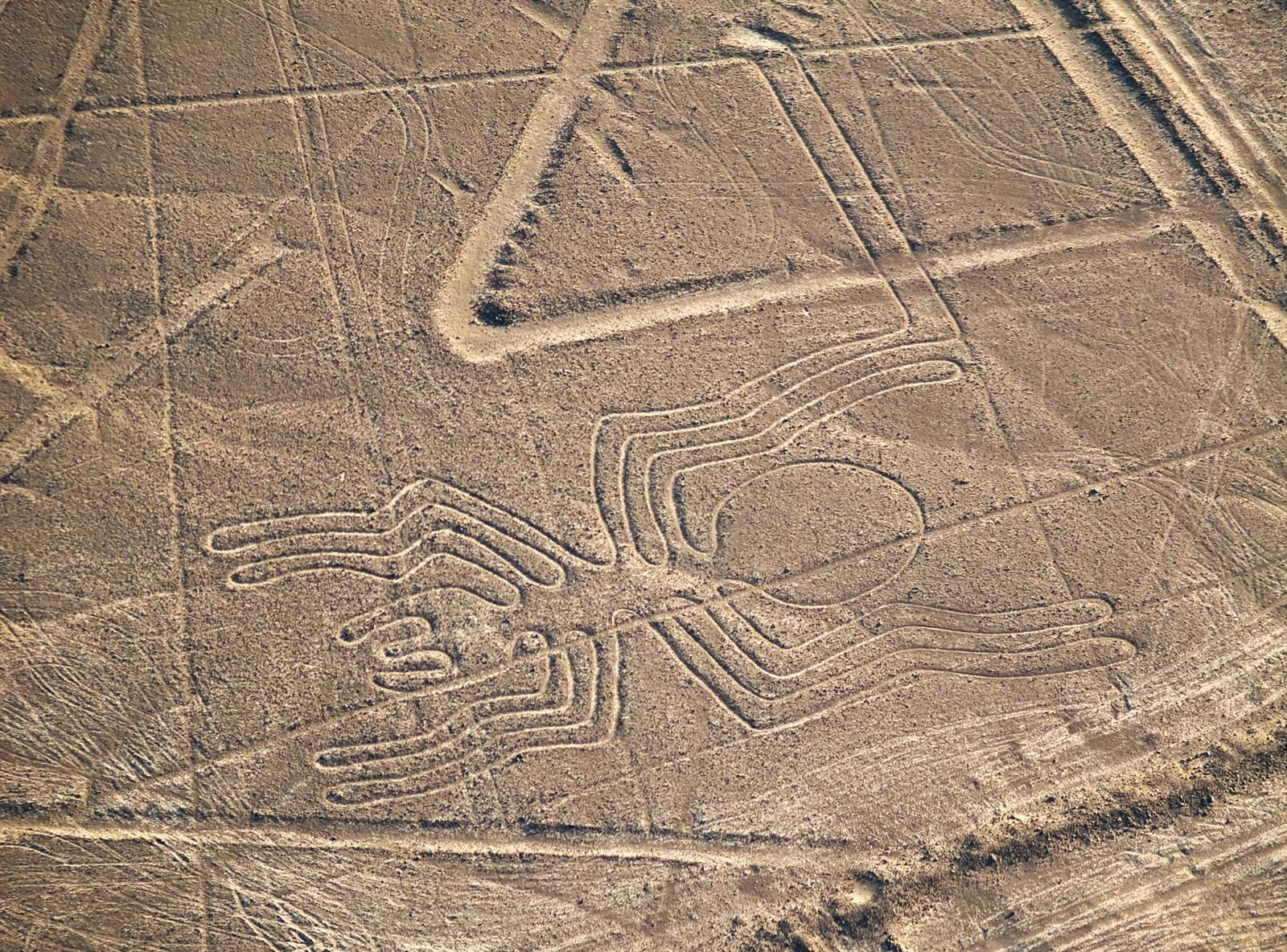
In the arid coastal plains of southern Peru, where the wind whispers across a sunburned landscape and rain almost never falls, the ground itself tells a story. From the earth, the Nazca Desert looks unremarkable—an expanse of reddish-brown gravel stretching toward distant Andean foothills. But from the sky, an astonishing transformation occurs. Lines stretch for kilometers in unwavering straightness. Spirals curl like cosmic fingerprints. Animals, plants, and abstract shapes emerge with breathtaking clarity. These are the Nazca Lines.
Created more than a thousand years ago by the Nazca culture, these geoglyphs remain among the most mysterious and visually striking archaeological features on Earth. They are not painted onto the surface. They are carved into it. By removing the dark, iron-oxide-coated stones that cover the desert floor and exposing the lighter soil beneath, ancient people created designs so vast they are best appreciated from above.
The Nazca Lines are not a single drawing, nor a handful. They are hundreds of lines and figures spread across roughly 450 square kilometers. Some are simple straight lines extending for kilometers. Others are complex biomorphic figures—monkeys, hummingbirds, spiders, and more. They were created roughly between 500 BCE and 500 CE, during the flourishing of the Nazca civilization.
What makes them truly bizarre is not just their size or age. It is the strange combination of precision, scale, environmental preservation, and lingering mystery. Over the decades, wild theories have emerged—ranging from extraterrestrial landing strips to coded astronomical calendars. Yet scientific research has steadily built a more grounded understanding.
Here are ten bizarre but scientifically supported facts about the Nazca Lines—facts that reveal not only their strangeness but also the remarkable ingenuity of the people who created them.
1. They Were Made Without Seeing Them from the Air
One of the most astonishing facts about the Nazca Lines is that they were created long before airplanes, drones, or any realistic means of aerial viewing existed. The Nazca people did not have access to flight. Yet they produced enormous designs that can only be fully appreciated from above.
This raises a natural question: how did they do it?
Archaeological evidence shows that the Nazca used surprisingly simple methods. They likely planned the figures using small-scale drawings and then transferred those designs onto the desert surface using a grid system. Wooden stakes discovered at some sites suggest they used ropes and markers to maintain straight lines and consistent proportions. By measuring carefully and following planned outlines, they could scale up small drawings into vast ground figures.
The straight lines, some extending over several kilometers, are especially striking. They maintain remarkable consistency despite crossing uneven terrain. This suggests deliberate surveying techniques rather than random scraping.
While the Nazca could not see their full designs from high altitudes, they may have viewed parts of them from nearby hills or constructed platforms. It is also possible that the act of creation, rather than the aerial view itself, was what mattered most. The lines may have been intended for divine beings in the sky rather than for human eyes.
The idea that such monumental artwork was created without aerial perspective remains one of the most fascinating aspects of the Nazca Lines. It challenges modern assumptions about what is necessary to produce large-scale design.
2. The Desert Is So Dry That the Lines Have Survived for Over 1,500 Years
The Nazca Lines have survived not because they are carved deeply into stone, but because they sit in one of the driest places on Earth. The Nazca Desert receives extremely little rainfall. In some areas, rain may fall only once every few years.
This hyper-arid environment plays a crucial role in preservation. The dark stones that cover the desert floor have developed a coating of iron oxide over thousands of years. When the Nazca people removed these stones, they exposed lighter soil beneath, creating contrast. Because there is almost no vegetation, little wind disturbance, and minimal rainfall, the exposed designs remain visible.
The desert’s stability has acted like a natural protective blanket. In many other regions, erosion would quickly erase such shallow markings. Here, the absence of water has been a silent guardian of history.
However, this preservation is fragile. Modern threats such as vehicle tracks, urban expansion, and climate change pose real dangers. Even a single tire track can permanently scar a line that has endured for centuries.
The survival of the Nazca Lines is therefore both miraculous and precarious. Their endurance reminds us that sometimes the harshest environments are the best archives of human creativity.
3. Some Lines Are Perfectly Straight for Kilometers
Among the most bizarre features of the Nazca Lines are the long, ruler-straight lines that stretch across the desert. Some extend for more than 10 kilometers without significant deviation.
Creating such straight lines across uneven terrain without modern tools seems extraordinary. Yet research indicates that the Nazca used simple surveying methods. By placing stakes in a straight alignment and using sightlines, they could maintain direction over long distances. Even slight elevation changes in the desert do not significantly distort the visual perspective at ground level.
The sheer scale of these lines suggests intentionality. They are not random marks. They intersect with one another, converge at certain points, and form trapezoidal shapes. Some researchers propose that these lines may have served as ceremonial pathways. Others suggest they align with specific topographical or water-related features.
While early theories speculated about astronomical alignments with stars or solstices, systematic studies have shown that most lines do not consistently correspond with celestial events. Although a few alignments may exist, the majority appear unrelated to precise astronomical tracking.
The existence of these immense straight lines is a testament to human determination and planning. Their geometric boldness continues to provoke awe.
4. The Animal Figures Are Scientifically Identifiable Species
The Nazca Lines include dozens of biomorphic figures representing animals and plants. Among the most famous are a hummingbird, a spider, a monkey, a condor, a heron, and even what appears to be a killer whale.
What makes this especially fascinating is that many of these figures can be identified as specific species native to the region. The spider, for example, closely resembles a species found in the Amazon rainforest rather than the immediate desert. This suggests that the Nazca people were aware of animals beyond their immediate environment, possibly through trade networks or shared cultural symbolism.
The hummingbird figure is exquisitely proportioned, with a long beak and symmetrical wings. The monkey features a curled spiral tail. These are not crude sketches. They display stylistic consistency with Nazca pottery and textiles, indicating cultural continuity in artistic expression.
The accuracy of these figures reflects careful observation and symbolic meaning. Animals likely held religious or cosmological significance. They may have represented fertility, water, or mythological beings.
The fact that these enormous ground drawings can be linked to real biological species highlights the Nazca’s intimate relationship with the natural world.
5. They May Be Connected to Water Rituals
One of the strongest scientific interpretations today links the Nazca Lines to water rituals. The Nazca civilization thrived in an extremely dry environment, relying on underground aqueduct systems known as puquios to access groundwater.
Water was life. It meant survival, agriculture, and prosperity.
Many of the lines and figures are located near water sources or ancient aqueduct systems. Some trapezoidal shapes appear to point toward water-rich areas in the foothills. Archaeological excavations have uncovered offerings such as pottery fragments and ceremonial objects near certain geoglyphs, suggesting ritual use.
The desert landscape itself may have served as a sacred canvas. Walking along the lines may have been part of ceremonial processions intended to honor deities associated with rain and fertility.
Rather than serving as astronomical calendars or alien runways, the lines may have functioned as part of a complex spiritual landscape centered on water. This interpretation aligns with broader Andean traditions in which mountains, water, and landforms held sacred meaning.
In a land defined by scarcity, carving massive symbols into the earth may have been an act of devotion and hope.
6. The Nazca Lines Were Not Created All at Once
It is tempting to imagine the Nazca Lines as a single coordinated project, but archaeological evidence indicates they were created over several centuries. The earliest geoglyphs date back to around 500 BCE, while later ones were added up to around 500 CE.
This means the Nazca Lines represent a long tradition rather than a single burst of activity. Different generations contributed to the landscape, possibly modifying or overlapping earlier designs.
Some lines cross over others, suggesting evolving priorities or ritual practices. The style of certain figures also changes over time, reflecting shifts in artistic conventions.
Understanding this gradual development adds depth to the story. The Nazca Lines were not a one-time spectacle. They were part of an enduring cultural practice that adapted and transformed.
This layered history reveals a living tradition embedded in the desert floor.
7. There Are Hundreds More Figures Than People Realize
For decades, only the most famous Nazca figures captured global attention. However, modern technologies such as satellite imagery, drones, and artificial intelligence have revealed many more geoglyphs than previously known.
Recent surveys have identified dozens of additional figures, including smaller and older designs that had been overlooked. Some are only a few meters long and are harder to detect from high altitudes.
These discoveries suggest that the Nazca landscape is even richer and more complex than once believed. It is not limited to a handful of iconic shapes but includes a vast network of designs.
The use of remote sensing technologies has transformed Nazca research. By analyzing high-resolution images, archaeologists can detect faint patterns invisible to the naked eye.
The desert continues to yield surprises, proving that even ancient mysteries can reveal new chapters in the digital age.
8. The Lines Were Part of a Larger Cultural Landscape
The Nazca Lines do not exist in isolation. They are part of a broader archaeological context that includes settlements, cemeteries, ceremonial centers, and irrigation systems.
Excavations in nearby areas have uncovered evidence of sophisticated pottery, textile production, and complex social organization. The Nazca people were skilled artisans and engineers.
The geoglyphs must therefore be understood as one element within a dynamic civilization. They were likely integrated into religious practices, seasonal ceremonies, and social gatherings.
By viewing the Nazca Lines within this broader cultural framework, they become less of an isolated enigma and more of a meaningful expression of a thriving society.
The desert was not empty when these lines were made. It was alive with community, belief, and creativity.
9. They Are Recognized as a UNESCO World Heritage Site
In 1994, the Nazca Lines and Geoglyphs were designated a UNESCO World Heritage Site. This recognition underscores their global significance as a unique cultural achievement.
The designation emphasizes both their archaeological importance and their vulnerability. Protection efforts aim to prevent damage from tourism, development, and environmental changes.
Despite protective measures, threats remain. Increased rainfall events linked to climate variability have occasionally caused erosion. Human activity, including unauthorized vehicle access, has caused damage in some areas.
Preserving the Nazca Lines requires balancing public access with conservation. They belong not only to Peru but to humanity’s shared heritage.
Their UNESCO status affirms that these ancient carvings are treasures of global importance.
10. The Greatest Mystery Is Not How They Were Made, but Why
Perhaps the most bizarre and enduring fact about the Nazca Lines is that their precise purpose remains uncertain. Scientific research has ruled out many sensational theories. There is no credible evidence that they were landing strips for extraterrestrials or coded messages to distant civilizations.
What remains is a more subtle mystery: what motivated the Nazca people to invest such enormous effort into carving the desert?
The leading theories point toward ritual, water worship, and ceremonial processions. Yet no single explanation accounts for every line and figure. The Nazca Lines likely served multiple purposes over time.
This uncertainty is not a failure of science. It is a reminder that ancient cultures had symbolic worlds we may never fully reconstruct.
The Nazca Lines endure as a dialogue between past and present. They challenge us to imagine the worldview of a civilization that saw the desert not as emptiness but as a sacred canvas.
In the silent expanse of southern Peru, the earth itself becomes a manuscript. The Nazca Lines are not merely drawings. They are gestures of belief etched into the land, whispers of devotion carried across centuries. They remind us that humans have always sought to communicate with forces larger than themselves—whether gods, nature, or the cosmos.
To stand above the Nazca Desert and see those immense shapes is to feel a connection across time. The lines are both ancient and immediate. They are strange, precise, fragile, and profound.
And perhaps their greatest lesson is this: even in the harshest landscapes, humanity has always found ways to leave meaning behind.