On a quiet plain in southern England, enormous stone pillars have stood against wind, rain, snow, and sunshine for thousands of years. They have watched generations of people come and go, witnessed the rise and fall of kingdoms, survived wars, and silently observed the changing world around them. Despite centuries of study, one question continues to fascinate archaeologists, historians, scientists, and curious travelers alike: who built Stonehenge, and why?
Stonehenge is one of the most famous prehistoric monuments on Earth. At first glance, it may seem like nothing more than a circle of giant stones standing in an open field. Yet behind its simple appearance lies one of humanity’s greatest archaeological mysteries. Every stone tells a story, every alignment hints at ancient knowledge, and every discovery raises new questions.
For hundreds of years, myths claimed that giants built Stonehenge. Others believed powerful wizards used magic to transport the stones. Some imagined it was created by the Romans or even visitors from another world. Modern archaeology has replaced these legends with evidence-based explanations, but many important mysteries remain unsolved.
Scientists now know that Stonehenge was built thousands of years before the pyramids of ancient Egypt reached their final form. They know that its construction took many centuries and involved remarkable planning, engineering, and cooperation. They have traced the origins of some stones across hundreds of kilometers. They have uncovered ancient burials, nearby villages, ceremonial avenues, and other monuments connected to the site.
Even so, no written records survive from the people who created Stonehenge. Unlike ancient civilizations that left books or inscriptions, Stonehenge’s builders communicated their ideas through earth, wood, and stone. Their voices have faded with time, leaving only clues buried beneath the soil.
This mystery is precisely what makes Stonehenge so captivating. It challenges modern people to imagine a world without metal tools, wheels for transporting heavy loads, or advanced machinery—a world where communities came together to create one of the most extraordinary monuments ever built.
What Is Stonehenge?
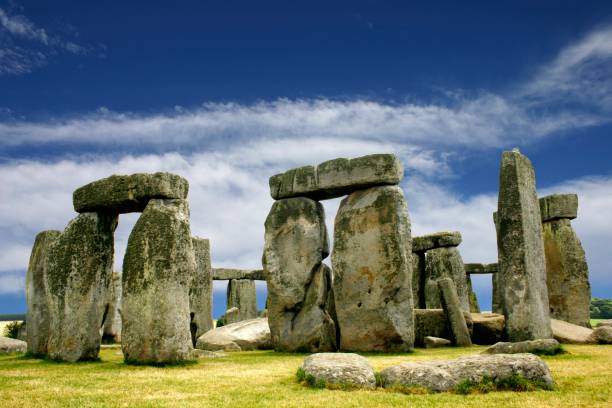
Stonehenge is a prehistoric stone monument located on Salisbury Plain in Wiltshire, England. It consists of massive standing stones arranged in circles and horseshoe-shaped formations, surrounded by earthworks and ditches.
Although many people think Stonehenge is simply a circle of giant rocks, the monument is much more complex. Some stones stand upright, while others rest horizontally across the tops of pairs of standing stones, forming structures called trilithons.
The stones vary greatly in size.
The largest sandstone blocks, known as sarsen stones, weigh up to around 25 tons each.
The smaller bluestones generally weigh between two and five tons, though some are heavier.
Today, many stones are missing or have fallen over, but archaeological evidence shows that the original monument was even more impressive than what visitors see today.
Stonehenge is part of a much larger prehistoric landscape containing burial mounds, ceremonial avenues, earthworks, and other ancient monuments.
Rather than existing alone, it formed the center of an important ceremonial landscape that developed over many centuries.
When Was Stonehenge Built?
One of the most surprising facts about Stonehenge is that it was not built all at once.
Construction occurred in several major phases over approximately 1,500 years.
The earliest activity at the site began around 3000 BCE, when people dug a large circular ditch and bank, creating what archaeologists call a henge.
Inside this enclosure were pits known as the Aubrey Holes, named after seventeenth-century antiquarian John Aubrey, who first identified them.
Around 2500 BCE, builders erected many of the famous sarsen stones that define Stonehenge today.
Later generations rearranged and added bluestones, modified stone circles, and continued altering the monument for centuries afterward.
This long construction history reveals something important.
Stonehenge was not the work of a single generation.
Instead, it represented the efforts, traditions, beliefs, and ambitions of many different communities over countless lifetimes.
People continued investing enormous time and energy into the monument because it clearly held deep cultural significance.
Who Built Stonehenge?
For centuries, the identity of Stonehenge’s builders remained one of history’s greatest mysteries.
Modern archaeology now provides a much clearer picture.
Stonehenge was built by prehistoric farming communities living in Britain during the Late Neolithic and Early Bronze Age.
These people were descendants of early agricultural populations who had gradually replaced or mixed with earlier hunter-gatherer groups.
They cultivated crops, raised livestock, built wooden houses, and developed increasingly complex societies.
Although they lacked iron, steel, cranes, and engines, they possessed remarkable practical knowledge.
They understood woodworking, stone shaping, rope making, engineering, and organization.
Building Stonehenge required careful planning and cooperation among hundreds, perhaps thousands, of people.
Leaders likely coordinated the work, while skilled craftspeople shaped the stones and organized transportation.
Rather than primitive people struggling to survive, Stonehenge’s builders were capable engineers and planners who possessed impressive technical skills for their time.
The Giant Sarsen Stones
The largest stones at Stonehenge are called sarsens.
These hard sandstone blocks came primarily from the Marlborough Downs, approximately 25 kilometers north of Stonehenge.
Transporting stones weighing over 20 tons without modern machinery remains one of archaeology’s greatest engineering achievements.
Scientists believe workers may have placed the stones on large wooden sledges.
Teams of people likely pulled these sledges using thick ropes while wooden rollers or lubricated tracks reduced friction.
Recent experimental archaeology has demonstrated that surprisingly small groups of determined people can move enormous stones using simple technologies.
Once the stones reached Stonehenge, builders dug deep pits.
One end of each stone was lowered into the hole before ropes, wooden frames, and human strength gradually raised it upright.
The builders then packed soil and rubble around the base to secure each stone firmly.
Even more remarkable, they lifted massive horizontal stones onto the standing uprights.
To achieve this, workers probably constructed earthen ramps or wooden scaffolding.
The precision of the finished structure demonstrates extraordinary craftsmanship.
The Mystery of the Bluestones
If moving the sarsens was impressive, transporting the bluestones was even more astonishing.
Geological research has traced many bluestones to the Preseli Hills in western Wales, roughly 225 kilometers from Stonehenge.
This discovery stunned scientists.
Why would prehistoric builders transport heavy stones across such an enormous distance when other rocks were available much closer?
Several explanations have been proposed.
The stones may have possessed religious or spiritual significance.
The communities living near their source may have formed important alliances with those constructing Stonehenge.
Some researchers suggest the bluestones were believed to possess healing powers.
Another possibility is that these stones represented symbols of identity or ancestral heritage.
Exactly how the bluestones traveled remains debated.
Builders may have transported them partly over land and partly by rivers or coastal waterways using wooden boats or rafts.
Regardless of the exact route, the achievement required remarkable determination.
Amazing Engineering Without Modern Technology
One of the greatest misconceptions about prehistoric people is that they lacked sophisticated knowledge.
Stonehenge proves otherwise.
The builders carefully shaped the stones using stone hammers made from even harder rocks.
They created smooth surfaces.
They fashioned rounded projections called tenons on top of upright stones.
Matching holes, known as mortises, were carved into the horizontal lintels.
These woodworking-style joints locked the stones together.
Even today, carpenters use similar techniques.
This clever engineering helped stabilize the monument and prevented horizontal stones from sliding off.
The builders also carefully curved certain lintels so that the completed circle appeared smooth.
Such precision required planning, measurement, and impressive practical mathematics.
Stonehenge and the Sun
One of Stonehenge’s most famous features is its relationship with the Sun.
Each year during the summer solstice, the rising Sun appears above the Heel Stone and shines into the center of the monument.
During the winter solstice, the setting Sun aligns with the monument in the opposite direction.
These alignments were almost certainly intentional.
Ancient people carefully observed seasonal changes because agriculture depended on understanding the yearly cycle.
Knowing when summer and winter began helped communities prepare for planting and harvesting.
The winter solstice may have been especially significant.
As the shortest day of the year passed, sunlight gradually returned, symbolizing renewal, hope, and the continuation of life.
Thousands of visitors still gather every year to witness these spectacular solar events.
Was Stonehenge an Ancient Calendar?
Some researchers have proposed that Stonehenge functioned as a calendar.
The monument’s solar alignments certainly suggest awareness of seasonal cycles.
Certain stone arrangements may have helped track important dates throughout the year.
However, archaeologists remain cautious.
While Stonehenge clearly reflects astronomical knowledge, there is no definitive evidence that it operated as a detailed calendar similar to modern systems.
Instead, it may have served as a ceremonial place where astronomical events held religious meaning.
Ancient societies often connected the movements of the Sun, Moon, and stars with ceremonies, agriculture, and beliefs about life and death.
Stonehenge and the Moon
Although the Sun receives much attention, the Moon may also have played an important role.
Some researchers believe certain alignments correspond to long-term lunar cycles.
The Moon’s position changes over periods lasting nearly nineteen years.
Recent studies continue exploring whether Stonehenge intentionally incorporated these complex lunar patterns.
If true, this would indicate remarkably advanced observational astronomy among prehistoric communities.
However, debate continues, and scientists remain careful not to claim more than available evidence supports.
A Sacred Place for Ceremony
Most archaeologists agree that Stonehenge was far more than an engineering project.
It was almost certainly a sacred ceremonial center.
People likely traveled long distances to gather there.
Ceremonies may have marked seasonal changes, celebrated community identity, honored ancestors, or strengthened alliances between different groups.
The monument’s immense scale suggests that it united many communities.
Building Stonehenge required cooperation beyond the capabilities of a single village.
Large gatherings may also have included feasting, trading, marriage arrangements, storytelling, music, and religious rituals.
Stonehenge was probably not just a monument.
It was a place where people came together to share important moments in their lives.
Stonehenge as a Burial Site
Excavations have revealed that Stonehenge also served as an important burial ground.
Human cremated remains dating to its earliest phases have been discovered within the monument.
These burials indicate that Stonehenge held deep spiritual importance.
Some individuals buried there may have been respected leaders or members of elite families.
Others may have held special ceremonial roles.
The combination of burial practices and monumental architecture suggests strong beliefs about ancestors and the afterlife.
Rather than separating the living from the dead, prehistoric communities may have viewed Stonehenge as a place connecting both worlds.
The People Who Gathered There
Archaeological discoveries around Stonehenge reveal fascinating glimpses into everyday life.
Nearby excavations uncovered evidence of houses, cooking, pottery, animal bones, and feasting.
Large numbers of pig bones suggest enormous communal meals.
Some animals appear to have traveled from distant regions.
These findings indicate that people journeyed considerable distances to attend important gatherings.
Stonehenge may have served as a central meeting place where different communities renewed social ties and participated in shared traditions.
Durrington Walls
Only a few kilometers from Stonehenge lies another remarkable monument called Durrington Walls.
This enormous earthwork once surrounded a large settlement.
Many archaeologists believe the people building Stonehenge lived there seasonally.
Evidence suggests Durrington Walls contained wooden houses and hosted large gatherings.
Interestingly, some researchers think the two monuments represented different symbolic worlds.
Wood, being associated with life, may have represented the living.
Stone, durable and enduring, may have represented ancestors or the dead.
A ceremonial avenue connecting Stonehenge to the River Avon further strengthens the idea that these places formed parts of a larger ritual landscape.
Legends of Giants
Long before archaeology existed, people invented stories explaining Stonehenge’s origin.
One legend claimed that giants transported the stones.
Their immense size seemed beyond ordinary human ability.
Such stories reflected genuine amazement.
Without understanding prehistoric engineering, people naturally imagined supernatural builders.
Although archaeology has shown that humans constructed Stonehenge, these legends remain fascinating parts of its cultural history.
They remind us that every generation has been captivated by the monument.
Merlin and Medieval Stories
Perhaps the most famous legend involves the wizard Merlin.
According to medieval writer Geoffrey of Monmouth, Merlin magically transported the stones from Ireland.
He claimed giants had originally placed them there before Merlin moved them to England.
Modern historians know this account is fictional.
Nevertheless, it became enormously influential.
For centuries, many people genuinely believed Merlin created Stonehenge through magic.
The story helped establish Stonehenge as one of Britain’s greatest legendary landmarks.
Were the Romans Responsible?
Early scholars sometimes attributed Stonehenge to the Romans.
Roman engineering was well known, making this explanation seem reasonable.
However, archaeological dating proved otherwise.
Stonehenge existed for nearly two thousand years before the Roman conquest of Britain.
The monument was already ancient when Roman soldiers first saw it.
Did Druids Build Stonehenge?
Another popular misconception links Stonehenge with the Druids.
The Druids were religious leaders among Celtic societies during the Iron Age.
However, Stonehenge predates the earliest historical evidence for Druids by well over a thousand years.
This means Druids almost certainly did not build Stonehenge.
They may have visited or used the monument because it already existed in their time, but they were not its original creators.
The Alien Theory
Few ancient monuments have inspired more speculation than Stonehenge.
Some people have suggested extraterrestrials built it.
These ideas became especially popular in books and television during the twentieth century.
However, no credible archaeological evidence supports such claims.
Everything discovered so far—including tools, construction methods, settlement remains, and dating evidence—fits human prehistoric societies remarkably well.
The engineering appears extraordinary but entirely achievable using known prehistoric technologies.
Human creativity provides a far more convincing explanation than extraterrestrial intervention.
Modern Scientific Discoveries
New technologies continue revealing remarkable information about Stonehenge.
Ground-penetrating radar allows archaeologists to detect buried structures without excavation.
Laser scanning creates highly detailed digital models.
Geochemical analysis identifies where stones originated.
Ancient DNA studies reveal information about prehistoric populations.
Radiocarbon dating establishes increasingly accurate construction timelines.
Each scientific advance helps answer old questions while generating exciting new ones.
Stonehenge remains one of the world’s most actively studied archaeological sites.
Why Stonehenge Still Matters
Stonehenge is far more than a tourist attraction.
It represents one of humanity’s greatest expressions of cooperation.
Thousands of people likely contributed across many generations.
They invested extraordinary effort without modern machinery.
Their achievement demonstrates that intelligence, creativity, organization, and determination existed long before written history.
Stonehenge also reminds us that people have always searched for meaning.
Like modern societies, prehistoric communities celebrated changing seasons, honored loved ones, observed the sky, and gathered for important ceremonies.
Although separated by thousands of years, their hopes and emotions were probably not so different from our own.
The Remaining Mysteries
Despite decades of research, important questions remain unanswered.
We still do not know precisely why the bluestones were so valuable.
We cannot fully reconstruct every ceremony held within the stone circle.
We do not know the names of its builders, their spoken language, or the stories they told their children.
Many wooden structures connected to Stonehenge disappeared long ago.
Organic materials decayed over thousands of years.
Without written records, archaeology must rely on physical evidence alone.
This ensures that Stonehenge will probably retain some mystery forever.
Rather than diminishing its importance, these unanswered questions make the monument even more compelling.
Conclusion
Stonehenge stands today as one of the world’s greatest prehistoric achievements and one of archaeology’s most enduring mysteries. Built over many centuries by Neolithic and Early Bronze Age farming communities, it demonstrates remarkable engineering skill, careful planning, and extraordinary cooperation. Massive sarsen stones were transported across the English countryside, while smaller bluestones traveled hundreds of kilometers from western Wales, reflecting a level of determination that still inspires admiration today.
Modern science has answered many long-standing questions about Stonehenge. Archaeologists have identified its builders, established its construction timeline, traced the origins of its stones, and uncovered evidence linking the monument to ceremonies, burials, astronomical observations, and large community gatherings. Yet the central question—why Stonehenge was built—remains only partially answered. It was likely a place where religion, astronomy, remembrance, seasonal celebrations, and social unity came together, but its full meaning has been lost with the people who created it.
Perhaps this is why Stonehenge continues to capture the imagination of millions. It reminds us that long before cities, written history, or modern technology, human beings possessed curiosity, intelligence, creativity, and an extraordinary desire to understand their world. Every stone standing on Salisbury Plain is a silent witness to that ancient spirit of discovery.
Thousands of years have passed since the last builders completed their work, yet Stonehenge still invites every visitor to ask the same timeless questions: Who built it? Why did they choose this place? What did these towering stones mean to the people who raised them? As archaeology continues to uncover new evidence, some answers will become clearer, while other mysteries may remain forever hidden beneath the grasslands of prehistoric Britain. And perhaps that enduring mystery is what makes Stonehenge one of the most remarkable monuments humanity has ever created.