Long before highways crossed the Americas and long before cities rose from forests and plains, a very different landscape stretched across the continents. Towering glaciers dominated the north, endless grasslands spread across the interior, and dense tropical forests thrived in the south. Among the extraordinary animals that inhabited this prehistoric world were creatures so unusual that they seem almost mythical today—giant ground sloths.
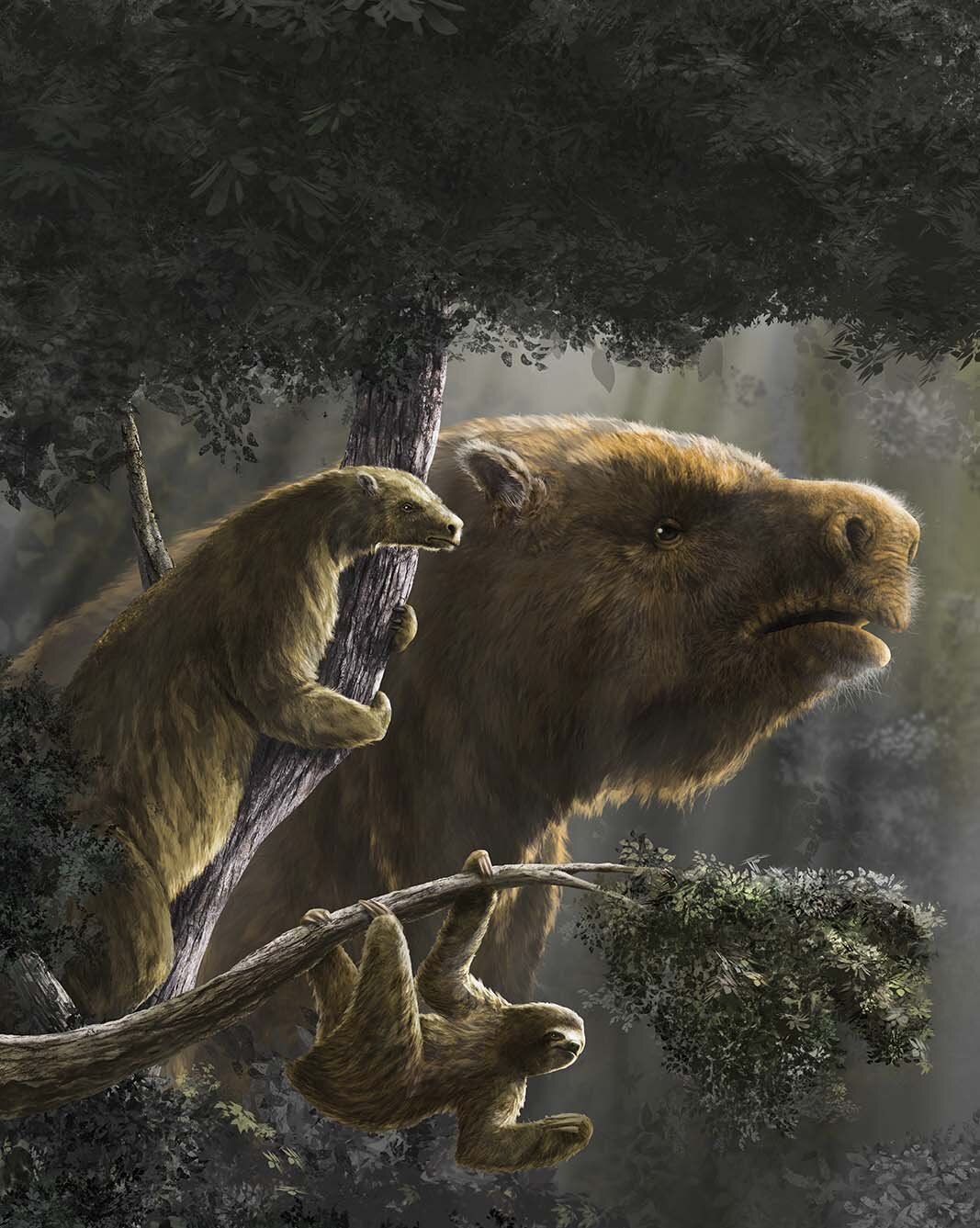
These animals, some as large as modern elephants, slowly roamed forests, grasslands, and deserts from the southern tip of South America to the cold plains of North America. They were not the small, tree-hanging sloths people recognize today. Instead, they were massive, powerful herbivores that walked upright on the ground, towering over humans when they stood on their hind legs.
Giant ground sloths belonged to an ancient lineage of mammals that evolved in South America millions of years ago. For a long time they flourished in isolation, becoming some of the largest land mammals in the Western Hemisphere. Their story is one of strange anatomy, evolutionary innovation, ecological success, and eventual disappearance.
Today, their fossils lie buried beneath deserts, caves, and ancient riverbeds, silently telling the story of a lost world.
The Sloths We Know Today
Modern sloths are quiet creatures of the rainforest canopy. They move slowly through the trees of Central and South America, feeding on leaves and spending most of their lives suspended upside down. Their slow movement and gentle nature have made them symbols of calm and patience.
These living sloths belong to a group of mammals called xenarthrans, which also includes armadillos and anteaters. Although modern sloths are relatively small, usually weighing only a few kilograms, they represent the last surviving members of a once-diverse family.
Millions of years ago, sloths were not limited to trees. Many species lived entirely on the ground, and some evolved into enormous animals capable of competing with the largest mammals of their time.
These ancient relatives were the giant ground sloths.
Evolution in an Isolated Continent
The story of giant ground sloths begins in South America roughly 35 million years ago. During this time, South America was isolated from the other continents, much like Australia today. This isolation allowed unique groups of animals to evolve without competition from species elsewhere.
Among these evolving creatures were the early ancestors of sloths. Over time, different species adapted to various environments. Some remained small tree-dwellers, while others gradually descended to the ground.
On the ground, new ecological opportunities awaited. Large herbivores were rare, and plants grew in abundance. Some sloths evolved larger bodies, stronger limbs, and adaptations for walking rather than climbing.
Over millions of years, these ground-dwelling sloths grew into giants.
By the late Cenozoic era, several families of giant ground sloths had emerged, each with distinctive shapes and lifestyles.
The Great American Biotic Interchange
For tens of millions of years, South America remained largely separated from North America. That changed about three million years ago when the Isthmus of Panama rose from the ocean floor, forming a land bridge between the continents.
This event triggered a massive exchange of animal species known as the Great American Biotic Interchange.
Animals from North America migrated south, including predators like cats and bears. At the same time, many South American species moved north. Among them were giant ground sloths.
As they spread across the Americas, ground sloths adapted to new climates and landscapes. Some lived in tropical forests, while others thrived in dry plains and even colder northern regions.
Fossils show that these animals eventually ranged from Argentina all the way to present-day Alaska.
Few prehistoric mammals achieved such an extraordinary geographic distribution.
The Colossal Megatherium
One of the most famous and impressive ground sloths was Megatherium. Its name means “great beast,” and the description is entirely appropriate.
Megatherium could grow more than six meters long and weigh several tons. Standing upright on its hind legs, it could reach heights comparable to modern giraffes. Its body was bulky and muscular, supported by powerful limbs and enormous claws.
Despite its intimidating appearance, Megatherium was primarily a plant-eater. Its massive claws likely helped pull down branches or dig for roots and tubers. By standing upright and bracing itself with its thick tail, it could reach leaves far above the ground.
Megatherium lived primarily in South America during the Ice Age and became one of the largest land mammals ever to inhabit the continent.
The Towering Megalonyx
Another remarkable species was Megalonyx, which roamed much of North America.
Megalonyx was smaller than Megatherium but still enormous compared with modern sloths. It could weigh hundreds of kilograms and stand several meters tall when upright.
Interestingly, the first fossils of Megalonyx discovered in North America were studied by Thomas Jefferson before he became president. At the time, Jefferson believed the animal might still exist in unexplored western territories.
Although that hope proved mistaken, the discovery sparked early scientific interest in the mysterious prehistoric animals of the Americas.
Megalonyx inhabited forests and woodlands, feeding on leaves, twigs, and other vegetation.
The Strange Shasta Ground Sloth
Not all ground sloths were gigantic giants. Some species were smaller but equally fascinating. One example is Nothrotheriops shastensis, often called the Shasta ground sloth.
This species lived in western North America, particularly in desert regions. Fossils and preserved remains have been found in dry caves, where the arid environment protected ancient dung, hair, and bones.
These discoveries provided extraordinary insights into the sloths’ diets and lifestyles. Analysis of fossilized droppings revealed that Shasta ground sloths ate desert plants such as yucca and agave.
The caves where they lived also contained scratch marks and bedding areas, suggesting that these animals used the caves as shelter.
Such findings offer rare glimpses into the daily lives of Ice Age animals.
Anatomy of a Giant
Giant ground sloths had bodies unlike almost any modern mammal. Their skeletons reveal powerful limbs, massive claws, thick tails, and unusual joints that allowed them to support enormous weight.
Their hind legs were particularly strong. Many species could rear up on their back legs, using their tails as a tripod for balance. This posture allowed them to reach vegetation high above the ground.
Their claws were long and curved, sometimes reaching lengths of over thirty centimeters. These claws likely helped them grasp branches, dig for roots, and defend themselves against predators.
Their teeth were also unique. Unlike the teeth of many herbivores, sloth teeth lacked enamel. Instead, they consisted of layers of dentin that wore down in a way that kept the teeth sharp and effective for grinding plant material.
Their digestive systems were adapted to process large amounts of tough vegetation.
Everything about these animals reflected their role as massive plant-eaters.
Life in the Ice Age
Giant ground sloths lived during the Pleistocene epoch, often called the Ice Age. During this period, large glaciers repeatedly expanded and retreated across the northern continents.
The climate fluctuated dramatically, shaping ecosystems across the Americas. Grasslands spread across many regions, while forests shifted with changing temperatures.
Giant sloths adapted to these environments in different ways. Some preferred forests where they could browse on leaves and branches. Others lived in open plains or desert landscapes.
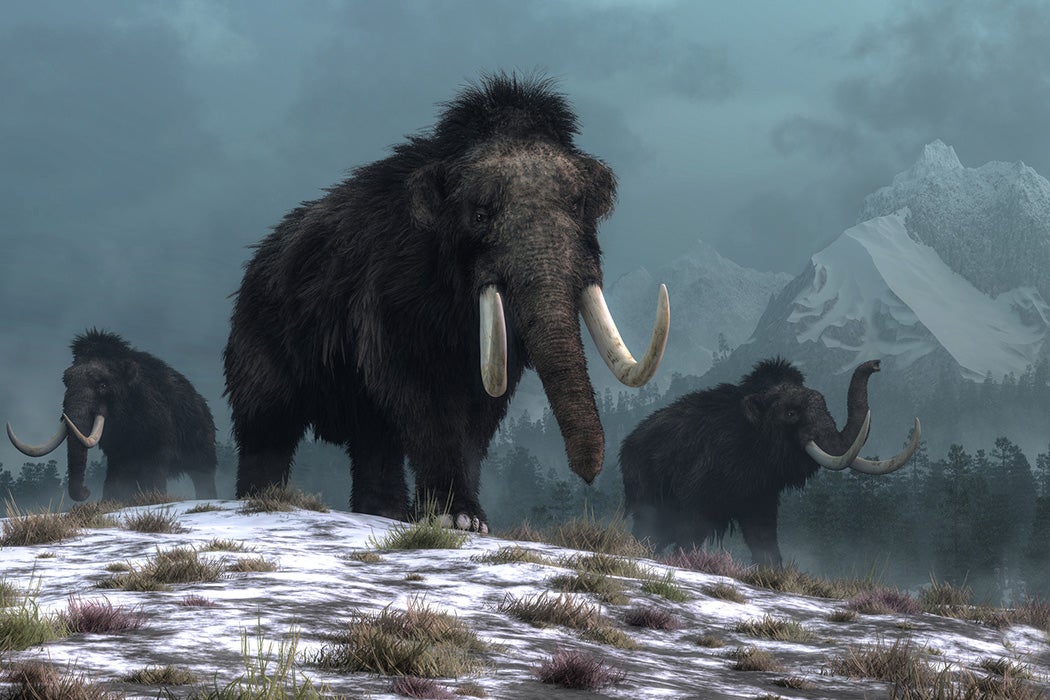
They shared their world with a spectacular array of megafauna. Mammoths, mastodons, giant bison, saber-toothed cats, and enormous short-faced bears all lived during this time.
These animals formed complex ecosystems where predators and herbivores interacted in intricate ways.
Ground sloths, despite their slow reputation, were formidable animals capable of defending themselves against many threats.
Defense Against Predators
Although giant sloths were herbivores, they were far from defenseless. Their size alone made them difficult prey. A full-grown Megatherium or Megalonyx would have been a daunting opponent for most predators.
Their massive claws could deliver powerful swipes capable of inflicting serious injuries. Standing upright, they could use these claws to fend off attackers.
Fossil evidence suggests that predators occasionally attempted to hunt them. Large Ice Age predators such as Smilodon may have targeted young or weakened individuals.
However, adult sloths likely relied on intimidation and strength to discourage attacks.
Their slow movements may appear vulnerable, but strength and size provided effective protection.
A World of Plants
As large herbivores, giant ground sloths played an important role in shaping their environments. They consumed enormous quantities of vegetation, influencing plant communities wherever they lived.
By pulling down branches and clearing vegetation, they may have helped open forest canopies, allowing sunlight to reach the ground. This process could promote the growth of new plants and create diverse habitats.
Their dung likely spread seeds across wide areas, aiding plant reproduction.
In this way, ground sloths functioned as ecosystem engineers—animals that alter landscapes and influence the survival of other species.
Their disappearance may have caused significant ecological changes across the Americas.
Fossils and Discoveries
The first scientific descriptions of giant ground sloths appeared in the late eighteenth century. Fossils discovered in South America fascinated European naturalists.
One of the earliest detailed studies was conducted by Georges Cuvier, who helped establish the science of paleontology. Cuvier recognized that these enormous bones belonged to extinct animals, providing evidence that species could vanish entirely from Earth.
This realization transformed scientific understanding of life’s history.
Over the centuries, countless ground sloth fossils have been uncovered across the Americas. Some of the most remarkable discoveries include nearly complete skeletons, preserved skin, and even hair.
These remains allow scientists to reconstruct the appearance and behavior of these ancient animals with remarkable accuracy.
Frozen and Preserved
In some rare cases, the remains of ground sloths have been preserved under extraordinary conditions. Dry caves in North America have yielded mummified sloths with preserved skin and fur.
These remains provide invaluable information about their anatomy and appearance.
Scientists have even recovered preserved dung deposits, allowing researchers to analyze ancient diets and environmental conditions.
Such discoveries transform fossils from simple bones into vivid windows into prehistoric life.
The Mystery of Their Extinction
Around the end of the last Ice Age, approximately 11,000 years ago, giant ground sloths disappeared from mainland North and South America.
Their extinction was part of a broader wave of megafaunal extinctions that affected many large animals across the globe.
The reasons for this extinction remain debated among scientists. Climate change likely played a role. As glaciers retreated and ecosystems transformed, food sources and habitats may have shifted.
Another possibility involves human activity. Early humans arrived in the Americas roughly 15,000 years ago. Archaeological evidence suggests that humans hunted large animals during this period.
Some researchers propose that a combination of climate change and human hunting drove the decline of giant ground sloths.
Whatever the cause, their disappearance marked the end of one of the most extraordinary chapters in the history of mammals.
Survivors on Islands
Interestingly, giant ground sloths did not vanish everywhere at the same time. Some species survived thousands of years longer on isolated islands in the Caribbean.
One example is Megalocnus, which lived in Cuba until about 4,000 years ago.
Island environments sometimes protect species from predators or environmental changes that occur on continents. However, when humans eventually reached these islands, the remaining sloths soon disappeared.
Their final extinction closed the evolutionary story of giant ground sloths.
Lessons from Ancient Giants
The story of giant ground sloths reveals the dynamic nature of life on Earth. Species evolve, adapt, spread across continents, and sometimes vanish.
These animals demonstrate how isolation, environmental change, and ecological opportunity can produce extraordinary forms of life.
They also remind us that extinction is a powerful force in nature.
Today, only the small tree-dwelling sloths remain, quietly hanging from branches in tropical forests. They are the last living representatives of a once-glorious lineage that included some of the largest mammals in the Americas.
When scientists study these living sloths, they glimpse echoes of their gigantic ancestors.
Echoes Beneath Our Feet
The fossils of giant ground sloths lie buried beneath deserts, caves, and ancient sediments across the Americas. Occasionally, construction projects or erosion reveal their bones, bringing pieces of the ancient world back into view.
Each discovery adds another detail to the story of these remarkable animals.
Through paleontology, scientists continue to reconstruct the ecosystems of the Ice Age and understand how these giants lived.
Their bones remind us that the world we know today is only the latest chapter in a much longer story.
Remembering the Giants
It is difficult to imagine the Americas as they once were—landscapes filled with mammoths, saber-toothed cats, and towering sloths pulling branches from trees.
Yet for millions of years, giant ground sloths were a familiar part of those environments. They shaped ecosystems, interacted with other species, and roamed vast territories.
Their slow movements, immense strength, and unusual forms made them some of the most distinctive animals ever to walk the Earth.
Though they vanished thousands of years ago, their legacy remains written in stone and bone.
And every fossil unearthed from ancient ground whispers the same remarkable truth: our planet was once home to giants.