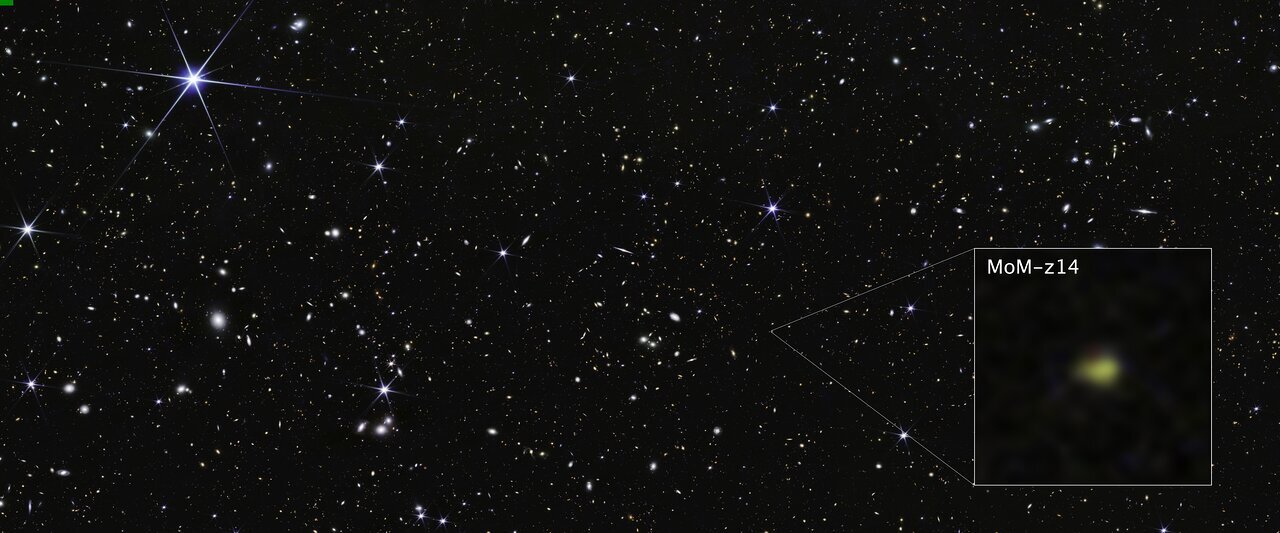
The light arriving at the James Webb Space Telescope today began its journey almost as soon as the universe itself existed. That light comes from MoM-z14, a galaxy now confirmed to have existed just 280 million years after the Big Bang, at a time when the cosmos was still wrapped in darkness and uncertainty. Webb has peered deep into space before, but this discovery pushes that view closer than ever to cosmic dawn, the moment when the first structures began to shine.
MoM-z14 is not just distant. It is startlingly bright. And that brightness is what makes astronomers pause. The early universe, as imagined before Webb launched, was supposed to be sparse, dim, and slow to organize. Instead, Webb keeps uncovering galaxies that glow far more intensely than expected. Each new detection deepens the mystery of how the universe grew up so fast.
A Stretch of Light Across Almost All of Time
Understanding just how ancient MoM-z14 is requires careful measurement, because space itself has been expanding ever since the Big Bang. As the universe stretches, so does the light traveling through it. This effect, known as cosmological redshift, shifts light toward longer, redder wavelengths the farther it travels.
Using Webb’s NIRSpec (Near-Infrared Spectrograph), astronomers measured MoM-z14’s redshift at 14.44. That number tells a staggering story. The galaxy’s light has been traveling through space for about 13.5 billion years, nearly the entire 13.8-billion-year history of the universe.
Images alone can suggest extreme distances, but spectroscopy is what turns possibility into certainty. As Pascal Oesch of the University of Geneva explained, confirming what we are truly seeing, and when it existed, requires that deeper level of detail. With MoM-z14, Webb delivered that confirmation.
A Galaxy That Should Not Be So Bright
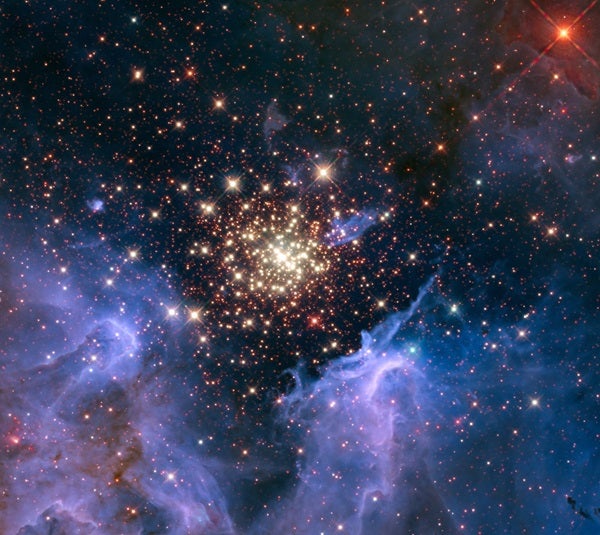
Before Webb ever unfolded its mirrors, theoretical studies predicted that galaxies this early would be rare and faint. Instead, MoM-z14 joins a growing group of early galaxies that are unexpectedly luminous. According to the research team, Webb has revealed roughly 100 times more bright galaxies in the early universe than theories anticipated.
This widening gap between prediction and observation has become impossible to ignore. Jacob Shen of MIT described it as a growing chasm, one that challenges long-held ideas about how the universe evolved. These galaxies are not subtle anomalies. They are bold signals that something fundamental about the early universe worked differently than scientists assumed.
Each new discovery reinforces the same message. The first few bright galaxies were not flukes. They were the opening lines of a much larger story.
Fossils in the Milky Way, Echoes Across Time
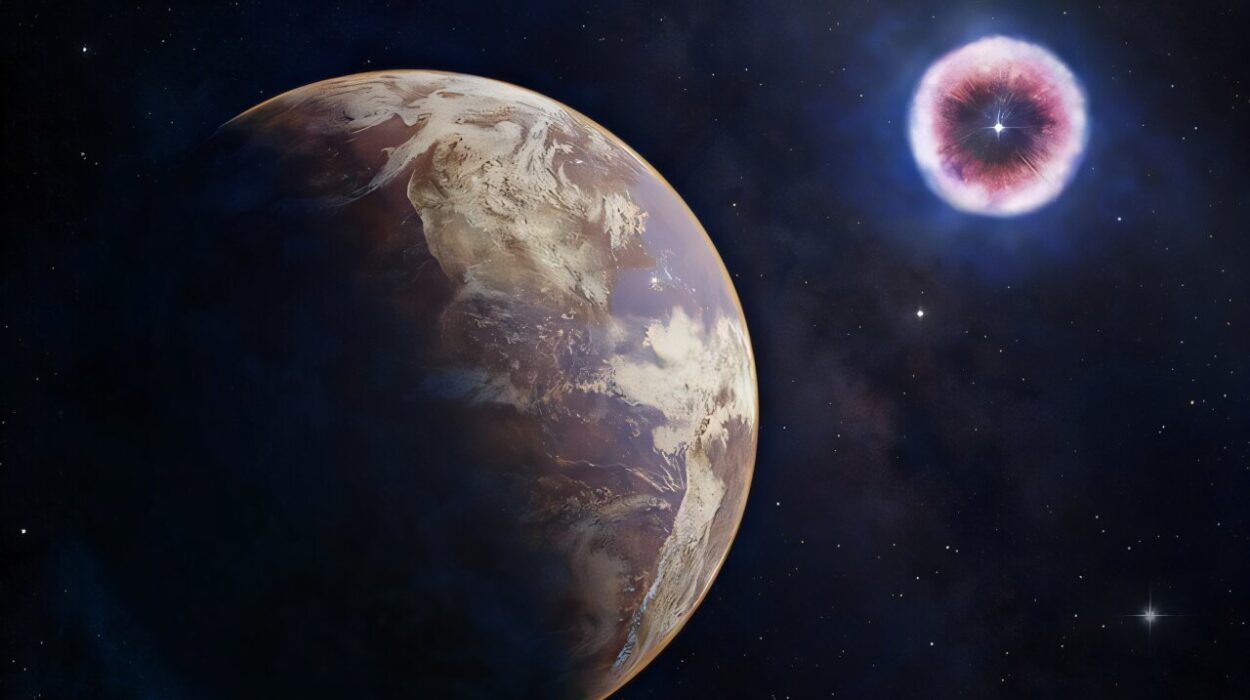
To understand what might be happening inside MoM-z14, astronomers turned their gaze closer to home. Within the Milky Way, a small population of ancient stars carries unusual chemical signatures. Some of these stars contain high amounts of nitrogen, a feature that also appears in Webb’s observations of MoM-z14 and other early galaxies.
Rohan Naidu of MIT likened this approach to archaeology. These old stars act like fossils, preserving clues from the universe’s earliest era. The difference is that astronomers now have both the fossils and direct observations of galaxies from that same ancient time.
The nitrogen connection is puzzling. Producing large amounts of nitrogen typically requires multiple generations of stars living and dying. But MoM-z14 existed far too early for that process to unfold as expected.
Too Much Nitrogen, Too Little Time
At just 280 million years after the Big Bang, the universe had barely begun forming stars, let alone recycling them through many generations. Yet MoM-z14 shows signs of significant nitrogen enrichment. The timeline simply does not fit traditional expectations.
One possible explanation offered by the researchers points to the extreme conditions of the early universe. Space was denser then, and that density may have allowed the formation of supermassive stars unlike anything seen in the local universe today. These stars could have produced nitrogen far more efficiently, leaving behind chemical fingerprints that Webb can now detect.
This idea remains a hypothesis, but it highlights how unfamiliar the early universe may have been. The rules that govern star formation today might not apply in the same way to the universe’s first luminous structures.
Pushing Back the Fog of the Early Cosmos
MoM-z14 is not only chemically intriguing. It also appears to be actively shaping its surroundings. In the early universe, space was filled with thick, neutral hydrogen gas that blocked light from traveling freely. This period is often described as a cosmic fog.
One of Webb’s central goals is to chart when and how this fog began to lift. That process, called reionization, occurred when early stars and galaxies produced energetic light capable of breaking through the hydrogen gas. Once cleared, light could travel vast distances across the universe.
MoM-z14 shows signs of carving out a clearer region around itself, suggesting it played a role in this transformation. Observations like this help astronomers map the timeline of reionization, something that remained largely out of reach before Webb’s launch.
Standing on the Shoulders of Earlier Discoveries
This moment did not arrive without warning. Even before Webb, the Hubble Space Telescope detected hints that the early universe might be brighter than expected. The discovery of GN-z11, a galaxy seen 400 million years after the Big Bang, raised eyebrows when it was announced. Webb later confirmed its distance, solidifying its place as a landmark discovery.
Since then, Webb has continued to push farther back in time, finding more galaxies like GN-z11 and now MoM-z14. Each new confirmation strengthens the pattern. The early universe was not quietly assembling in the dark. It was alive with luminous activity.
Yijia Li, a member of the research team, described this era as an incredibly exciting time, with Webb revealing the early universe in unprecedented detail and showing just how much remains unknown.
Why This Discovery Matters
MoM-z14 is more than a record-breaking galaxy. It is a challenge to our understanding of cosmic history. Its brightness, chemical makeup, and impact on its environment all suggest that the universe’s first few hundred million years were far more dynamic than once believed.
By confirming galaxies like MoM-z14, Webb is forcing scientists to rethink how quickly stars formed, how massive they could become, and how early galaxies transformed their surroundings. These discoveries reshape the timeline of the universe’s youth and redefine what “normal” looks like at cosmic dawn.
Every photon from MoM-z14 carries a message from a time when the universe was still inventing itself. By listening carefully, astronomers are learning that the universe’s earliest chapters were not quiet beginnings, but bold, brilliant openings that still echo across space and time.
Study Details
Rohan P. Naidu et al, A Cosmic Miracle: A Remarkably Luminous Galaxy at zspec=14.44 Confirmed with JWST, arXiv (2025). DOI: 10.48550/arxiv.2505.11263