Imagine a world before the dawn of the great dinosaurs, a landscape of lush evergreen conifers and winding riverbeds that would one day become the arid stretches of Arizona’s Petrified Forest National Park. Within this Late Triassic ecosystem, roughly 225 to 201 million years ago, lived a creature so strange that it challenges our modern understanding of how animals grow and move. This was the era of the archosaurs, a time when the ancestors of birds and crocodiles were locked in an evolutionary arms race, often mimicking one another’s shapes and habits.
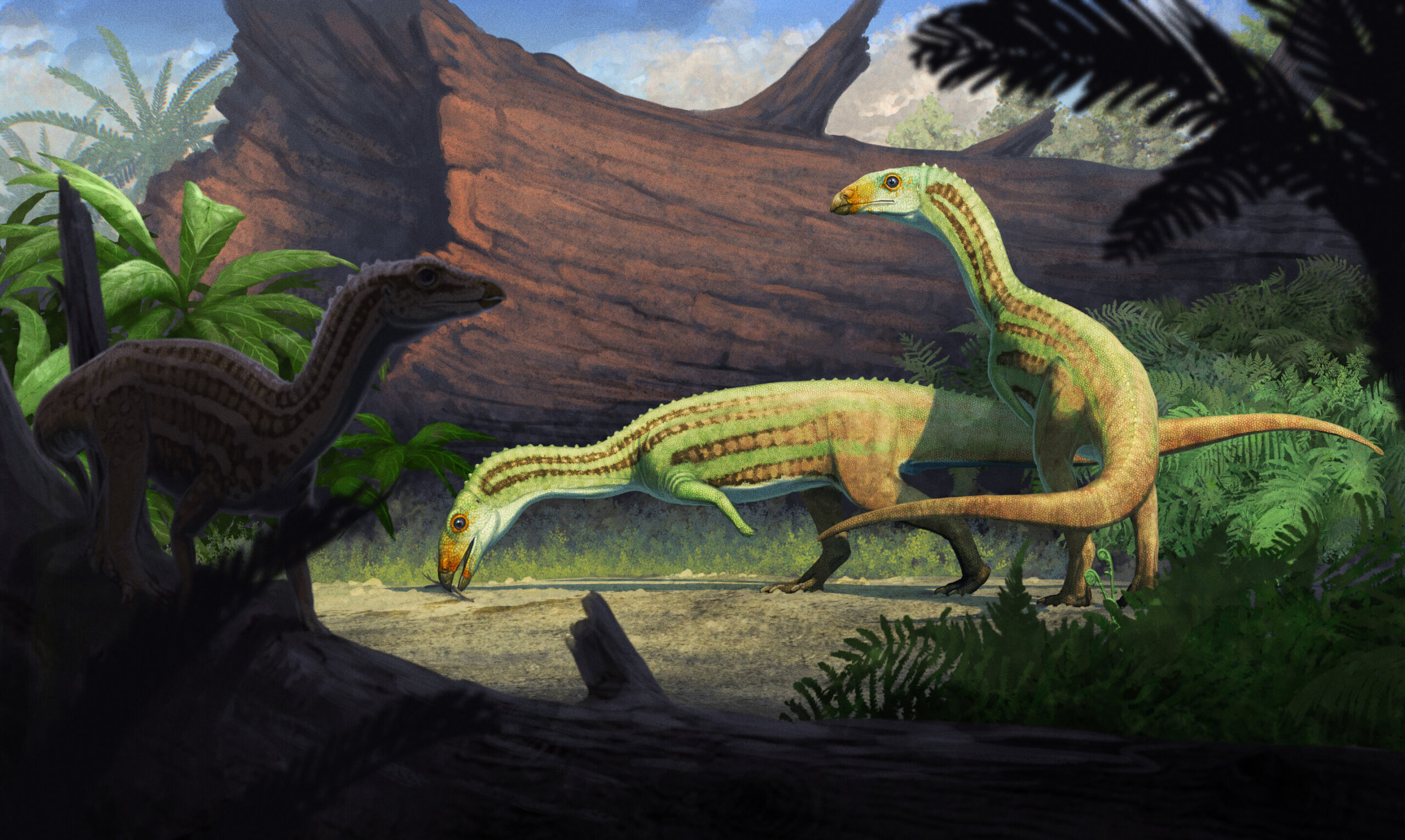
In the heart of this ancient forest, a small reptile known as Sonselasuchus cedrus spent its days navigating the undergrowth. To a casual observer, the adult creature might have looked remarkably like a small dinosaur. It stood about 25 inches tall, roughly the size of a modern-day poodle, and possessed a toothless beak and remarkably large eye sockets. However, despite its bird-like appearance, Sonselasuchus was not a dinosaur at all. It was an ancient relative of the crocodile, belonging to a group known as the shuvosaurids.
What makes this creature truly remarkable, however, is not just its lineage, but the peculiar transformation it underwent as it aged. According to a new study from the University of Washington Department of Biology and the Burke Museum, this animal likely began its life as a quadruped, scurrying through the ferns on four legs, only to rise up and spend its adulthood walking on two.
A Transformation Written in the Bones
The discovery of this “peculiar” walking style came down to a matter of geometry and growth. Lead author Elliott Armour Smith and Professor Christian Sidor spent years meticulously analyzing the limb skeletons of these animals. By comparing the proportions of the bones across different individuals, they noticed a striking trend that defied the typical rules of reptilian development.
The researchers discovered what they call a differential growth pattern. When Sonselasuchus was young, its forelimbs and hindlimbs were more proportional to one another, a physical trait that suggests the juveniles spent their time on all fours. This four-legged stance would have provided stability and perhaps a different method of foraging or escaping predators during their most vulnerable years.
However, as the animal matured, something fascinating happened to its anatomy. The hindlimbs began to grow significantly longer and more robust than the front limbs. By the time it reached adulthood, the shift in its center of gravity and the sheer strength of its back legs meant it had transitioned into a bipedal stance. It had literally grown out of its four-legged childhood and into a two-legged maturity, a transition that Smith describes as particularly unusual in the fossil record.
Echoes of a Parallel Evolution
The physical appearance of Sonselasuchus provides a masterclass in a concept known as convergent evolution. Even though it was on the croc-line of the evolutionary tree, it possessed hollow bones, a toothless beak, and a bipedal gait—features most people associate exclusively with the bird-line archosaurs, specifically the ornithomimid dinosaurs.
These two very different groups of animals lived in the same Late Triassic ecosystems, and because they faced similar environmental pressures, they arrived at nearly identical physical solutions. They were filling the same ecological roles, evolving to be fast, light, and efficient foragers. While the ornithomimid dinosaurs were perfecting the art of the beak and the two-legged sprint, the shuvosaurids like Sonselasuchus were doing the exact same thing on an entirely different branch of the family tree.
The name Sonselasuchus cedrus itself pays homage to the world it inhabited. The “Sonsela” portion refers to the Sonsela Member of the Upper Triassic Chinle Formation, the specific geologic unit where the fossils were found. The species name, cedrus, is a nod to the cedar trees and evergreen conifers that dominated the forests of ancient Arizona, providing the backdrop for this reptile’s strange life cycle.
A Decade of Dust and Discovery
The revelation of this animal’s life story was not the result of a single lucky find, but a decade of grueling fieldwork and patience. The story began in 2014, when Professor Sidor and a team of researchers first began excavating a specific site within the Petrified Forest. What they found was a fossil bonanza.
In the ten years since the dig began, the site has yielded more than 3,000 fossil bones, including 950 Sonselasuchus fossils alone. This massive “bonebed” has acted as a time capsule, preserving a vibrant snapshot of an extinct world. Alongside the remains of Sonselasuchus, the team discovered the fossils of fish, amphibians, and even early dinosaurs.
This project became a massive collaborative effort, involving over 30 University of Washington students and volunteers working alongside the National Park Service. The sheer volume of material allowed the scientists to look at many different individuals at various stages of life, which was the key to unlocking the secret of their changing gait. Without a large sample size of bones to compare, the transition from four legs to two might have remained a hidden chapter of natural history.
Why This Ancient Walker Matters
The study of Sonselasuchus is more than just an investigation into a long-dead reptile; it is a window into the incredible flexibility of life. This research proves that the “dinosaur-like” body plan—featuring bipedalism and hollow bones—was so successful that nature invented it multiple times across different lineages.
By understanding how Sonselasuchus grew, scientists gain a deeper perspective on how animals adapt to their environments over the course of a single lifetime. It reminds us that the path of evolution is rarely a straight line and that the ancestors of today’s crocodiles were once much more diverse, daring, and dynamic than their modern descendants.
As the Sonselasuchus bonebed continues to produce new finds, it serves as a reminder that even in a place as well-studied as the Petrified Forest, there are still profound mysteries buried in the bedrock. The story of the poodle-sized crocodile relative that learned to walk upright is a testament to the surprises that await when we look closely at the proportions of a bone and the history of the earth.
Study Details
Osteology and relationships of a new shuvosaurid (Pseudosuchia, Poposauroidea) from the Upper Triassic Chinle Formation of Petrified Forest National Park, Arizona, U.S.A., Journal of Vertebrate Paleontology (2026). DOI: 10.1080/02724634.2025.2604859