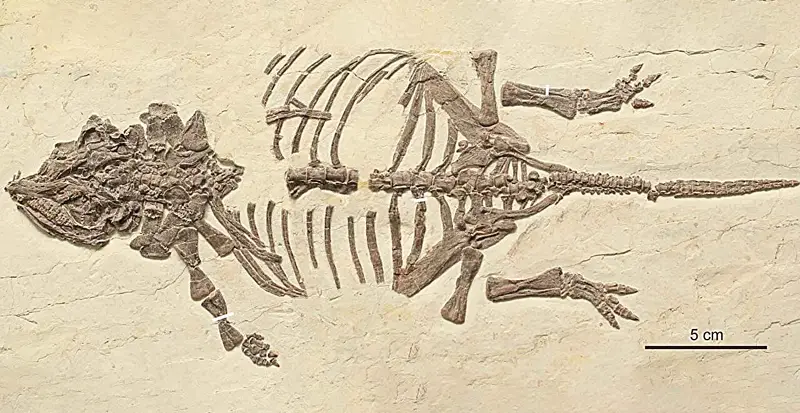
For more than twenty years, a handful of tiny dinosaur fossils quietly unsettled paleontology. They were unmistakably real dinosaurs, complete with hints of armor, yet they were astonishingly small. None of them stretched longer than 40 centimeters, barely the length of a school ruler. Their name, Liaoningosaurus paradoxus, seemed almost prophetic, a paradox fossilized in stone. Were these the remains of a bizarre, miniature species of armored dinosaur, or something even stranger?
When the first specimen was described in 2001, scientists classified it as an ankylosaur, a group of heavily armored plant-eating dinosaurs best known for their tank-like bodies. But ankylosaurs are usually massive animals, commonly reaching three meters or more in length. Liaoningosaurus did not fit the picture. As more fossils were unearthed, all of them similarly tiny, the mystery deepened rather than resolved. No adult-sized individual ever appeared, despite years of searching.
Speculation flourished. Some researchers wondered whether Liaoningosaurus represented the first known example of a dwarf ankylosaur, a fully grown adult that never became large. Others proposed even more radical ideas, including the possibility that these animals lived partly in water. The absence of larger fossils left room for imagination, and the name paradoxus continued to earn its keep.
Now, new research published in the Journal of Vertebrate Paleontology has finally brought clarity. The tiny armored dinosaurs were not miniature adults at all. They were babies.
Following the Clues Hidden Inside Bone
At first glance, body size alone could not solve the mystery. Every known Liaoningosaurus fossil fell within the same small size range, making it difficult to determine whether the animals were young or simply small by nature. To move beyond speculation, researchers turned to the internal structure of the fossils themselves, searching for a biological record of age and growth written deep within the bone.
Bones, like trees, keep time. Within their tissue are growth lines, each one marking a year of life. The spacing between those lines can reveal how quickly an animal grew, while their number can indicate its age at death. This method has become a powerful tool for paleontologists trying to reconstruct the life histories of long-extinct species.
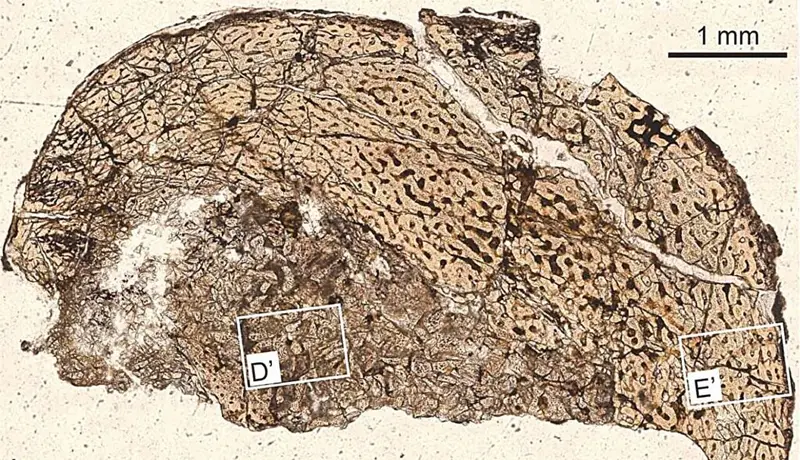
The research team sampled bones from two Liaoningosaurus specimens, deliberately choosing extremes. One was the largest fossil discovered so far, the other among the smallest. If the species truly consisted of miniature adults, these bones should have carried at least some record of years lived.
They did not.
Neither specimen showed any growth lines at all. The absence of these markers suggested that both individuals were less than a year old when they died. In the smaller fossil, the bone microstructure told an even more striking story. Its tissue closely resembled that of other dinosaurs at a very early developmental stage, far earlier than adulthood.
Professor Paul Barrett, one of the study’s co-authors, explains the significance of what they found. “Liaoningosaurus has caused a lot of debate because there is a lot we don’t know about this species and we haven’t managed to identify an adult.
“But our research confirms that these are baby dinosaurs rather than small adults. Fossils of young ankylosaurs are rare, so there is a lot that these remains can tell us about the early development of armored dinosaurs.”
A Dinosaur That Barely Left Its Egg
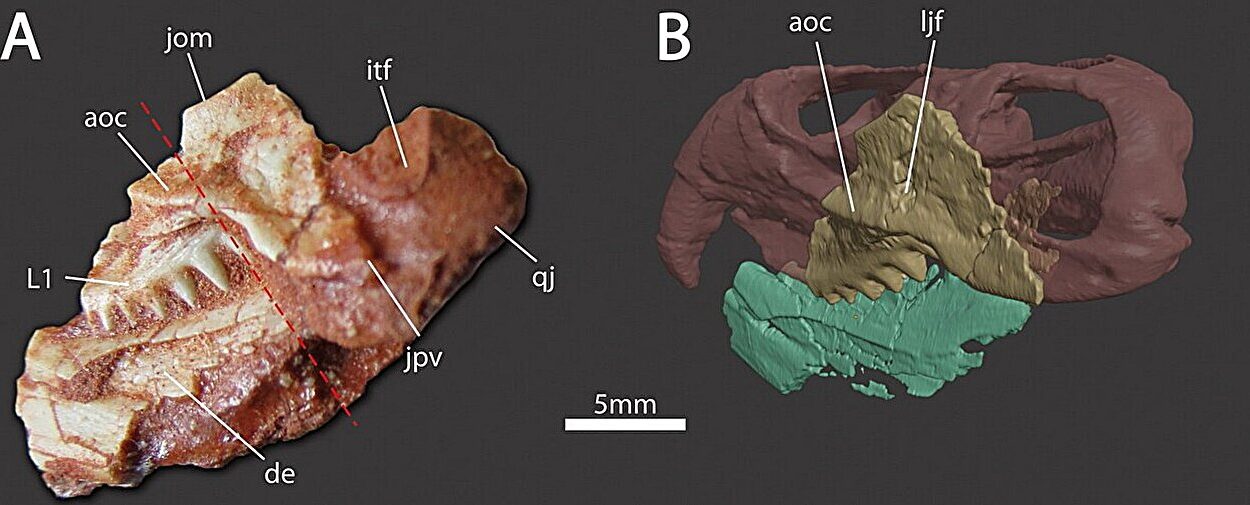
One fossil, in particular, stood out. Within its bone structure, researchers identified a delicate feature known as a hatching line, a small, ring-like mark laid down at the moment an animal emerges from its egg. This feature is fleeting and fragile, and it is rarely preserved over millions of years.
“The smaller fossil showed characteristics that we can see in other newborn dinosaurs, such as the presence of a hatching line,” says Barrett.
“This is a small, ring-like feature in the bone that is laid down at the time the animal hatches from the egg. So, we can say that this individual had very recently hatched at the time of its death, which would make it the first hatchling ankylosaur we’ve ever discovered.”
With that discovery, Liaoningosaurus transformed from a taxonomic oddity into something far more valuable. It became a snapshot of ankylosaur life at its very beginning, offering a glimpse of these armored giants as they first entered the world.
A Landscape That Freezes Time
All known Liaoningosaurus fossils come from Liaoning Province in northeastern China, a region famous for its extraordinary fossil record. During the Cretaceous Period, between 145 and 66 million years ago, this area was home to a rich ecosystem that included feathered dinosaurs such as Microraptor and Sinornithosaurus. The conditions that preserved these creatures were nothing short of exceptional.
The animals likely lived near shallow lakes. When they died, their remains sank to the lake bottom, where fine sediments quickly buried them. Frequent volcanic activity in the region blanketed these lake beds with ash, sealing the fossils in place and protecting them from decay and disturbance. The result is an unusually detailed record of ancient life, preserved with remarkable clarity.
This geological fortune explains how such delicate fossils, including those of newly hatched dinosaurs, could survive long enough to be discovered millions of years later. It also explains why Liaoningosaurus, despite its mystery, has become one of the most informative ankylosaur fossils ever found.
Armor Before Adulthood
Ankylosaurs are famous for their heavy armor, bony plates embedded in the skin that made them living fortresses. Yet fossils of young ankylosaurs are exceedingly rare, and the few that exist often lack this defining feature. This has led some scientists to argue that ankylosaurs developed their armor relatively late in life, perhaps as a response to increasing size and predation risk.
Liaoningosaurus complicates that picture in an intriguing way. Even as babies, these dinosaurs already showed signs of armor. This discovery suggests that the development of protective features began much earlier than previously thought, challenging long-held assumptions about ankylosaur growth.
“As we have found so few fossil babies, Liaoningosaurus is really the only good window we have into what ankylosaurs are like just after they hatch,” says Barrett.
“The Liaoningosaurus fossils had already developed some armor. Now that we know they are babies and not miniature adults, we can say that these kinds of features came in quite early during the animal’s growth.
“But what would give us even bigger insights is if we also found an adult. Then we can find the differences between the adults and babies of the same species and see how these features are developing.”
Why This Discovery Matters
The resolution of the Liaoningosaurus paradox does more than settle a long-standing debate. It reshapes how scientists understand the early lives of one of the most distinctive dinosaur groups ever to walk the Earth. By confirming that these fossils belong to baby ankylosaurs, researchers have gained rare access to a developmental stage that is almost entirely missing from the fossil record.
This discovery shows that ankylosaurs were not born as soft, vulnerable creatures that only later acquired their defenses. Instead, they entered the world already equipped with some degree of armor, suggesting that protection was essential from the very start of their lives. It also demonstrates how misleading appearances can be when fossils are viewed in isolation, and how powerful microscopic evidence can be in revealing biological truth.
Most importantly, Liaoningosaurus reminds us that paleontology is not just about finding the biggest or most spectacular fossils. Sometimes, the smallest bones carry the deepest stories. In this case, a dinosaur no bigger than a newborn puppy has illuminated the earliest moments of a lineage that would later produce some of the most heavily armored animals in Earth’s history.
More information: Wenjie Zheng et al, Bone histology ofLiaoningosaurus paradoxus(Ornithischia: Ankylosauria) from the Lower Cretaceous of Liaoning Province, China, Journal of Vertebrate Paleontology (2025). DOI: 10.1080/02724634.2025.2566325