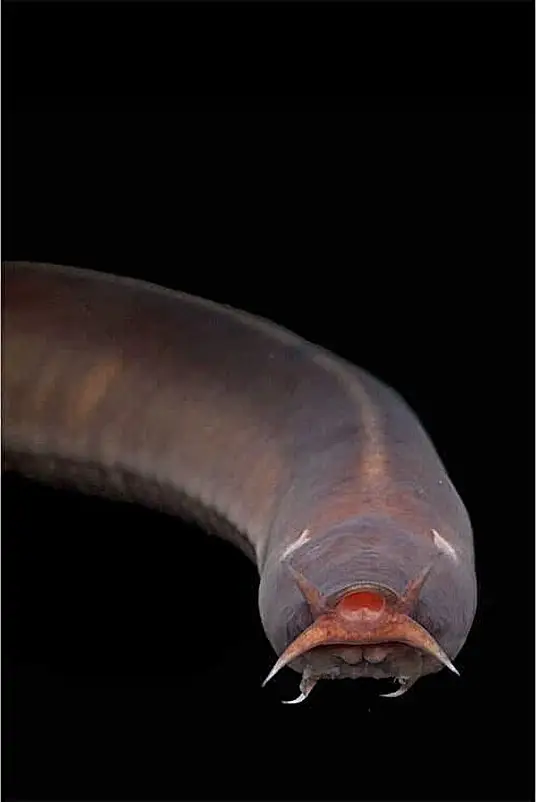
In the cold, dark corners of the ocean lives a creature that seems to have slipped through time. The hagfish, known scientifically as Eptatretus burgeri, looks nothing like the animals most people associate with scientific breakthroughs. It has no jaws. Its body carries many primitive features. At first glance, it might seem like a living relic rather than a source of modern discovery.
And yet, inside this ancient-looking vertebrate, researchers have found something unexpectedly sophisticated: a rich and complex system for sensing the world through smell.
Scientists from the University of Tsukuba and their collaborators have taken a deep dive into the hagfish genome, focusing on the genes that enable olfaction. Their work, published in the journal iScience, reveals that this seemingly simple animal carries an elaborate collection of olfactory receptor genes, challenging long-standing ideas about how the sense of smell evolved in vertebrates.
The findings suggest that the roots of vertebrate olfaction stretch deeper and wider into evolutionary history than scientists once believed.
Following the Trail of Smell
Smell is one of the most fundamental ways animals interact with their environment. It helps them find food, detect danger, and communicate with others of their kind. From humans to fish, this sensory world is made possible by specialized receptor proteins that detect chemical signals and translate them into neural messages.
In vertebrates, four major families of receptors are responsible for this task. These include olfactory receptors, known as ORs, vomeronasal type 1 receptors or V1Rs, vomeronasal type 2 receptors called V2Rs, and trace amine-associated receptors, abbreviated as TAARs. Together, they form a molecular toolkit that allows animals to interpret the chemical landscape around them.
Despite their importance, the evolutionary origins of these receptor families have remained unclear. Scientists have known what these receptors do in living animals, but understanding how and when they first appeared has been much more difficult. The early chapters of vertebrate sensory evolution have largely remained hidden.
That is where the hagfish enters the story.
A Genome Full of Surprises
The researchers turned their attention to the hagfish genome, searching for genes linked to olfactory receptors. What they found was both detailed and surprising.
In total, the team identified 48 genes belonging to the olfactory receptor family. They also found two genes associated with vomeronasal type 1 receptors. But the real surprise came with the discovery of a remarkably large group of vomeronasal type 2 receptor genes. The hagfish genome contained 135 V2R genes.
Even more striking was what the researchers did not find. There were no trace amine-associated receptor genes present at all.
This combination paints a picture of an olfactory system that is both selective and deeply specialized. While some receptor families appear modest in number, others have expanded dramatically within the hagfish lineage.
The pattern hints at a long evolutionary history shaped by adaptation and diversification, rather than a simple, primitive setup frozen in time.
Genes That Are Not Just Silent Passengers
Finding genes in a genome is only part of the story. Genes can exist without being used. To understand whether these olfactory receptor genes actually play a role in the hagfish’s sense of smell, the researchers carried out expression analyses.
The results showed that most of the identified receptor genes were actively expressed in the olfactory organ. This means they are not just remnants of ancient DNA, but working components of the animal’s sensory system.
In other words, the hagfish is not merely carrying these genes as evolutionary baggage. It is using them.
This confirmation strengthens the idea that the hagfish possesses a highly developed olfactory system, despite its otherwise primitive anatomy. Smell, it seems, has been a critical sense for vertebrates since the very beginning.
The Assumption That Did Not Hold
Among the most important findings of the study is the presence of true vomeronasal type 2 receptors in the hagfish. For a long time, scientists believed that V2Rs evolved only in jawed vertebrates, animals that appeared later in evolutionary history.
The hagfish, as a jawless vertebrate, was not expected to have them.
But the genetic evidence tells a different story. The discovery of functional V2Rs in the hagfish overturns this long-standing assumption. It suggests that these receptors did not suddenly appear with jawed vertebrates, but were already present much earlier.
This shift in understanding carries significant implications. It means that the common ancestor of all vertebrates likely already possessed functional V2Rs. Rather than being a later innovation, these receptors appear to be part of the original sensory toolkit from which all vertebrate olfactory systems evolved.
A Broader Beginning Than Anyone Imagined
The study goes further than identifying individual genes. By examining how these receptor families have diversified, the researchers found evidence of substantial lineage-specific expansion.
In the hagfish, certain olfactory receptor gene families have grown in unique ways, reflecting adaptations specific to this lineage. This pattern suggests that the vertebrate common ancestor likely had a broader and more complex olfactory repertoire than previously proposed.
Instead of starting with a small, simple set of receptors that gradually expanded over time, early vertebrates may have already possessed a rich array of sensory tools. Different lineages then took this inherited diversity and shaped it according to their own ecological needs.
The hagfish, in this light, becomes more than a primitive survivor. It becomes a window into the sensory world of early vertebrates.
Why the Hagfish Matters
Hagfish are often overlooked, even dismissed, because of their unusual appearance and ancient traits. But this research highlights their importance as a model organism for reconstructing the biology of early vertebrates.
By studying the hagfish, scientists can glimpse what the sensory systems of the earliest vertebrates might have looked like. The animal’s combination of primitive features and sophisticated olfactory machinery makes it uniquely valuable for this purpose.
The discovery underscores the idea that evolution does not always move from simple to complex in a straight line. Instead, complexity can arise early, persist, and then be reshaped in different ways across millions of years.
Why This Discovery Matters
This research matters because it reshapes our understanding of how one of the most essential senses evolved. Smell is not a minor accessory to life. It is a core interface between organisms and their environment, influencing survival, behavior, and communication.
By showing that functional vomeronasal type 2 receptors were already present in the common ancestor of all vertebrates, the study pushes the origin of complex olfactory systems further back in time. It suggests that early vertebrates were not sensory novices, but creatures equipped with a sophisticated ability to interpret chemical signals.
The findings also remind us that living species with ancient traits are not evolutionary dead ends. They are living archives. Inside their genomes are stories that can rewrite what we think we know about the past.
In uncovering the hidden richness of the hagfish’s sense of smell, this research does more than solve a technical puzzle. It restores depth and complexity to the early chapters of vertebrate evolution and shows that even the most unassuming creatures can carry profound insights about where we come from and how we perceive the world.
More information: Hirofumi Kariyayama et al, Hagfish olfactory repertoire illuminates lineage-specific diversification of olfaction in basal vertebrates, iScience (2025). DOI: 10.1016/j.isci.2025.114118