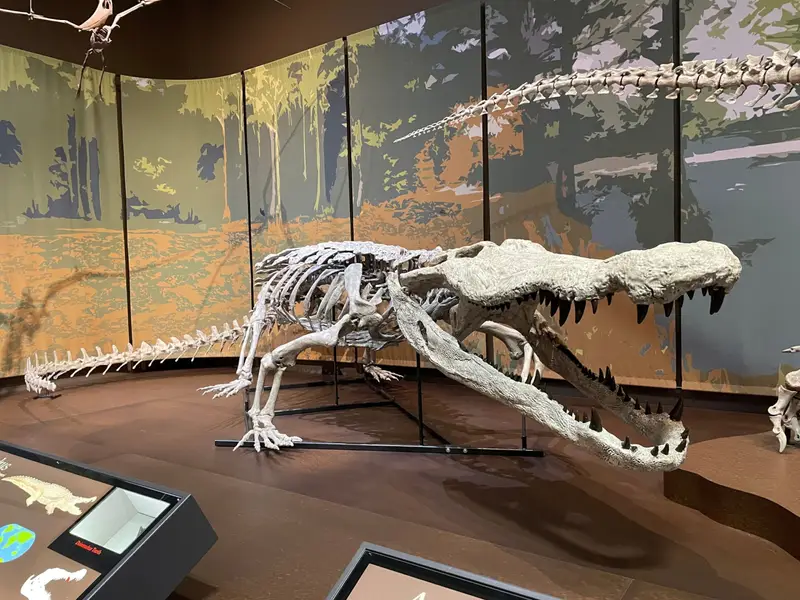
For decades, Deinosuchus lived mostly in fragments. Teeth here, bones there, scattered clues locked inside stone. It was known by reputation as a “dinosaur-killer,” a creature so large and powerful that its very name carried menace. But now, for the first time, Deinosuchus schwimmeri stands whole.
Inside the Tellus Science Museum in Cartersville, Georgia, a school-bus-sized predator from the Late Cretaceous has been given form again. Measuring up to 31 feet long, the mounted skeleton replica does more than loom over visitors. It tells a story that has been unfolding for more than forty years, guided by one paleontologist’s persistence and curiosity.
Dr. David Schwimmer, a Columbus State University geology professor and one of the world’s leading experts on the giant North American crocodilian genus Deinosuchus, has helped bring this ancient apex predator back into view. His research contributed directly to the creation of the first-ever scholarly accurate, mounted skeleton replica of Deinosuchus schwimmeri, a species that once dominated the waterways of what is now the eastern United States between 83 million and 76 million years ago.
The Crocodilian That Ruled Its World
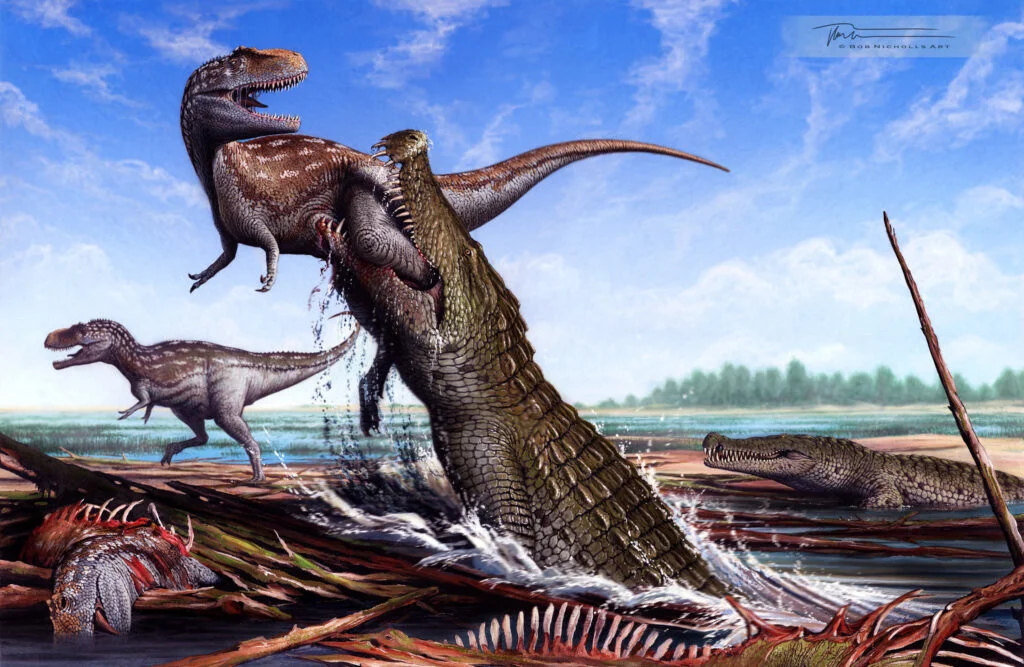
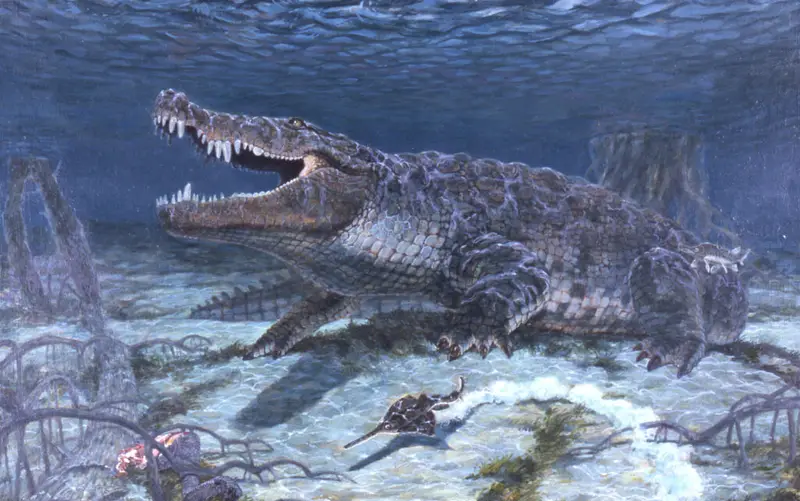
Deinosuchus schwimmeri was not a dinosaur, but it fed on them. A massive relative of modern alligators, it walked and swam through ancient ecosystems as one of the most powerful predators of its time. Known for decades as a “dinosaur-killer,” it was almost certainly the apex predator of its day.
The newly installed prototype at Tellus Science Museum represents a culmination. It brings together fossil evidence, cutting-edge scanning, and decades of scholarly work into a single, towering presence. Commissioned by the museum and developed over two years in consultation with Triebold Paleontology Inc., the replica reflects a careful reassembly of the creature’s skeletal structure and dermal armor.
For visitors, the experience is immediate and visceral. Numbers can describe size, but they struggle to convey scale in the way a life-sized form can. As Rebecca Melsheimer, the museum’s curatorial coordinator, explained, “Tellus is currently the only museum to have a cast of Deinosuchus schwimmeri, so this is an experience our visitors can’t get anywhere else. The scale of the dinosaurs and other creatures that lived during [the Late Cretaceous epoch] is hard to capture in words or pictures. We can tell you that Deinosuchus is 30 feet long, but seeing it is far more impactful.”
A Museum Becomes a Window Into Ancient Georgia
The arrival of Deinosuchus schwimmeri at Tellus is not just about spectacle. It is about place. The creature once roamed ecosystems that existed where modern Georgia now stands, and the museum sees the replica as a bridge between visitors and their own deep past.
“Each year, we have thousands of students visit us from across Georgia and neighboring states,” said Hannah Eisla, the museum’s director of education. “Many of these students come on school field trips specifically to learn more about the region they call home and how it has changed over time. The addition of Deinosuchus schwimmeri allows us to provide a more detailed picture of this area’s ecosystem in the Cretaceous Period.”
For young visitors especially, the mounted skeleton transforms abstract time into something tangible. The Late Cretaceous is no longer just a label in a textbook. It becomes a living environment, filled with immense predators and complex ecological relationships.
A Name Earned Through Decades of Patience
The species Deinosuchus schwimmeri was formally classified and named in 2020, honoring the very scientist who helped reveal its story. A group of paleontologists named the “terror croc” after Schwimmer, recognizing his lifelong dedication to studying its fossils and environment.
In their article published by the Journal of Vertebrate Paleontology in July 2020, they wrote that naming it after Schwimmer honored “his tireless work on the Late Cretaceous paleontology of the Southeast and Eastern Seaboard, U.S..”
That recognition came after years of meticulous fossil study, journal publications, conference presentations, and Schwimmer’s 2002 book on the giant North American Cretaceous crocodilian genus. For more than forty years, he has searched for and excavated fossil evidence of Deinosuchus schwimmeri, carefully piecing together its anatomy and behavior from scattered remains.
The fossils Schwimmer recovered are now permanently preserved by major national institutions, including the Smithsonian Institution in Washington, D.C., the American Museum of Natural History in New York, and the Tellus Science Museum itself.
From a Childhood Museum Visit to a Life’s Work
Schwimmer’s connection to Deinosuchus began long before the species bore his name. He grew up in New York City just ten blocks from the American Museum of Natural History. There, a terrifying skull display captured his imagination and planted a seed that would grow into a lifelong pursuit.
In 1979, a year after joining Columbus State, Schwimmer found his first Deinosuchus fossil remains. From that moment on, his research focused on reconstructing not just the creature, but the world it inhabited. Over time, this work made him a worldwide expert on life in the Late Cretaceous epoch in the Southeast United States.
His research, dating back to the 1980s, led to discoveries of several notable “firsts” in Georgia, including flying reptiles, the first dinosaurs, and the first Deinosuchus identified in the region. Each find added context, turning isolated fossils into chapters of a broader story about ancient ecosystems.
Turning Stone Into a Living Blueprint
Creating a life-sized, scientifically accurate fossil replica is a process that demands patience and precision. Schwimmer described it as far more than assembling bones for visual impact. The two-year project required Triebold Paleontology’s team to capture high-resolution 3D scans of Deinosuchus fossil records. These scans allowed them to carefully rearticulate the creature’s skeleton and dermal armor in a way that reflects current scientific understanding.
For Schwimmer, the value of such replicas goes beyond display. “These replicas are more than just creating a ‘scare factor,'” he explained. “Understanding dinosaurs’ predatory habits helps us decode some of nature’s greatest survival strategies. By studying these ancient apex predators, we are essentially looking back in time to see exactly how life adapted and dominated a changing world.”
In this sense, the replica becomes a research tool as much as an educational one. It provides a full-body perspective that individual fossils cannot, helping paleontologists refine their interpretations of how Deinosuchus moved, hunted, and interacted with its environment.
Writing, Teaching, and Sharing the Crocodilian King
Schwimmer’s work has reached far beyond excavation sites. Once a science writer for ocean explorer Jacques-Yves Cousteau, he brought the same storytelling instinct to paleontology. His 2002 book, “King of the Crocodylians: The Paleobiology of Deinosuchus,” detailed the first two decades of his research and helped shape public and academic understanding of the species.
The book became an Amazon top-seller in its category for several weeks and was selected by science-oriented reading clubs, expanding the reach of Deinosuchus research beyond academic journals. Schwimmer is currently updating the book, continuing to refine the story as new discoveries emerge.
His expertise has since been sought by institutions such as Atlanta’s Fernbank Museum of Natural History, the University of Texas’ Vertebrate Paleontology Laboratory, and the Tellus Science Museum, all of which have relied on his insights to interpret fossil collections and build educational displays.
Students in the Field, History in Their Hands
Schwimmer’s influence is also felt through his students. He has long emphasized that fields like paleontology offer unique opportunities for hands-on research, especially at regional universities. Local geology becomes a living laboratory.
In 2010, two studies linked to Deinosuchus drew international attention. One focused on dinosaur-bone bite marks, while the other examined fossilized dung, known as coprolites. The latter study was conducted by undergraduate environmental science and geology major Samantha (Harrell) Stanford under Schwimmer’s supervision.
Both studies were published in the special symposium volume of the “New Mexico Museum of Natural History and Science Bulletin” and presented at the March 2010 Geological Society of America Northeastern-Southeastern Annual Meeting. Harrell was cited as contributing to both works.
Reflecting on that collaboration, Schwimmer said, “[Harrell] came out in the field and collected fossils with me. At most universities, undergraduates rarely collaborate on or publish peer-reviewed research. Institutions of our size provide undergraduate students like Samantha with greater one-on-one access to faculty mentors and field-based research opportunities like this that, while local, are still quite impactful on the field.”
A Landscape Rich With Ancient Clues
The southeastern United States, particularly around Columbus, Georgia, has proven to be fertile ground for Deinosuchus discoveries. With several known sites within 40 miles of the city, Schwimmer and his students have spent decades exploring a landscape layered with ancient life.
That proximity is one reason Schwimmer sees the Tellus Science Museum as a fitting home for the Deinosuchus schwimmeri replica. The creature once thrived in ecosystems that existed right where modern visitors now stand, creating a powerful connection between past and present.
Why This Giant Still Matters
In the end, the towering skeleton at Tellus is not just about size or fear. It is about understanding life as it once was and how it responded to change. Fossils, Schwimmer reminds us, are incomplete storytellers on their own.
“Bones and fossils tell us only part of the story,” he said. “Fully assembled, life-size replicas become a blueprint for better understanding the dynamic animals that creatures like Deinosuchus really were.”
This research matters because it transforms fragments into meaning. It shows how ancient predators shaped their environments and how ecosystems functioned long before humans appeared. It brings deep time into the present, allowing students, researchers, and families to stand face-to-face with a creature that once ruled its world.
Through decades of dedication, collaboration, and careful reconstruction, Deinosuchus schwimmeri has stepped out of stone and into view, reminding us that the past is not gone. It is waiting to be understood.