Beneath the rolling hills of southern China, locked within layers of ancient sediment, lay a secret that has eluded scientists for generations. It is a story of beginnings—not just of the shimmering schools of fish that populate our oceans today, but of the very lineage that eventually walked out of the water and became us. For decades, the “missing link” in the history of bony fishes, or osteichthyans, remained a ghost in the fossil record. While the world was familiar with the highly specialized creatures of the Devonian period, the earlier ancestors that stood at the crossroads of evolution were nowhere to be found.
That silence was finally broken by a research team led by Professors Zhu Min, Lu Jing, and Zhu You’an from the Institute of Vertebrate Paleontology and Paleoanthropology (IVPP). Their journey, spanning more than a decade of meticulous fieldwork and advanced laboratory analysis, has culminated in the discovery of the oldest known bony fish fossils. These specimens do more than just fill a gap in a museum shelf; they redraw the map of how jawed vertebrates conquered the planet.
A Tiny Traveler from the Deep Past
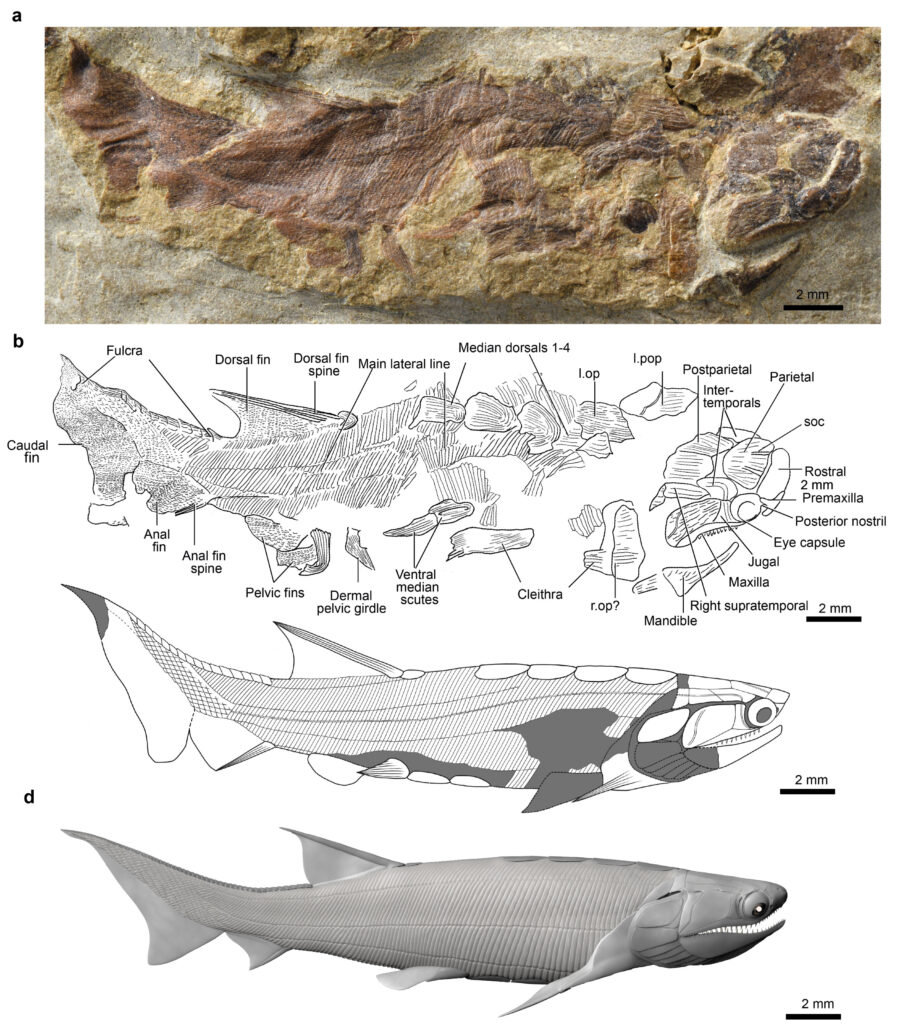
The story begins in the Early Silurian deposits of Xiushan, Chongqing, approximately 436 million years ago. Here, researchers unearthed a creature that seems humble at first glance, measuring a mere 3 centimeters in length. They named it Eosteus chongqingensis. Despite its diminutive stature, this fossil is a titan of scientific importance. It is the oldest complete bony fish fossil ever discovered globally, predating even the microscopic scales and bone fragments that researchers previously relied on to guess at this era of life.
What makes Eosteus so remarkable is its “mosaic” of features. It represents a biological transition caught in the act. To the naked eye, its streamlined body and single dorsal fin look strikingly like a modern fish. It even possesses specialized scales known as caudal fulcra, a trait typically seen in ray-finned fishes, the group that includes over 30,000 species today, from goldfish to tuna.
However, Eosteus also carries the baggage of its ancestors. It lacks lepidotrichia, the bony fin rays that define modern bony fishes, and it sports an anal fin spine—a feature previously thought to belong only to cartilaginous fishes like sharks or the extinct armored placoderms. This tiny pioneer proves that the core characteristics we associate with bony fishes today actually began to assemble much earlier than anyone assumed, showing up in a miniature package long before the “Age of Fish” truly began.
The Giant that Ruled the Silurian Seas
While Eosteus tells a story of origins through its small, complete frame, another discovery from the Late Silurian of Qujing, Yunnan, speaks to the power and diversity of these early pioneers. Roughly 423 million years ago, a predator roamed the waters of what is now South China that would have dwarfed almost everything else alive. This was Megamastax amblyodus, the largest known Silurian vertebrate.
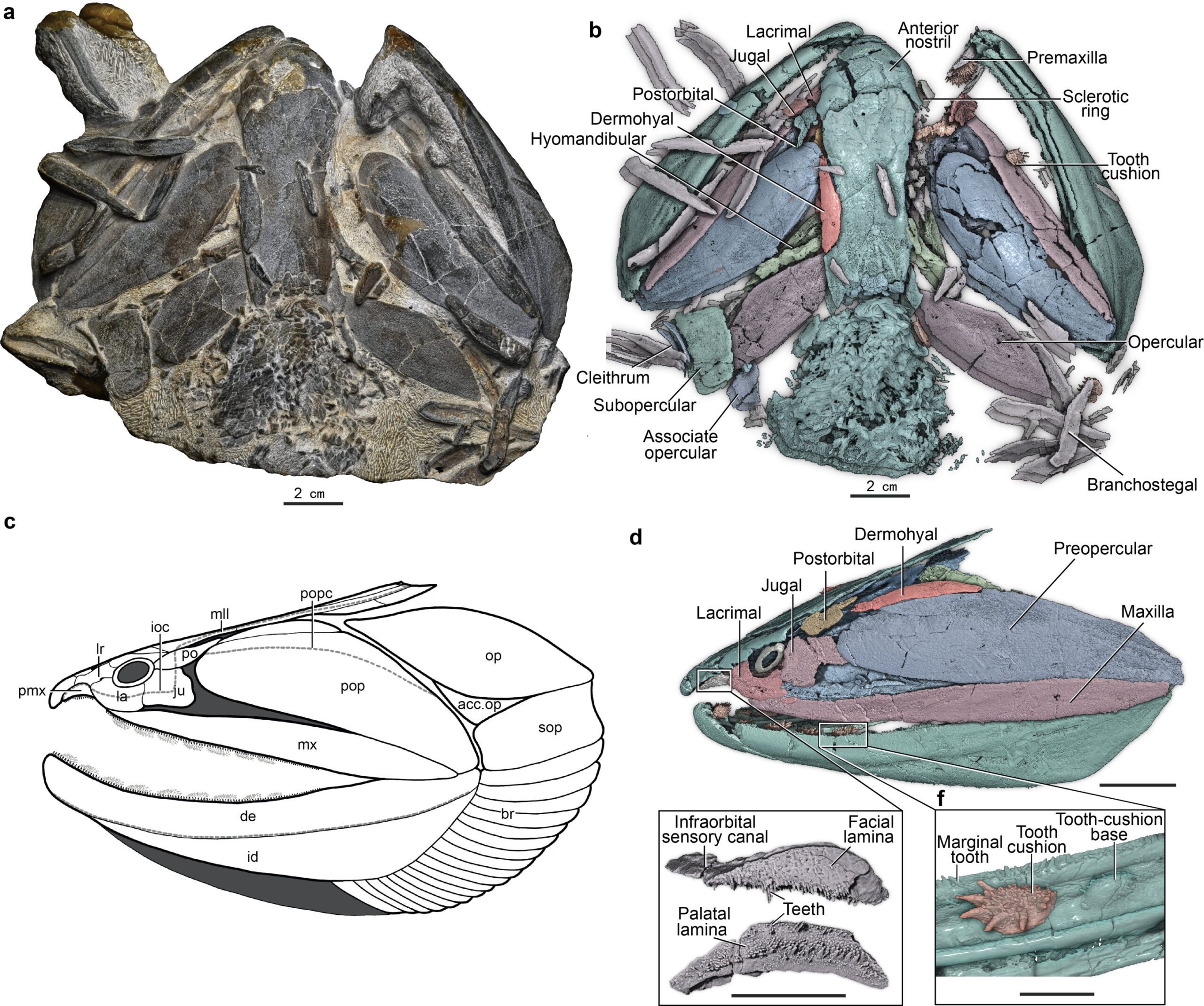
Growing to over 1 meter in length, Megamastax was the undisputed heavyweight of its time. For years, parts of this creature remained a puzzle. Scientists had found isolated tooth cushions in the Baltic region but could never quite figure out where they belonged on the tree of life. The IVPP team, after dozens of attempts and a decade of persistence, used high-resolution computed tomography (HRCT) and 3D computer reconstruction to peer inside the rock and rebuild the giant’s head.
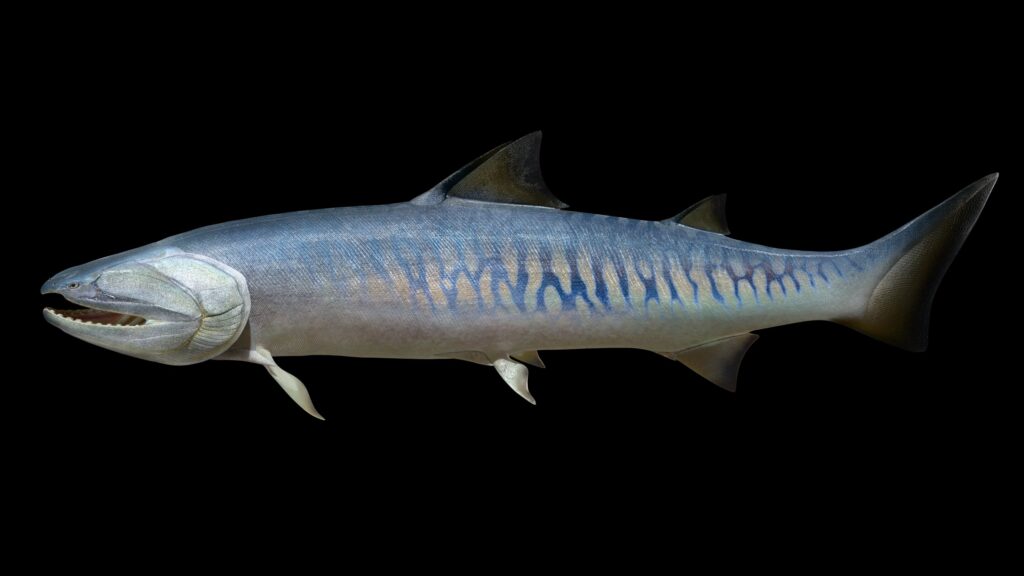
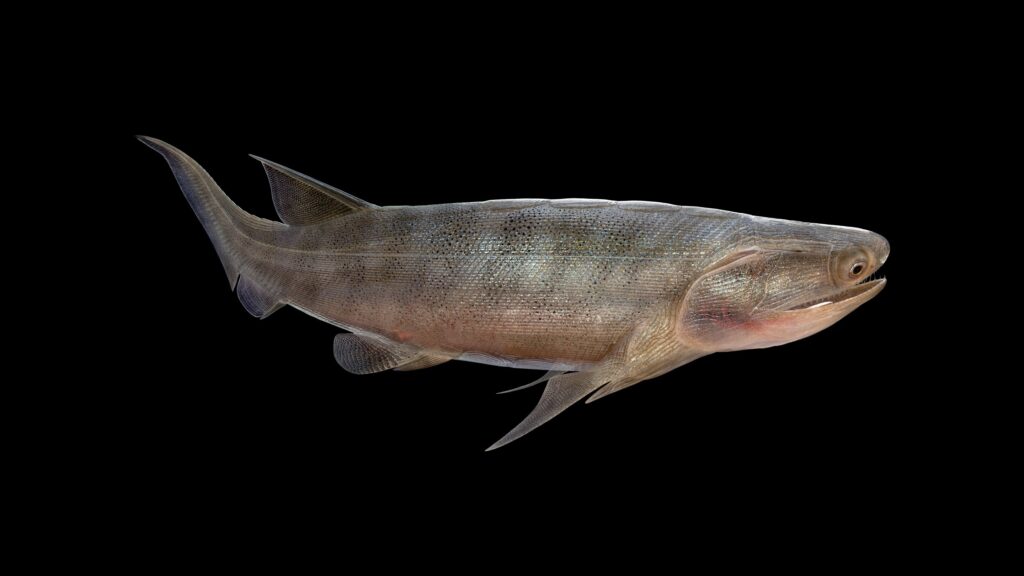
The digital resurrection revealed a complex cranial anatomy and a unique dentition. Megamastax possessed both inner and outer dental arcades. Its inner row of teeth sat atop blunt bases, forming tooth cushions. This discovery solved a half-century-old debate, proving that these strange tooth structures were actually a primitive condition for bony fishes. By seeing the full “instruction manual” for the Megamastax skull, the researchers finally placed those mysterious Baltic fossils into their rightful taxonomic home.
The Crossroads of the Vertebrate Tree
To understand why these two fishes matter, one must look at the massive “trunk” of the vertebrate tree of life. Bony fishes eventually split into two great lineages: the ray-finned fishes and the lobe-finned fishes. The ray-finned group stayed in the water and diversified into the staggering variety of fish we see today. The lobe-finned group took a different path; during the Devonian period, one branch of this family developed limbs and moved onto land, eventually giving rise to all tetrapods—including humans.
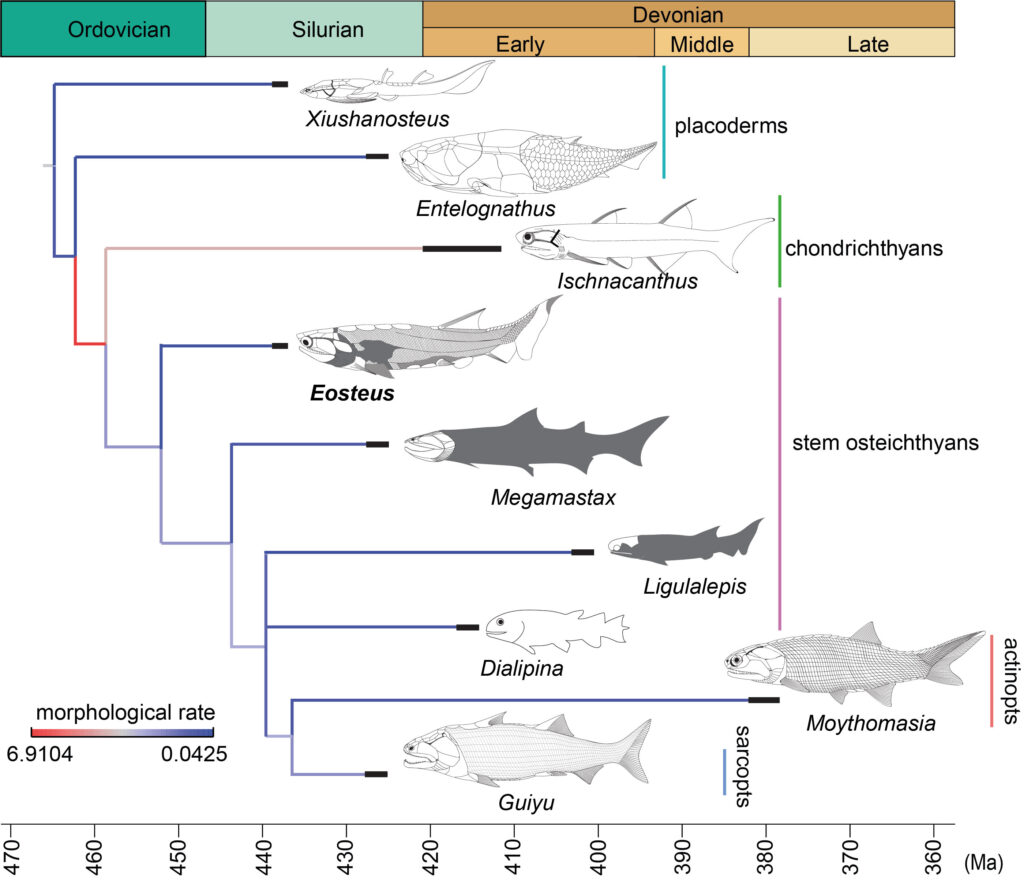
Until now, the “stem” of this tree—the part before the big split—was a mystery. Most fossils found were already clearly one or the other. Eosteus and Megamastax change that. Phylogenetic analyses place both of these taxa within the bony fish stem group. They represent the ancestral state of all modern bony fishes before the great divergence.
By studying these “stem” species, the team has refuted the long-held hypothesis that the very first bony fishes looked more like lobe-finned fishes. Instead, they discovered a more complex evolutionary trajectory for jaws and teeth. These fossils provide the first clear look at the last common ancestor of almost every familiar vertebrate, revealing the blueprint that would eventually lead to the evolution of the human frame.
Why This Ancient Journey Matters to Us
The discovery of Eosteus and Megamastax is more than a triumph of paleontology; it is a profound clarification of our own history. These findings solidify South China as the “cradle” of evolution for jawed vertebrates. It was here, in these ancient Silurian waters, that the fundamental building blocks of the human body—our jaws, our teeth, and our braincases—first began to take their modern shape.
By filling the major gap in the “from fish to human” narrative, this research provides the missing chapters of a story that is over 400 million years old. It reminds us that the complex structures of our own bodies are not random accidents, but the result of a long, traceable lineage of survival and adaptation. These ancient fishes, one no larger than a thumb and the other a meter-long hunter, are the distant grandfathers of every creature that swims, crawls, or walks on Earth today. Through their fossilized remains, we finally have a clear window into the moment our ancestors first began to stand out from the rest of life in the sea.
Study Details
Min Zhu, The oldest articulated bony fish from the early Silurian period, Nature (2026). DOI: 10.1038/s41586-026-10125-2. www.nature.com/articles/s41586-026-10125-2
Lu, J., Choo, B., Zhao, W. et al. Largest Silurian fish illuminates the origin of osteichthyan characters. Nature(2026). doi.org/10.1038/s41586-025-10008-y