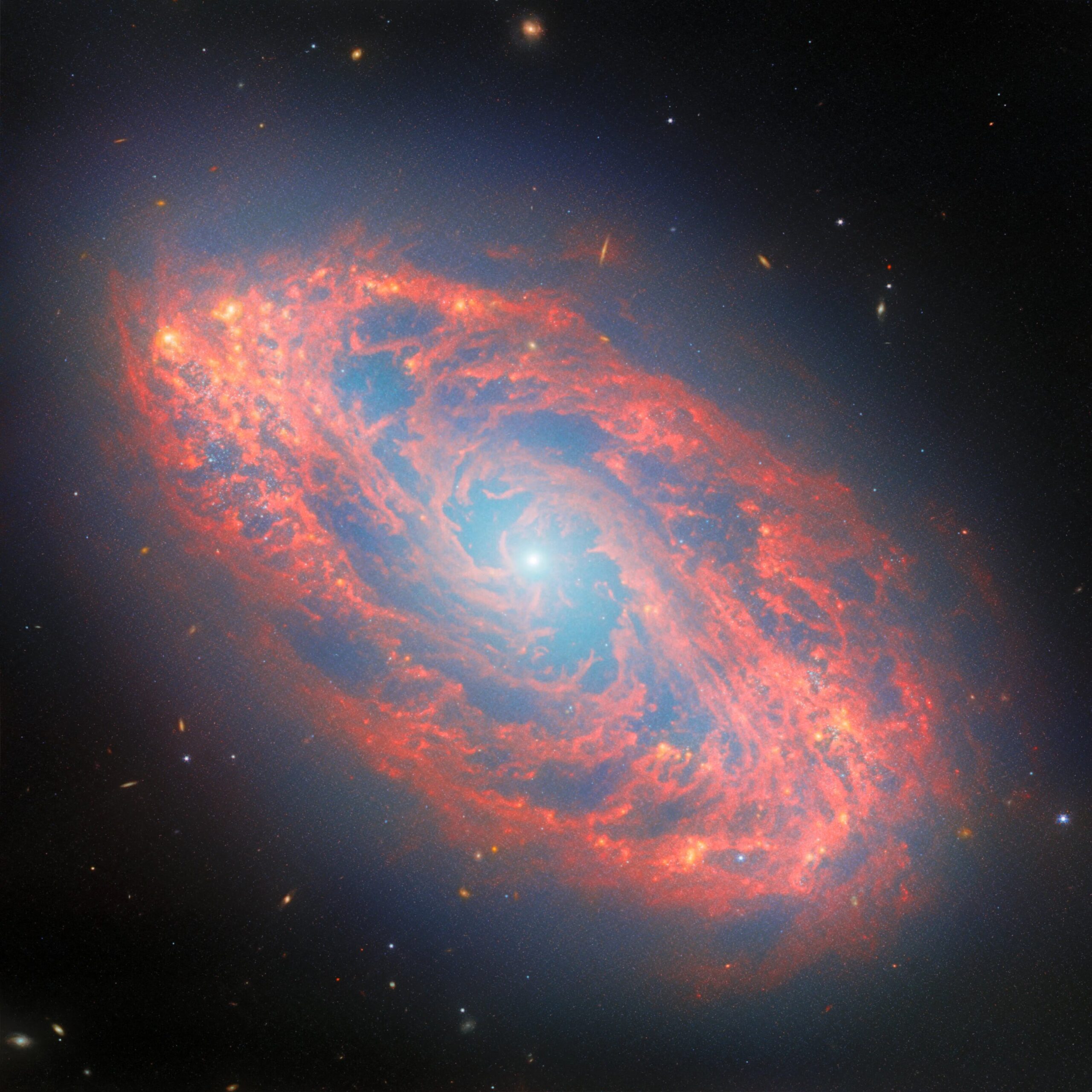
Across the vast, silent stretches of the cosmos, a message has been traveling toward Earth for sixty-five million years. The light that recently touched the gold-plated mirrors of the James Webb Space Telescope began its journey at a momentous time in our own history—just as the reign of the Tyrannosaurus rex was coming to a violent end. While that light traversed the void, empires rose and fell, and the very face of our planet shifted. Now, that ancient radiation has been captured, revealing the stunning, tightly wound anatomy of a spiral galaxy known as NGC 5134.
Located in the constellation Virgo, this galaxy is considered a close neighbor in the grand scheme of the universe, despite its distance of 65 million light-years. Because it is relatively nearby, the telescope can peer into its heart with unprecedented clarity, peeling back layers of cosmic history to reveal the fundamental machinery that keeps a galaxy alive. To understand how NGC 5134 breathes and grows, two of Webb’s most powerful instruments worked in tandem, each seeing a different side of the same story.
The Invisible Glow of Interstellar Dust
The first part of the story is told by the Mid-InfraRed Instrument, or MIRI. While our eyes see stars as the primary features of a galaxy, MIRI looks for the warm, glowing material that exists in the spaces between them. It detects the mid-infrared light emitted by interstellar clouds, tracing the intricate clumps and delicate strands of dusty gas that weave through the galaxy’s spiral arms. This dust is far more than mere space soot; it is a complex chemical laboratory.
Deep within these clouds, MIRI has identified the signatures of polycyclic aromatic hydrocarbons. These are complex organic molecules made of interconnected rings of carbon atoms. For astronomers, these molecules are like fingerprints that reveal the chemical evolution taking place within the dark reaches of the galaxy. By mapping where these molecules congregate, scientists can see the raw materials that will eventually become the building blocks of future worlds.
While MIRI focuses on the cold and the chemical, the Near-InfraRed Camera, known as NIRCam, focuses on the heat of creation. NIRCam records shorter-wavelength near-infrared light, which originates primarily from the burning hearts of stars and the dense star clusters that pepper the spiral arms like brilliant jewels. Together, these two perspectives create a comprehensive portrait of a galaxy in a state of constant, rhythmic change.
A Grand Cycle of Life and Destruction
The images of NGC 5134 reveal a galaxy defined by a perpetual ebb and flow. It is a world of “give and take,” where the birth of a star is both a beginning and a consumption of resources. The massive gas clouds billowing along the spiral arms are the nurseries of the cosmos. As gravity pulls this gas together to ignite new suns, each successful birth chips away at the galaxy’s finite supply of star-forming gas. If this were a one-way street, the galaxy would eventually run out of fuel and fade into darkness. However, the universe has a way of recycling its treasures.
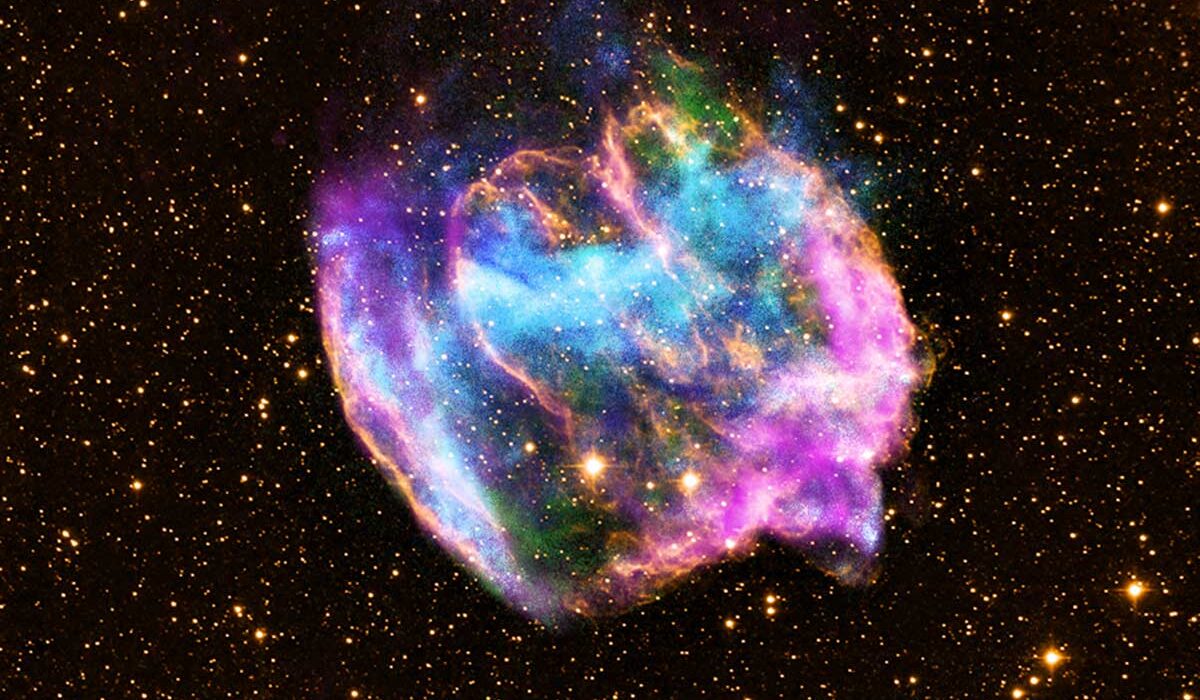
The death of a star is just as important as its birth. When stars reach the end of their lives, they return their heavy elements and gases back into the interstellar medium. This process happens in two distinct ways, depending on the mass of the star. The most dramatic contributors are massive stars, those with more than eight times the mass of the sun. These giants do not go quietly; they end their lives in cataclysmic supernova explosions. These blasts are so powerful that they scatter stellar material across hundreds of light-years, enriching the surrounding space with the elements forged in their cores.
Medium-sized stars, including those similar to our own sun, follow a gentler path of reincarnation. Instead of exploding, they balloon into massive, bubbling red giants. In their final acts, they softly shrug off their outer atmospheres, sending waves of gas drifting into the void. Whether through the violence of a supernova or the slow exhale of a red giant, this recycled material eventually finds its way back into new gas clouds, where it is incorporated into the next generation of stars.
Lessons From a Nearby Neighbor
The study of NGC 5134 is part of a much larger scientific endeavor. Astronomers are currently using the James Webb Space Telescope to observe 55 galaxies in our nearby neighborhood. Each of these targets is actively forming new stars and has been previously studied across various wavelengths of light. By adding Webb’s high-resolution infrared data to the mix, researchers are gaining a profound understanding of the life cycle of tiny dust grains and the specific shape and properties of star-forming clouds.
This research is pulling back the curtain on the invisible links between interstellar gas and dust. It allows scientists to witness the exact process by which newly formed stars begin to push, pull, and reshape the very environment that created them. By observing these “local” examples in such high definition, astronomers are building a toolkit of knowledge. They can see the individual clusters and the fine structure of the gas in NGC 5134 in a way that is impossible for more distant objects.
Why This Cosmic Portrait Matters
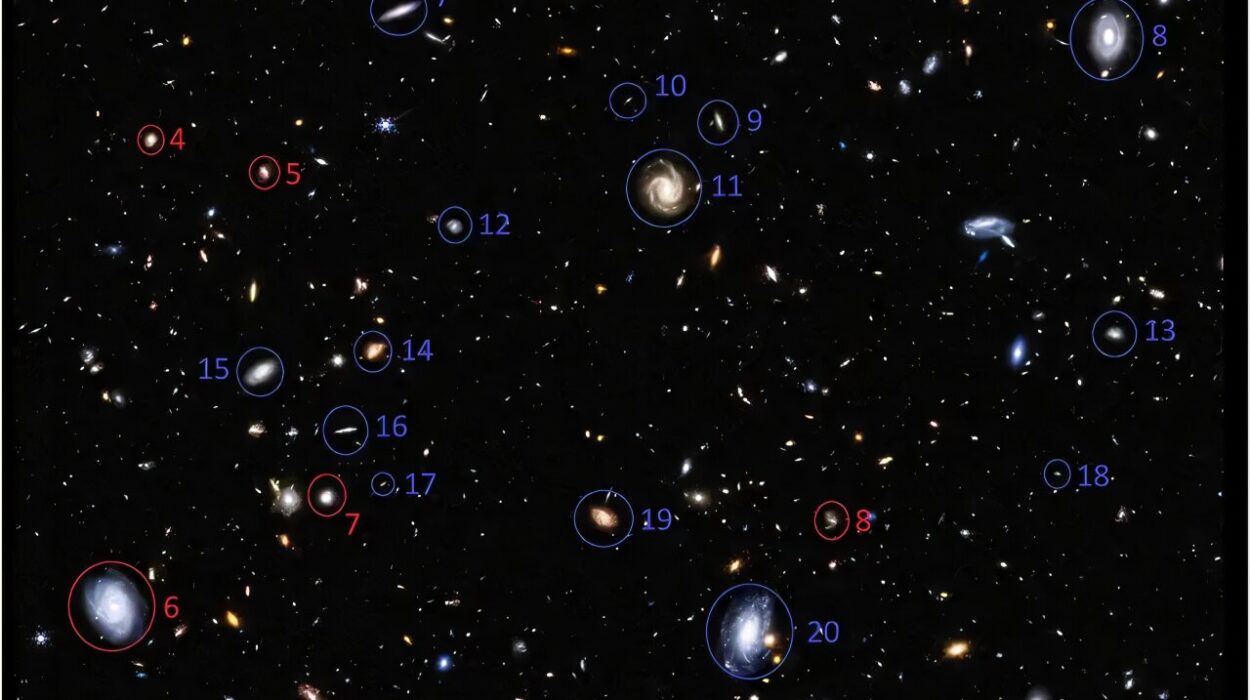
This research matters because it provides the “Rosetta Stone” for understanding the rest of the universe. In the background of the images of NGC 5134, there are countless other galaxies visible—some appearing as nothing more than tiny, faint points of light. These background galaxies are too far away for us to see their individual stars or the delicate filaments of their dust clouds. They remain mysterious and out of reach for detailed structural analysis.
However, by mastering the physics and chemistry of a nearby galaxy like NGC 5134, astronomers can apply what they learn to the farthest reaches of space. The lessons learned about how stars are born, how they die, and how they recycle their material in our local neighborhood can be used to interpret the light from those distant, blurry specks. Ultimately, studying this one spiral galaxy helps us understand the fundamental laws of star formation and galactic evolution that govern every corner of the observable universe. We are looking at a neighbor to learn the story of the entire cosmos.