Most stars are creatures of habit. They circle the galaxy calmly, drifting along with their neighbors in a slow, predictable dance. But every so often, astronomers spot a rebel: a runaway star tearing through space at astonishing speed, as if flung from some unseen slingshot. For decades, scientists have wondered what could possibly give a massive star such a violent shove.
Now, a new study has brought that long-standing mystery into sharper focus. By piecing together careful observations and detailed stellar models, astronomers have found compelling evidence that one such runaway star, HD 254577, was hurled into space when its stellar partner exploded in a catastrophic supernova. The blast didn’t just tear the pair apart. It may have left behind a glowing cosmic wreckage known today as the Jellyfish nebula.
This research, led by Baha Dinçel at the University of Jena and published in Astronomy & Astrophysics, adds rare weight to a theory first proposed more than sixty years ago. It tells a dramatic story of companionship, destruction, and survival written across tens of thousands of years of cosmic motion.
When Gravity Alone Is Not Enough
Runaway stars are not entirely new to astronomy. Many have been traced back to crowded star clusters, where close encounters with heavier neighbors can gravitationally kick a star outward. This explanation works well for smaller stars, but it falters when applied to the most massive ones.
Massive stars are heavy, stubborn objects. Pushing them to speeds of tens to hundreds of kilometers per second requires extraordinary force. Simple gravitational scuffles rarely provide enough energy. This mismatch has long hinted that something far more violent might be responsible.
In 1961, Dutch astronomer Adriaan Blaauw proposed an alternative idea that was radical for its time. He suggested that massive runaway stars were once locked in close binary systems, orbiting a companion of similar heft. When one of those stars reached the end of its life and collapsed in a supernova, the sudden loss of mass would shatter the delicate gravitational balance. The surviving star would be released instantly, flung outward at its former orbital speed, now free but forever marked by the explosion.
It was an elegant solution. The problem was proof.
A Theory Waiting for Evidence
For decades, Blaauw’s idea lingered in textbooks and discussions, supported more by logic than observation. Astronomers struggled to find clear examples of runaway stars still connected to the remnants of the explosions that launched them.
There was one exception. HD 37424, a star with 12 to 13 solar masses, sits inside the supernova remnant S147 and is widely regarded as the only high-confidence example of a binary–supernova runaway system. One star was not enough to turn a theory into a statistical reality.
Dinçel and his colleagues wanted more. Their goal was to build a meaningful sample of such systems, stars whose violent pasts could still be read in their surroundings. To do that, they needed to find runaway stars that had not yet escaped far from the debris of their birth catastrophe.
Following the Clues Written in Starlight
The search began by weaving together several independent lines of evidence. One of the most powerful tools came from the Gaia observatory, operated by the European Space Agency. Gaia’s precise astrometry allows astronomers to measure a star’s position and motion against the distant background of the galaxy with unprecedented accuracy.
But motion alone is not enough to tell a star’s life story. The team also turned to spectroscopic data, which reveals a star’s temperature, chemical composition, and evolutionary stage. These details can hint at whether a star once lived in close company with another massive star, sharing a common origin and timeline.
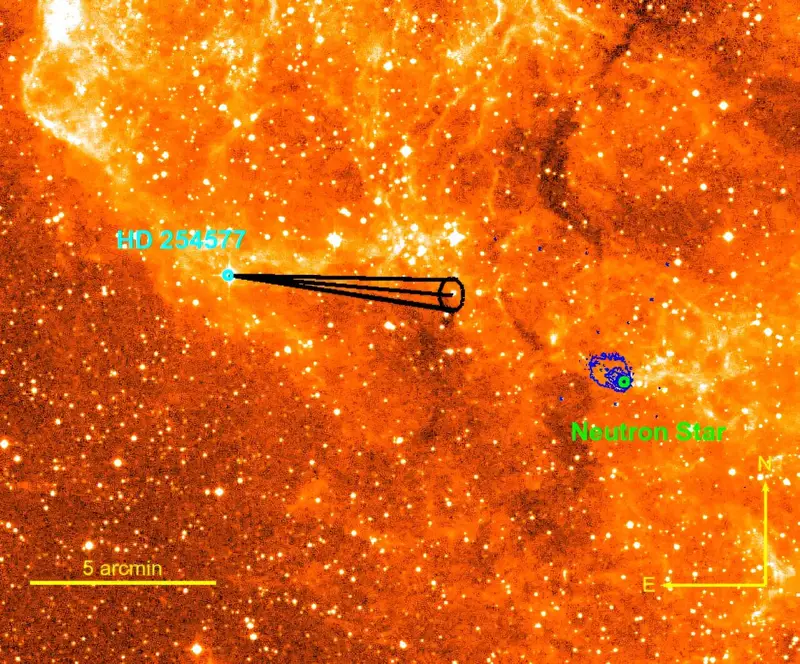
Among the candidates they studied, HD 254577 stood out. It is a massive, highly evolved star, and crucially, it is no longer part of a binary system. That absence is telling. Stars like this are expected to form in pairs. Finding one alone suggests that something dramatic intervened.
The pieces were starting to align with Blaauw’s vision.
Rewinding a Stellar Escape
To strengthen the case, the team needed to show that HD 254577 was not just unusual, but truly a runaway. Using stellar modeling techniques, they reconstructed its past motion through space, effectively rewinding its trajectory.
By comparing its kinematics with those of neighboring stars, the researchers demonstrated with far greater confidence than before that HD 254577 had been violently ejected rather than gently drifting away. Its speed and direction were inconsistent with normal stellar motion, but perfectly consistent with a sudden release from a tight gravitational bond.
The timeline that emerged was equally striking. The ejection likely occurred between 10,000 and 30,000 years ago, a blink of an eye in cosmic terms. Somewhere in that window, a companion star met a fiery end.
A Ghostly Companion in the Jellyfish
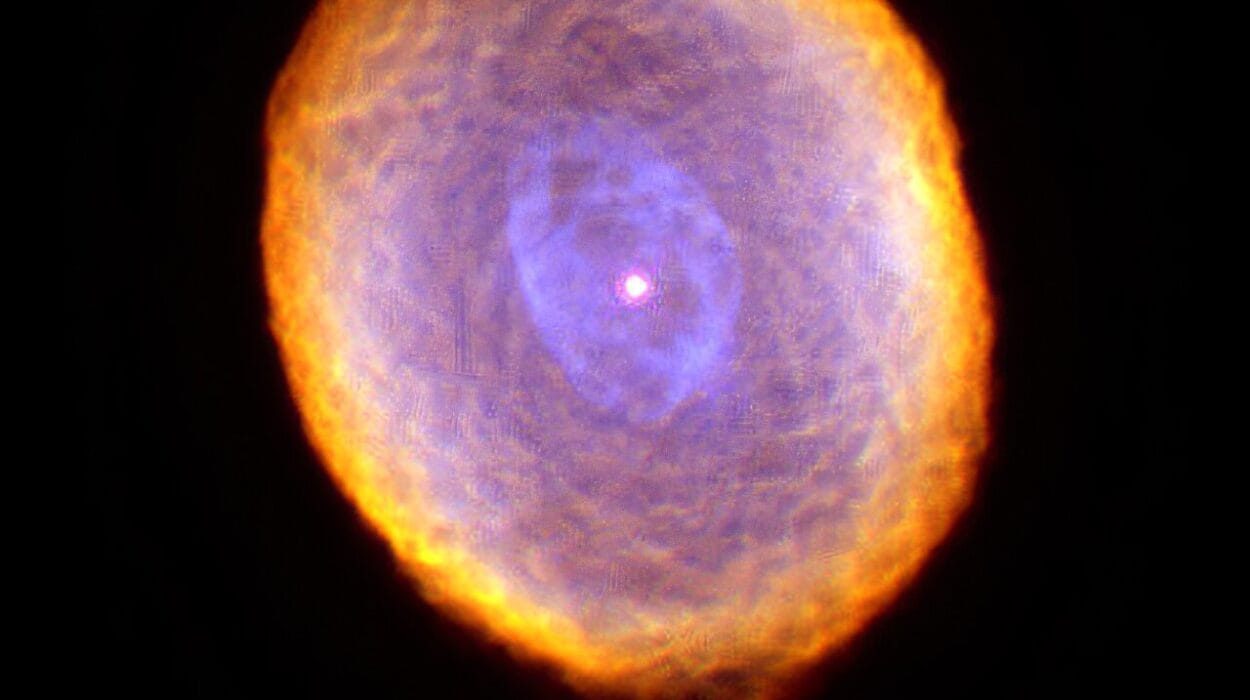
If HD 254577 was launched by a supernova, the remains of that explosion should still be visible. Astronomers believe they have found them in IC 443, better known as the Jellyfish nebula.
This nebula is a tangled cloud of gas and dust, the aftermath of a stellar explosion expanding unevenly through surrounding space. The team’s analysis suggests that IC 443 marks the site where HD 254577’s companion collapsed and detonated.
Adding to this picture is the presence of a neutron star, the dense core left behind after the supernova. Although its exact motion is difficult to measure precisely, its cometary X-ray tail points away from the same explosion site as the runaway star. Together, these signs form a coherent narrative: a binary system torn apart, one star racing outward, the other reduced to a compact remnant wrapped in glowing debris.
The Hidden Complexity of Stellar Death
One of the most intriguing aspects of this discovery lies in what it reveals about supernova remnants themselves. Astronomers often assume that the center of a remnant marks the location of the original explosion. The Jellyfish nebula challenges that assumption.
According to Dinçel, IC 443 is expanding asymmetrically through dense molecular clouds, meaning its visible shape does not neatly trace back to its true origin. This makes connecting runaway stars to their parent explosions far more difficult than once thought.
The study also indicates that the progenitor star was extremely massive, with an initial mass of about 30 solar masses. Such giants live fast and die violently, and their explosions can reshape vast regions of space. Understanding their final moments helps astronomers better grasp how energy and material are redistributed throughout the galaxy.
Why This Story Matters
This discovery does more than add a new name to the list of runaway stars. It breathes life into a theory that has waited decades for confirmation. By linking HD 254577 to the Jellyfish nebula, the researchers provide some of the strongest evidence yet that massive runaway stars can indeed be survivors of binary systems destroyed by supernovae.
That matters because it gives astronomers a new roadmap. If runaway stars and supernova remnants can be connected through careful analysis of motion, evolution, and surrounding debris, then many more such pairings may be waiting to be uncovered. Each one would offer a snapshot of stellar death and survival frozen in motion.
More broadly, this work reminds us that stars are not isolated points of light. They are shaped by relationships, by proximity, and sometimes by catastrophe. A single explosion can send one star racing across the galaxy while another collapses into near invisibility, leaving behind only a ghostly nebula as evidence.
In the end, HD 254577 is not just a fast-moving star. It is a witness. Its journey carries the memory of a long-lost companion and a violent moment that forever changed both their fates. By learning to read that memory, astronomers are beginning to understand how some of the galaxy’s loneliest travelers came to be.
Study Details
B. Dinçel et al, Massive runaway star HD 254577: The pre-supernova binary companion to the progenitor of the supernova remnant IC 443, Astronomy & Astrophysics (2026). DOI: 10.1051/0004-6361/202556086. On arXiv: DOI: 10.48550/arxiv.2511.14686