In the crowded, tangled architecture of the early universe, some places are meant to be loud with creation. Gas flows in, stars ignite, and galaxies grow fast and bright. That is why the discovery of something calm and strangely silent caught astronomers off guard.
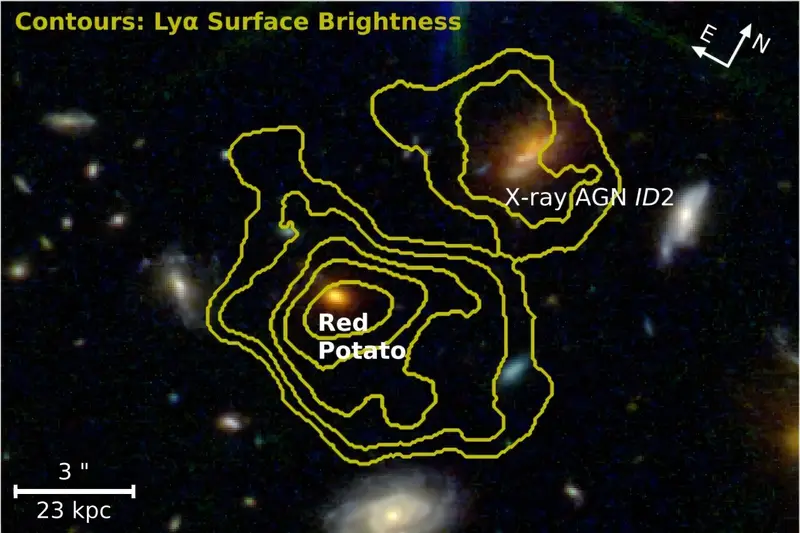
Using the James Webb Space Telescope, an international team of researchers peering deep into a distant cosmic web node stumbled upon a galaxy that seemed profoundly out of place. Massive, red, and unexpectedly quiet, it sat in an environment rich with the very fuel galaxies need to grow. Instead of bursting with new stars, it appeared to be resting. The team gave it a nickname that reflects both its shape and its oddity: Red Potato.
The finding was reported in a research paper posted on January 28 to the arXiv pre-print server, and it tells a story not of explosive growth, but of restraint, interruption, and cosmic influence.
Where the Cosmic Web Gathers Its Threads
The story begins with a structure known as MQN01, a dense node in the cosmic web observed at a redshift of approximately 3.25. These nodes are intersections where filaments of gas and matter converge, forming fertile grounds for galaxy formation. In the early universe, such places are typically filled with cool and molecular gas, the raw material from which stars are born.
Astronomers have long believed that galaxies growing inside these environments should be exceptionally efficient at forming stars. Gas streams in, gravity pulls it together, and stellar nurseries light up. That expectation made MQN01 an attractive target for observation.
Led by Weichen Wang of the University of Milan, the research team used JWST’s Near Infrared Camera (NIRCam) and Near Infrared Spectrograph (NIRSpec) to investigate this gas-rich region in detail. What they found was not what theory would predict.
Amid all that available fuel, they spotted a galaxy that looked old, red, and largely finished with star formation.
Meeting the Galaxy Called Red Potato
The galaxy, formally designated MQN01 J004131.9-493704, stood out immediately because of its color and shape. Its appearance led the team to give it a memorable name: Red Potato.
Measurements revealed that this was no small object hiding in the shadows. Red Potato has a stellar mass of 110 billion solar masses, making it a heavyweight even by galactic standards. Its half-light radius of about 3,260 light years shows that a significant portion of its stars are packed into a relatively compact space.
Despite its size, the galaxy showed little sign of ongoing stellar birth. It was classified as quiescent, a term astronomers use for galaxies that have largely stopped forming new stars. Finding such a galaxy at this early cosmic time, and in this particular environment, made the discovery especially striking.
The researchers emphasized that this was not a theoretical candidate or a statistical guess. Red Potato was spectroscopically confirmed through JWST observations, leaving little doubt about its nature.
A Galaxy Surrounded by Fuel, Yet Starved
One of the most puzzling aspects of Red Potato is its relationship with gas. The galaxy resides at the center of a large reservoir of cool circumgalactic medium, a halo of gas that typically feeds galaxies and sustains star formation. Yet Red Potato appears unable, or unwilling, to make use of it.
The team calculated the galaxy’s molecular gas mass to be less than 7 billion solar masses, resulting in a molecular gas fraction smaller than 0.06. This is an unusually low amount for a galaxy of such mass, particularly one embedded in a gas-rich node of the cosmic web.
Further observations deepened the mystery. The researchers found no detection of carbon monoxide and no sodium D-lines, both of which are indicators of molecular and neutral gas. There was also no evidence of gas outflows, suggesting the galaxy is not actively expelling material either.
In terms of motion, Red Potato behaves like a dispersion-dominated system, meaning the movement of its gas is governed more by random motions than by orderly rotation. This kinematic signature hints at internal or external processes that have stirred the gas without organizing it into a star-forming disk.
A Whisper of Star Formation in a Massive Body
Even quiescent galaxies are rarely completely silent, and Red Potato is no exception. The team measured a star-formation rate of 4.0 solar masses per year. While this might sound productive, context changes everything.
For a galaxy as massive as Red Potato, and at such an early time in the universe, this rate is strikingly low. The researchers found it to be at least one dex below the star-forming main sequence, the benchmark relationship that describes how actively galaxies of a given mass typically form stars.
This means Red Potato is forming stars at less than one-tenth the expected rate. And it is doing so while sitting in the middle of a vast gas supply. Something appears to be blocking the flow between the surrounding medium and the galaxy itself.
Turbulence in the Invisible Halo
Clues to that blockage emerged when the team examined the galaxy’s internal motions more closely. Red Potato’s stellar velocity dispersion of 268 km/s points to unusually energetic conditions. Such high dispersion suggests that the gas in and around the galaxy is highly turbulent.
This turbulence does not seem to originate from within the galaxy alone. Observations of Lyα and Hα line profiles indicate elevated gas velocity dispersion in the surrounding circumgalactic medium, implying that the halo itself is in a restless state.
Turbulent gas has a hard time settling down. Instead of flowing smoothly into a galaxy and cooling into stars, it remains agitated, suspended, and inefficient. For Red Potato, this turbulence may be the key to understanding its quiet nature.
A Jet That Changed a Galaxy’s Fate
The most intriguing piece of the puzzle came from deep X-ray data. These observations revealed an extended X-ray jet near Red Potato. The jet does not appear to originate from the galaxy itself, but rather from a neighboring luminous X-ray active galactic nucleus.
According to the researchers, this jet is likely interacting with Red Potato’s circumgalactic medium. This kind of interaction is known as jet-mode feedback, a process in which energetic jets inject energy into surrounding gas, increasing its turbulence and preventing it from cooling and accreting.
The team argues that this jet-driven turbulence has effectively cut off Red Potato’s gas supply. Even though the fuel is present all around it, the galaxy cannot draw it in efficiently enough to sustain star formation. The result is a massive galaxy that has gone quiet far earlier than expected.
As the authors conclude, the increased turbulence in the circumgalactic medium has likely reduced gas accretion onto the galaxy, shaping its evolution in a profound way.
Why a Red Potato Matters in a Young Universe
Red Potato is more than a cosmic curiosity with a playful name. It represents a challenge to simple ideas about how galaxies grow. Here is a massive, quiescent galaxy existing in a place where conditions seem ideal for rapid star formation. Its presence suggests that environment alone does not dictate a galaxy’s fate.
The discovery highlights the powerful role of external feedback, showing that activity from neighboring galaxies can dramatically alter the evolution of another. A single X-ray jet, not even originating from Red Potato itself, may have been enough to shut down its growth.
This finding also demonstrates the unique power of the James Webb Space Telescope. Without its ability to probe the infrared universe with high sensitivity and precision, such a subtle and unexpected object might have gone unnoticed.
Most importantly, Red Potato reminds astronomers that the early universe was not uniformly chaotic or uniformly productive. Even in its youth, the cosmos contained places of calm, shaped by invisible forces and distant neighbors. Understanding how and why such galaxies form will help researchers piece together a more complete story of how the universe built its vast and varied population of galaxies.
In the quiet presence of Red Potato, astronomers have found a new voice in that story, one that speaks not through brightness, but through silence.
Study Details
Weichen Wang et al, A Quiescent Galaxy in a Gas-Rich Cosmic Web Node at z~3, arXiv (2026). DOI: 10.48550/arxiv.2601.20473