When astronomers pointed NASA’s Hubble Space Telescope toward a young star system about 1,000 light-years from Earth, they expected something familiar. Protoplanetary disks—the swirling, flattened clouds of gas and dust that give birth to planets—are not strangers to Hubble. Over decades, the telescope has captured many of them, often appearing serene and symmetrical, like cosmic vinyl records glowing softly in space.
What Hubble found this time was nothing like that.
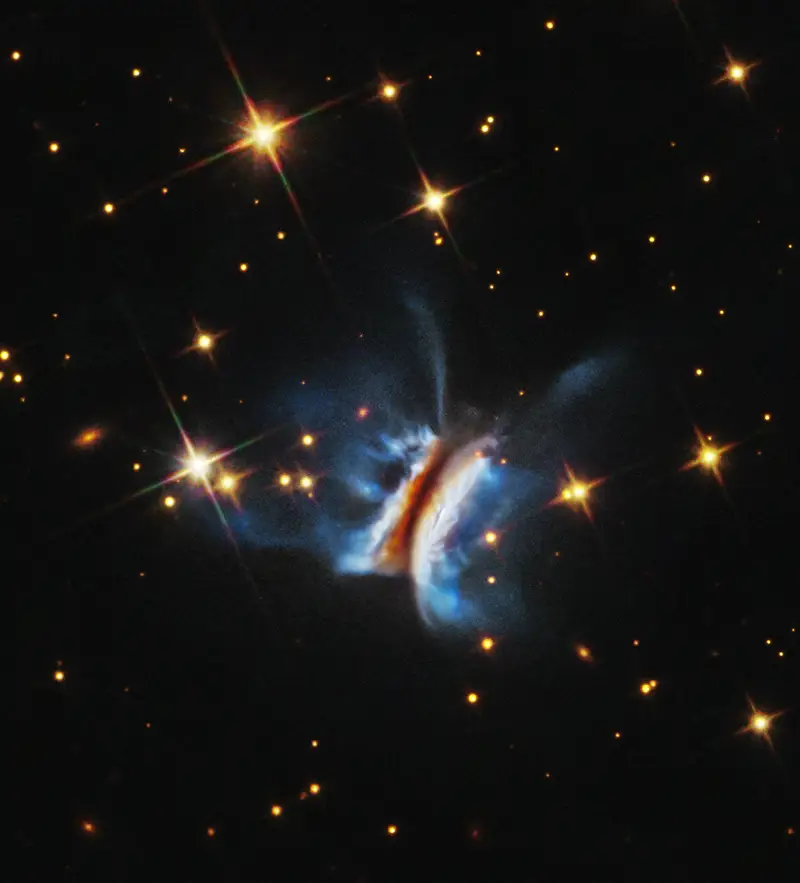
Instead of calm order, the images revealed turmoil. Instead of neat balance, they showed lopsided chaos. The largest protoplanetary disk ever observed was not just immense—it was unruly, turbulent, and strangely one-sided. For the first time in visible light, Hubble captured a planet-forming disk whose upper layers billowed far above and below its plane, stretching into wisps and filaments that seemed to claw their way into surrounding space.
Even more puzzling, those dramatic filaments appeared on only one side.
Meeting “Dracula’s Chivito”
The object at the center of this discovery is formally known as IRAS 23077+6707, a name as technical as the phenomenon itself. But its discoverers couldn’t resist giving it something more memorable. They call it “Dracula’s Chivito,” a playful nickname that reflects the backgrounds of its researchers—one from Transylvania, the legendary home of Dracula, and another from Uruguay, where a beloved national sandwich is known as a chivito.
The name fits the imagery. Seen nearly edge-on, the disk looks like a cosmic hamburger. A dark central lane slices across the middle, blocking light from the young star hidden inside. Above and below that lane glow the disk’s upper layers of dust and gas, illuminated and sculpted by the star’s energy.
Except this hamburger is colossal.
Spanning nearly 400 billion miles, the disk is about 40 times wider than our solar system out to the Kuiper Belt, the region of icy cometary bodies beyond Neptune. It is not only the largest known planet-forming disk—it is quickly becoming one of the strangest.
A Star Hidden Behind Dust
At the heart of “Dracula’s Chivito” lies a mystery. The disk is so thick and opaque that it completely obscures the young star, or possibly stars, at its center. Astronomers believe the hidden object could be a hot, massive star, or perhaps a pair of stars locked in orbit around each other.
Whatever its true nature, this central source is powerful enough to shape the surrounding disk on a vast scale. Gas and dust swirl around it, gradually accreting inward while simultaneously providing the raw materials for planets yet to form.
This is the standard story of planetary birth. But the details Hubble uncovered suggest this system is far from standard.
When Order Breaks Down
“The level of detail we’re seeing is rare in protoplanetary disk imaging, and these new Hubble images show that planet nurseries can be much more active and chaotic than we expected,” said lead author Kristina Monsch of the Center for Astrophysics | Harvard & Smithsonian (CfA).
The chaos appears most dramatically in the disk’s vertical structure. Instead of staying close to a thin plane, wisps of material rise high above and plunge far below the disk. These filaments extend much farther than astronomers have seen in similar systems, giving the disk a turbulent, windswept appearance.
What makes this even more unsettling is that the turbulence is not symmetrical. One side of the disk displays towering, filament-like features, while the other side looks sharply cut off, almost as if something sliced away its outer layers.
This imbalance challenges assumptions about how disks behave.
A Disk That Refuses to Be Symmetrical
The asymmetry caught researchers by surprise.
“We were stunned to see how asymmetric this disk is,” said co-investigator Joshua Bennett Lovell, also an astronomer at the CfA.
In most observed protoplanetary disks, features tend to mirror each other across the disk’s midplane. Gravity, rotation, and pressure usually conspire to maintain a kind of large-scale balance. But IRAS 23077+6707 seems to be breaking those rules.
The one-sided filaments suggest that something dynamic is happening—possibly the recent infall of dust and gas onto the disk, or interactions with its surrounding environment. The disk may be plowing through leftover material from its birth cloud, or absorbing matter unevenly, creating localized disturbances that puff up one side while leaving the other sharply defined.
“Hubble has given us a front row seat to the chaotic processes that are shaping disks as they build new planets—processes that we don’t yet fully understand but can now study in a whole new way,” Lovell said.
Seeing the Invisible, in Visible Light
What makes this discovery especially significant is how it was made. Hubble observed the disk in visible light, something rarely achieved at this level of detail for such systems. Dust often blocks visible wavelengths, forcing astronomers to rely on infrared telescopes to peer inside planet-forming regions.
Both Hubble and NASA’s James Webb Space Telescope have glimpsed similar structures in other disks, but this system stands apart.
“We’re seeing this disk nearly edge-on and its wispy upper layers and asymmetric features are especially striking,” Monsch explained. “Both Hubble and NASA’s James Webb Space Telescope have glimpsed similar structures in other disks, but IRAS 23077+6707 provides us with an exceptional perspective—allowing us to trace its substructures in visible light at an unprecedented level of detail. This makes the system a unique, new laboratory for studying planet formation and the environments where it happens.”
In essence, Hubble has turned what was once a vague silhouette into a richly textured landscape.
A Scaled-Up Solar System?
All planetary systems begin the same way: with disks of gas and dust circling young stars. Over time, gas falls inward, feeding the star, while the remaining material clumps together to form planets.
IRAS 23077+6707 appears to be this process on overdrive.
Astronomers estimate that the disk contains between 10 and 30 times the mass of Jupiter. That is an extraordinary amount of material, more than enough to build multiple gas giant planets. In size and mass, the disk may represent a scaled-up version of our own solar system’s earliest days.
“In theory, IRAS 23077+6707 could host a vast planetary system,” said Monsch.
Yet the extreme size and turbulence of the disk raise new questions. Does planet formation proceed the same way in such massive environments? Do planets form faster, slower, or in entirely different configurations? Could chaos at this scale shape worlds unlike anything we see around our own Sun?
More Questions Than Answers
Despite the wealth of new detail, the images leave astronomers with more mysteries than solutions. Why are the filaments confined to one side? What triggered the disk’s dramatic vertical extension? How stable is this structure, and how long can such chaos last before planets emerge?
“While planet formation may differ in such massive environments, the underlying processes are likely similar,” Monsch said. “Right now, we have more questions than answers, but these new images are a starting point for understanding how planets form over time and in different environments.”
That starting point matters. Every unexpected feature forces scientists to revisit their theories, refine their models, and reconsider what “normal” really means when it comes to building worlds.
Why This Discovery Matters
This discovery is not just about a single strange disk. It is about expanding the boundaries of what we believe planetary systems can be.
By revealing a protoplanetary disk that is enormous, turbulent, and profoundly asymmetric, Hubble has shown that planet formation can unfold in environments far more extreme than previously imagined. If planets can arise amid such chaos, then the universe may be capable of creating planetary systems in a wider range of conditions than we once thought.
The findings also mark a milestone for Hubble itself. Even after decades in space, the telescope continues to deliver firsts—offering new ways to see, and new reasons to wonder. As NASA’s missions push humanity’s exploration of the universe and our place in it, discoveries like this remind us that the cosmos still holds surprises waiting just beyond the edge of what we expect.
“Dracula’s Chivito” is not just a curiosity with a playful name. It is a reminder that the birth of planets is not always a quiet, orderly affair. Sometimes, creation begins in turbulence, imbalance, and chaos—and from that disorder, entire worlds may eventually emerge.
More information: Monsch et al, Hubble Reveals Complex Multi-scale Structure in the Edge-on Protoplanetary Disk IRAS 23077+6707, The Astrophysical Journal, DOI: 10.3847/1538-4357/ae247f