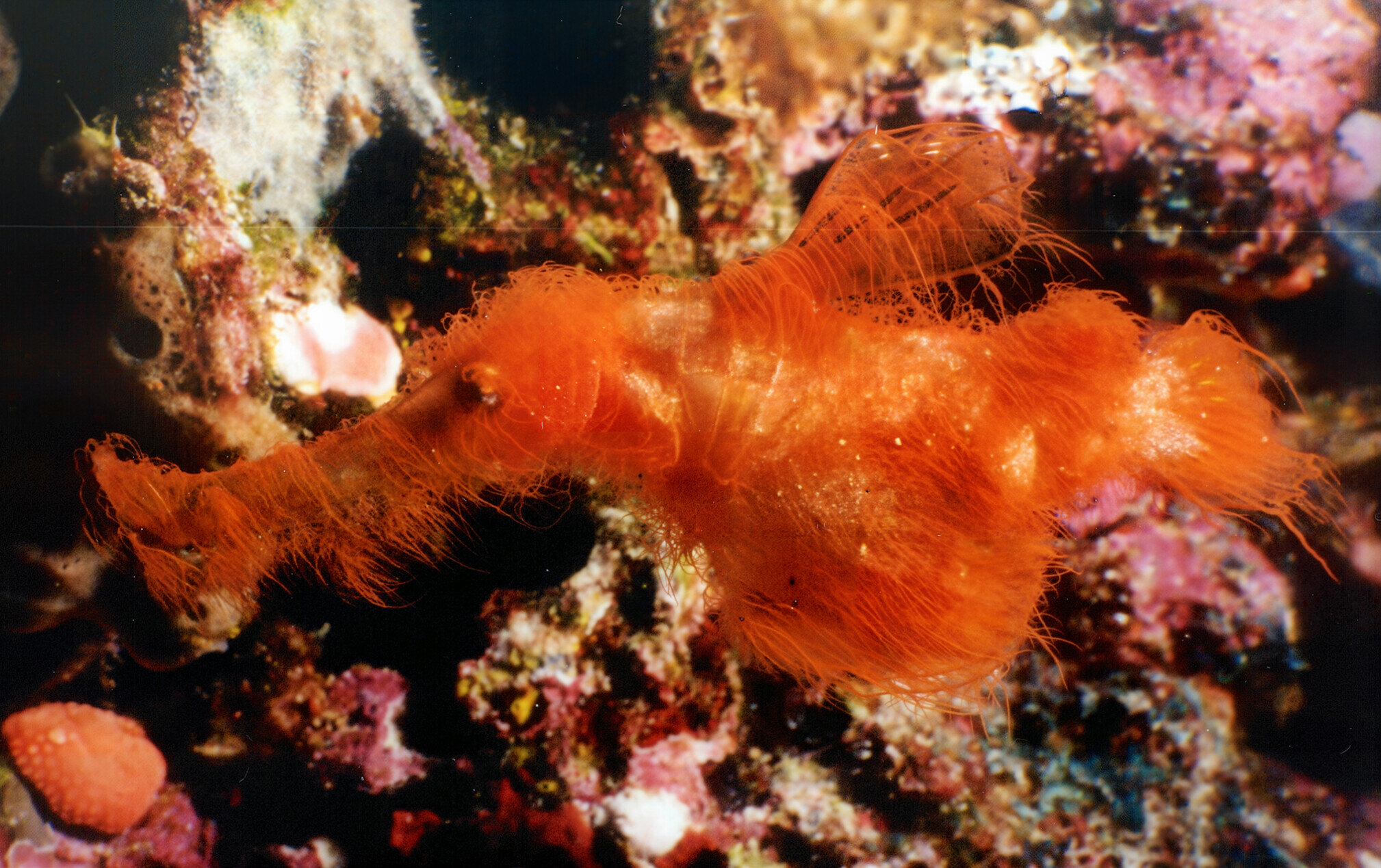
Scientists have identified a new species of ghost pipefish living in the Great Barrier Reef region, a bright orange-red animal with a shaggy, filament-covered body and long snout that helped it stay hidden in plain sight. Genetic testing revealed a striking 22% mitochondrial DNA difference from a closely related species, confirming it was not what researchers had assumed. The discovery, published in the Journal of Fish Biology, highlights how even well-studied ecosystems can still hold undocumented species.
A strange-looking fish with a long snout and fuzzy skin has been swimming through coral reefs for years—noticed by divers, photographed repeatedly, and shared online—yet misunderstood almost every time it appeared.
Now, scientists say it wasn’t just an unusual version of a known species. It was something entirely new.
A “Muppet” Fish That Blended In Too Well
The newly identified species has been named the hairy ghost pipefish (Solenostomus snuffleupagus), a nod to its resemblance to Mr. Snuffleupagus from Sesame Street. It has a bright orange-red body, a long snout, and a distinctive hairy appearance caused by long skin filaments.
That shaggy look turned out to be part of the reason it stayed unrecognized for so long.
Ghost pipefish are known for their camouflage abilities. Closely related to seahorses and sea dragons, they often match the colors of their environment and grow skin filaments that resemble coral or algae. These natural disguises can make them extremely difficult to identify correctly, even for experts.
Because of that, scientists have historically struggled to separate one ghost pipefish species from another, especially when they share similar textures and body shapes.
Years of Sightings, But No Confirmation
Although the fish is new to science, it was not new to divers.
For years, underwater photographers and reef explorers had posted images and videos of the animal online, including in Facebook groups and citizen science platforms such as iNaturalist. In most cases, people assumed they were seeing the already known rough ghost pipefish (Solenostomus paegnius), which also has a shaggy appearance.
But marine biologist David Harasti, working with research partner Graham Short, began noticing something unusual.
Across multiple photographs and sightings, the same features kept appearing—features that did not match museum specimens of the rough ghost pipefish. The differences were consistent enough that the researchers decided the fish deserved closer investigation.
Their findings were later published in a scientific paper in the Journal of Fish Biology, where the authors noted that the species’ “conspicuous shaggy appearance” was consistently observed across its known range.
DNA Evidence Confirmed It Was a Different Species
To test whether this was truly a separate species, Harasti and Short analyzed mitochondrial DNA from two specimens collected from the Coral Sea.
They then compared that DNA to existing genetic records of the rough ghost pipefish.
The result was decisive: the researchers found a 22% genetic difference, which provided strong evidence that the fish was not simply a variation of an existing species.
That genetic gap helped confirm what the visual evidence had been suggesting all along—this animal belonged to a separate branch of the ghost pipefish family.
Micro-CT Scans Revealed Hidden Skeletal Clues
DNA wasn’t the only tool used to solve the mystery.
The researchers also built 3D skeletal models using high-resolution micro-CT scans, allowing them to examine bone structure in detail without damaging specimens.
When they compared the skeleton of the new species to related ghost pipefish, they found one of the clearest physical distinctions: vertebrae count.
Most close relatives have 32–34 vertebrae, but the newly identified species has 36 vertebrae.
The scans also revealed another surprising feature—unique star-shaped bony structures embedded in the fish’s skin. These structures were not described in the same way for the related species, giving researchers yet another anatomical marker that supported the species classification.
In the paper, the researchers emphasized that combining modern scanning tools with traditional biology methods opened new windows into the group’s diversity.
Traditional Measurements Backed Up the High-Tech Findings
Even with genetic testing and 3D scanning, the team still relied on a classic method of species identification: detailed physical measurement.
They carefully measured body proportions and fin shapes in museum specimens and compared those measurements across species.
That approach revealed additional differences. Compared to its relatives, the hairy ghost pipefish has a more compact and “chunkier” body shape.
This physical build, combined with the vertebrae differences and genetic separation, strengthened the case that the animal was not merely misclassified—it had never been formally described before.
The researchers noted that integrating micro-CT imaging with standard anatomical and molecular analysis provided new insights into the skeletal diversity of the genus Solenostomus.
A New Species Hiding in One of the World’s Most Studied Reefs
The discovery is especially striking because it comes from the Great Barrier Reef region—an ecosystem that has been heavily studied for decades.
Despite extensive research, the reef continues to produce surprises, and this new species shows how difficult it can be to document biodiversity even in well-known marine environments.
In this case, the fish’s success at blending into coral habitats may have worked too well. Its camouflage, combined with its similarity to other ghost pipefish, allowed it to evade formal classification even while being repeatedly observed and photographed.
Why This Matters
The identification of Solenostomus snuffleupagus is a reminder that even familiar ecosystems can still contain species that science has not officially recognized.
By confirming the species through mitochondrial DNA, micro-CT skeletal imaging, and detailed anatomical measurement, the researchers demonstrated how combining modern technology with traditional taxonomy can reveal overlooked biodiversity.
In practical terms, recognizing a species correctly is essential for understanding reef ecosystems, documenting marine life accurately, and ensuring that conservation efforts reflect the true diversity living beneath the surface.
Study Details
Graham Short et al, Solenostomus snuffleupagus sp. nov., a hairy ghost pipefish (Teleostei: Solenostomidae) from the Southwest Pacific, with an integrative comparison to S. paegnius, Journal of Fish Biology (2026). DOI: 10.1111/jfb.70497