Latin America is far more likely to view wildlife as part of their social community, while the United States and Canada view animals as resources for human use. A new international study published in Nature Sustainability and led by Colorado State University traces these deep cultural differences back to European colonization, religious history, and the lasting influence of Indigenous worldviews.
The way people think about wild animals isn’t just personal—it can shape laws, conservation strategies, and even whether killing animals is considered acceptable. Now, researchers say these attitudes may also carry the fingerprints of history going back centuries.
In what they describe as the first international study of wildlife values, a team led by Colorado State University uncovered a sharp cultural divide across the Americas. The results suggest that the split between Latin America and North America isn’t random—it may be rooted in the institutions and beliefs introduced during European colonization.
Two Competing Views of Wildlife
The study identifies two broad value systems that shape how societies relate to animals.
One is called mutualism, where wildlife is seen as part of the social community and viewed as deserving of rights similar to humans.
The other is called domination, where wildlife is primarily viewed as a resource—something to be used, managed, or controlled for human benefit.
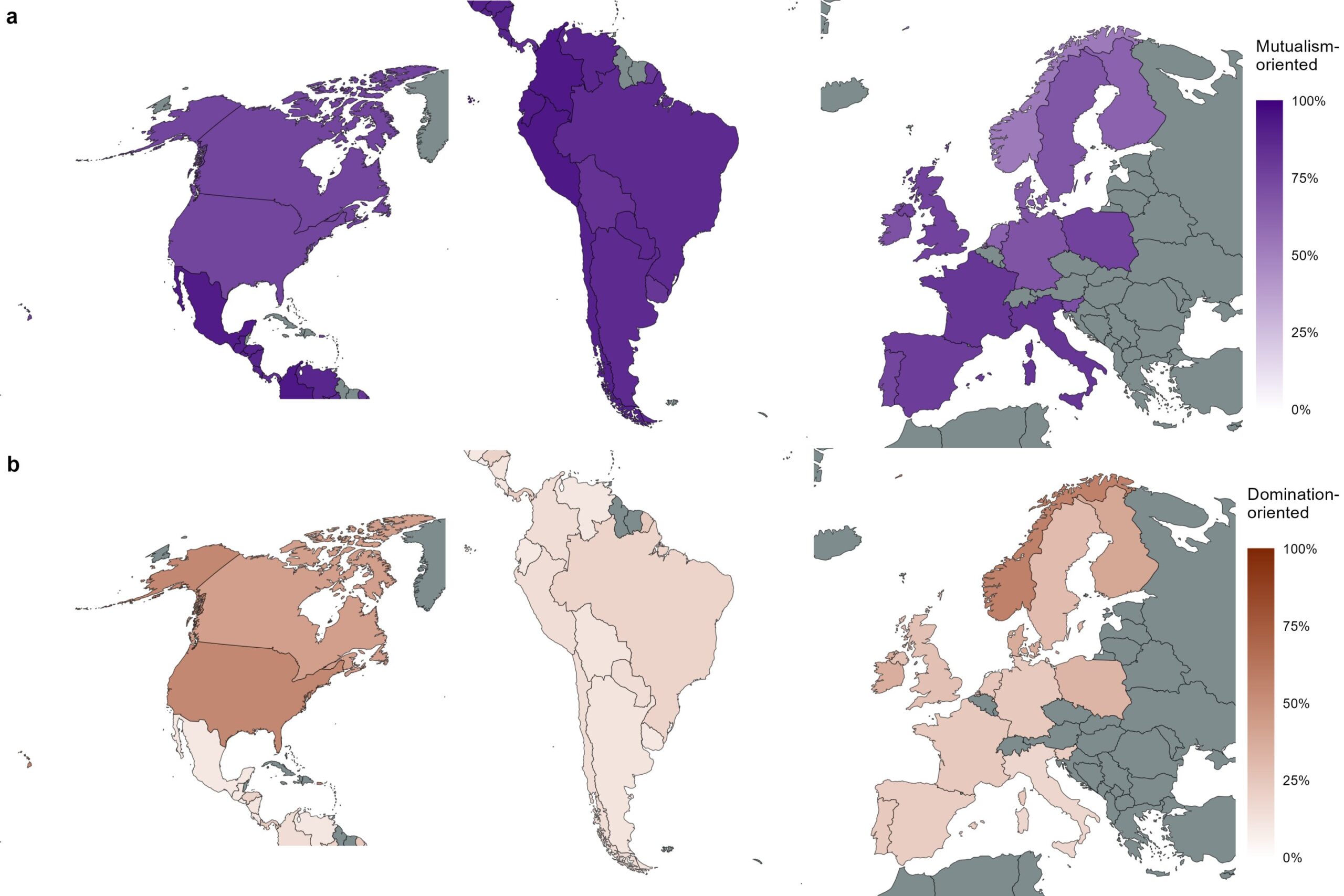
According to the study, Latin America strongly leans toward mutualism. In contrast, the United States and Canada tend to lean more toward domination, viewing wildlife more often through a human-centered lens.
While both regions contain a range of attitudes, the overall patterns were clear enough that researchers linked them to deeper historical forces.
How Colonization Shaped Today’s Wildlife Values
The research argues that these modern differences align closely with the values of the European powers that colonized different regions of the Western Hemisphere.
North America was largely colonized by Britain, while much of Latin America was colonized by Spain and Portugal.
Lead author Michael Manfredo, a professor in CSU’s Warner College of Natural Resources, said British institutions were designed to build permanent settlements, while Spanish and Portuguese institutions focused more heavily on resource extraction.
“British institutions fostered the establishment of settlements, while Spanish and Portuguese institutions focused on the extraction of resources such as gold,” Manfredo said.
The researchers also connected the wildlife value divide to religious and cultural differences within Europe itself.
Religion and the Rise of Domination Thinking
Manfredo pointed to shifts in northern Europe during the 16th and 17th centuries, when Protestant movements promoted the idea that humans were meant to control the natural world—including animals.
According to the study, this worldview supported domination-oriented values.
Southern European countries, which were historically Catholic, were more likely to hold mutualist views. Manfredo argued that modern wildlife values across the Americas still reflect these older European differences.
“Moreover, the religious orientation of the countries of northern Europe called for human domination, which was not the case in southern Europe,” he said. “Today’s values are consistent with these differences.”
A Massive Survey Across Two Continents
To measure wildlife values, the researchers surveyed nearly 18,500 people across 33 countries in the Americas and Europe.
Responses fell along a spectrum between mutualism and domination, showing that wildlife values vary widely depending on geography and culture.
The findings revealed that North America and northern European countries show high levels of mutualism, but are still more domination-oriented than Latin America and much of Europe.
Latin America stood out as the region with the lowest levels of domination and extremely high levels of mutualism—higher even than Spain and Portugal, the countries that colonized much of the region.
That detail raised an important question: if Spain and Portugal were mutualism-oriented, why is Latin America even more so?
The researchers say the answer may lie in the influence of Indigenous populations.
Indigenous Influence May Help Explain Latin America’s Strong Mutualism
The study found that people with Indigenous ancestry across the Americas were strongly mutualistic.
Latin America also had much larger Indigenous populations at the time of colonization than North America did, which may have shaped the region’s long-term cultural values.
Manfredo said that during colonization, Latin America included large cities and vast Indigenous populations.
“At the time of European colonization, there were large cities and significant numbers of Indigenous people in Latin America—50 million people or more,” he said.
The researchers concluded that Latin America’s modern wildlife values may have developed through acculturation, where Indigenous and Iberian perspectives blended over time.
“We would conclude that the current values of mutualism there arose through the acculturation of reasonably compatible views toward wildlife among Iberians and Indigenous people,” Manfredo said.
Wildlife Values Aren’t Just Beliefs—They Shape Policy
The researchers emphasize that cultural views of wildlife have real consequences, especially when it comes to wildlife management and conservation strategies.
When conservation groups or policymakers apply ideas across borders without understanding cultural differences, conflict can emerge. What seems like an acceptable solution in one country may be viewed as unethical in another.
“Sustaining wildlife is a global problem, and unless you take into consideration the cultural differences, success will be difficult,” Manfredo said. “What is acceptable practice in one country may be unacceptable in others.”
One of the clearest examples is the use of lethal control to manage conflicts between humans and wildlife.
Lethal Control Reveals the Sharpest Divide
In countries with higher domination values, lethal control is more commonly accepted as a management tool.
Countries with stronger mutualist values tend to support lethal control only in extreme situations, particularly when human lives are threatened.
The survey asked participants whether lethal control should be used in various scenarios, including crop damage, vehicle collisions, zoonotic disease concerns, attacks on pets or livestock, and attacks on humans.
Manfredo said lethal control plays a particularly central role in North American wildlife management.
“Lethal control is North America’s fundamental way of dealing with human-wildlife conflict,” he said. “It is used for a wide variety of purposes, including safety, agricultural production and limiting invasive species.”
The study suggests that these different value systems can help explain why wildlife policies and public debates look so different across regions.
Wildlife Values Change Slowly Over Generations
The researchers also found that wildlife values tend to be persistent and deeply rooted, shaped over long periods rather than shifting quickly.
Study co-author Tara Teel, a CSU professor and interim head of the Department of Human Dimensions of Natural Resources, said conservation groups need to understand that deep cultural values may not be easily changed.
“We need to work within the value sets that exist in different places and understand those to be effective in conservation,” she said.
Still, Teel noted that broad cultural shifts can happen over time. She pointed to animal rights movements as an example of gradual change that can push societies more toward mutualism.
The study also connects these shifts to modernization.
The United States May Be Slowly Moving Toward Mutualism
Although North America has historically leaned toward domination values, Teel said the United States is showing signs of change.
In previous research, she and Manfredo worked with U.S. state wildlife agencies to evaluate how public attitudes toward wildlife evolve.
“We see in the United States a shift away from domination toward more mutualist values due to modernization forces like increased income, education and urbanization,” Teel said.
She added that it’s important for wildlife agencies to monitor public opinion regularly to ensure their policies remain aligned with the people they serve.
Why This Matters
Wildlife conservation isn’t just about biology—it’s also about culture, history, and what people believe animals are in relation to humans. This study suggests that modern debates over wildlife policy may be shaped by centuries-old institutions and religious traditions, along with the enduring influence of Indigenous perspectives.
By identifying these deeper roots, the research offers a practical message for conservation groups: success may depend less on imposing universal solutions and more on understanding local values. In a world where wildlife conflicts are increasingly global, recognizing these cultural differences could determine whether conservation efforts succeed—or fail.
Study Details
Enduring cultural legacies affect Euro-American wildlife values, Nature Sustainability (2026). DOI: 10.1038/s41893-026-01825-8