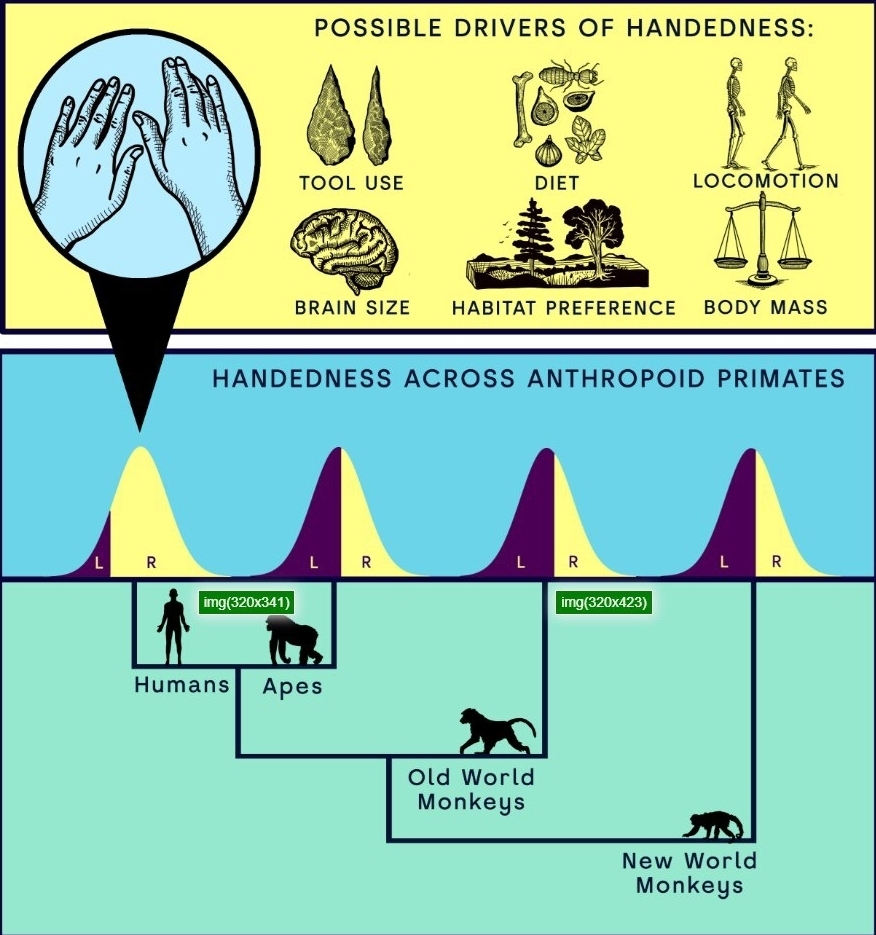
Bipedal walking and brain expansion are the primary reasons why most humans are right-handed, according to a new study led by the University of Oxford. By analyzing 2,025 individuals across 41 primate species, researchers revealed that our overwhelming right-handedness is a predictable evolutionary outcome rather than a random quirk.
For decades, scientists have wrestled with a simple but stubborn question: why do humans show such an extreme preference for the right hand? Across nearly every culture on Earth, about 90% of people favor their right hand—a striking level of consistency that no other primate species comes close to matching.
Now, new research suggests the explanation may be rooted in the very traits that helped define what it means to be human.
A Mystery That No Other Primate Shares
Handedness isn’t unique to humans. Many animals show individual preferences for one limb over another, and primates are no exception. But what makes humans different is the scale of the imbalance.
In humans, right-handedness isn’t just common—it dominates across societies and populations. That consistency has long suggested that some deep evolutionary mechanism may be shaping the pattern.
Yet past explanations have remained fragmented. Some theories focused on tool use. Others pointed to diet, habitat, or social behavior. Still others suggested links to brain structure and language. But none fully explained why humans stand so far apart from other primates.
Testing Every Major Theory in One Framework
The new study, led by Dr. Thomas A. Püschel and Rachel M. Hurwitz at the University of Oxford’s School of Anthropology and Museum Ethnography, with Professor Chris Venditti of the University of Reading, aimed to tackle the problem more comprehensively than before.
Published in PLOS Biology, the research drew from a dataset of 2,025 individuals spanning 41 species of monkeys and apes.
Instead of focusing on one explanation at a time, the researchers tested multiple major hypotheses together. Their analysis included factors such as tool use, diet, habitat, body mass, social organization, brain size, and locomotion.
To do this, the team used Bayesian modeling, a statistical approach that can evaluate complex relationships while accounting for uncertainty. Crucially, their model also considered evolutionary relationships between species, allowing them to compare primates in a way that reflects shared ancestry.
The goal was clear: identify which factors actually predict handedness patterns across primates, and determine why humans appear so extreme.
Humans Look Like an Outlier—Until Two Variables Are Added
At first, the results reinforced the longstanding mystery.
Humans stood conspicuously outside the pattern that explained handedness in every other primate species. None of the usual suspects—tool use, habitat, diet, or social factors—could fully account for why human handedness is so strongly skewed.
But the story changed dramatically when the researchers added two additional variables into the model: brain size and the relative length of arms versus legs, which serves as a standard anatomical marker of bipedal locomotion.
Once those two traits were included, the human anomaly vanished.
In other words, humans only seem like an evolutionary mystery if you ignore two of the most defining traits of human evolution. When upright walking and large brains are considered, human right-handedness begins to look like a predictable outcome rather than an exception.
Upright Walking May Have Started the Shift
The findings support the idea that handedness did not appear suddenly. Instead, it likely strengthened gradually as the human lineage evolved.
The researchers propose a two-stage evolutionary process. The first stage may have been driven by walking on two legs.
Bipedalism fundamentally changes how an animal interacts with its environment. When locomotion no longer requires the hands, the hands become available for other tasks—carrying, manipulating objects, and performing fine movements.
That shift may have created selective pressure for more specialized and consistent manual behavior, including a preference for one hand over the other.
According to the study’s interpretation, upright walking may have laid the groundwork for handedness by freeing the hands from constant locomotor demands.
Brain Expansion May Have Locked It In
The second stage appears tied to the evolution of a much larger brain.
As brain size increased and the brain reorganized over evolutionary time, the researchers suggest that lateralization—the tendency for one side of the brain to specialize—may have intensified. That, in turn, could have strengthened a population-wide preference for the right hand.
The study’s results indicate that bipedalism may have started the process, but larger brains pushed it toward the extreme right-handed pattern seen today.
Rather than being driven mainly by tool use or culture alone, handedness may be deeply linked to the biological transformation of the human body and brain.
Reconstructing Handedness in Ancient Human Relatives
Using the same evolutionary models, the researchers also estimated likely handedness patterns in extinct human ancestors.
What they found was not an abrupt leap, but a gradual progression.
Early hominins such as Ardipithecus and Australopithecus were predicted to have only mild rightward preferences, broadly similar to modern great apes. That suggests early human ancestors may not have been overwhelmingly right-handed, even if they showed some directional tendency.
But with the emergence of the genus Homo, the predicted right-hand bias strengthens significantly.
Species such as Homo ergaster, Homo erectus, and Neanderthals appear to fall along a trajectory of increasing rightward preference, culminating in the extreme dominance observed in Homo sapiens.
This supports the idea that modern handedness is the result of long-term evolutionary momentum rather than a sudden behavioral shift.
The “Hobbit” Species That Breaks the Pattern
One species stood out as a striking exception: Homo floresiensis, the small-bodied human relative discovered in Indonesia and often nicknamed the “hobbit.”
The model predicts that Homo floresiensis had a much weaker handedness preference compared to other members of Homo.
The researchers argue this fits their broader conclusion. Floresiensis is known for having a small brain and a body adapted for a mixed form of movement that included both upright walking and climbing, rather than full commitment to bipedalism.
In the context of the study, this species becomes a natural test case: when brain size is smaller and locomotion is less purely bipedal, the extreme right-hand bias weakens.
What This Study Changes About the Handedness Debate
One of the study’s major contributions is methodological. According to Dr. Püschel, this is the first research effort to test several major hypotheses for human handedness within a single unified framework.
“This is the first study to test several of the major hypotheses for human handedness in a single framework,” Püschel said. “Our results suggest it is probably tied to some of the key features that make us human, especially walking upright and the evolution of larger brains.”
By comparing many primate species at once, the researchers argue that it becomes possible to separate ancient traits shared across primates from traits that became uniquely intensified in humans.
Questions That Still Remain
While the findings help resolve why humans are so strongly right-handed, the researchers stress that major questions remain open.
The study does not fully explain the role of cumulative human culture in reinforcing right-handedness over time. It also leaves unanswered why left-handedness persists at all, despite the strong population-level bias.
The researchers also note that limb preference in other animals—such as parrots and kangaroos—raises the possibility that similar evolutionary pressures may produce comparable outcomes in very different species.
Why This Matters
Understanding handedness is not just about curiosity over whether people write with their right or left hand. It offers a window into how the human body and brain evolved together.
This study suggests that the same evolutionary shifts that shaped human identity—walking upright and developing larger brains—may also have shaped the way we use our bodies every day. By tying handedness to these core traits, the research reframes right-handedness not as an odd accident of history, but as a measurable outcome of human evolution.
And in solving one of anthropology’s most persistent puzzles, the study highlights a broader lesson: sometimes the most familiar human behaviors carry the deepest evolutionary fingerprints.
Study Details
Thomas A. Püschel et al, Bipedalism and brain expansion explain human handedness, PLOS Biology (2026). DOI: 10.1371/journal.pbio.3003771