What looked like one of the strongest hints yet of a lunar-mass primordial black hole has now been overturned. A new reanalysis of public telescope observations shows the star nicknamed “Phoebe” naturally changes in brightness over time, invalidating the earlier interpretation of a rare gravitational microlensing event.
The search for primordial black holes took an unexpected turn after researchers revisited a remarkable observation that had briefly raised hopes of detecting one of these elusive objects. Instead of uncovering evidence for an ancient black hole left over from the early universe, the new analysis points to a much simpler explanation: the star itself was behaving like many ordinary variable stars.
The findings are described in a paper posted to the arXiv preprint server on June 17.
A Claim That Sparked Excitement
The debate began in May 2026, when researchers studying millions of stars in the Large Magellanic Cloud with the Dark Energy Camera (DECam) reported a striking observation.
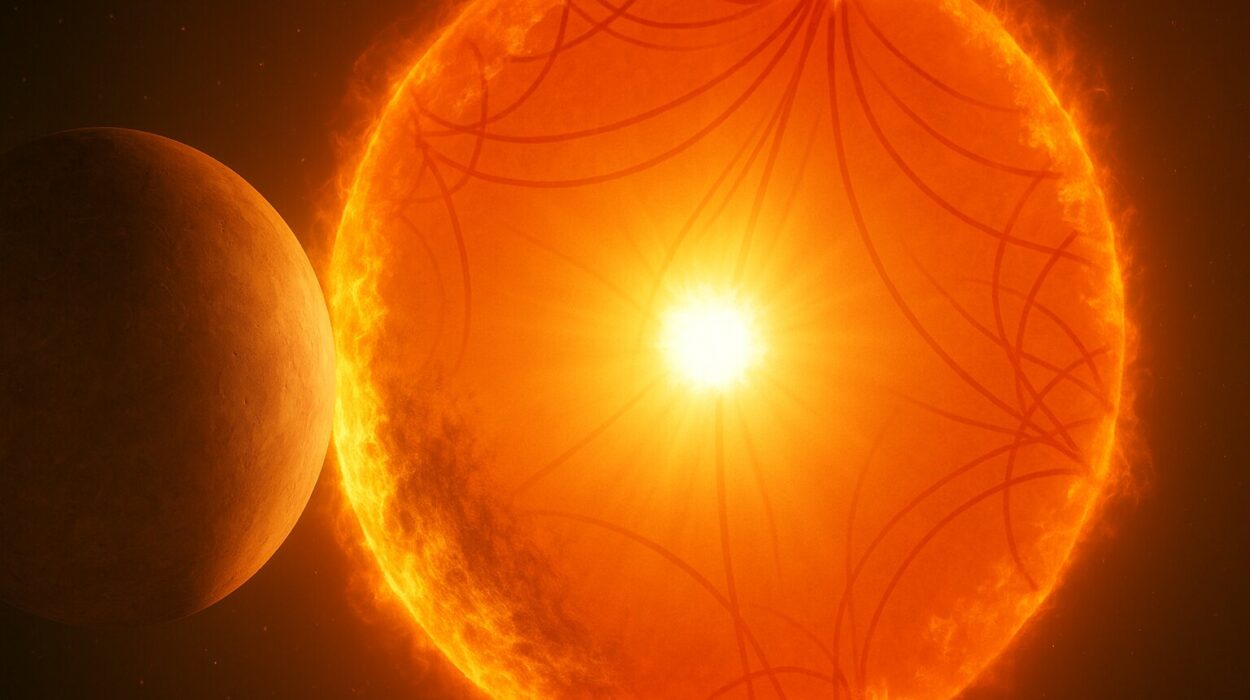
One star briefly brightened for less than one hour before returning to normal. The team interpreted this short-lived flash as a gravitational microlensing event, a phenomenon that occurs when a compact object passes in front of a distant star. The object’s gravity temporarily bends and magnifies the star’s light, making it appear brighter for a short time.
Because the brightening lasted such a brief period, the researchers estimated that the unseen object acting as the gravitational lens had roughly the mass of the Moon.
They proposed that this object could be a primordial black hole, a hypothetical relic formed in the very early universe. If such objects exist in large numbers, they could account for dark matter, making the observation potentially significant for one of astronomy’s biggest mysteries.
A Conflict With Earlier Survey Results
The interpretation immediately faced an important challenge.
Another long-running telescope survey, the Optical Gravitational Lensing Experiment (OGLE), has monitored the same region of the sky with high precision for many years.
If lunar-mass primordial black holes truly made up dark matter, the OGLE survey should have recorded hundreds to thousands of similar short-lived brightening events. Instead, it found none that convincingly matched this type of signal.
In their new study, Andrzej Udalski and Przemek Mróz of the University of Warsaw emphasized this discrepancy.
They wrote that “No convincing short-timescale microlensing events were found in the OGLE data, placing strong limits on the abundance of lunar- and planetary-mass PBHs in the Milky Way dark matter halo.”
That inconsistency motivated the researchers to take another careful look at the DECam observations.
A Fresh Look at the Same Data
Rather than relying only on the observations examined in the original study, Udalski and Mróz performed an independent analysis of the publicly available DECam data while also including additional observations collected during 2020 and 2021.
Their investigation revealed something the earlier interpretation had overlooked.
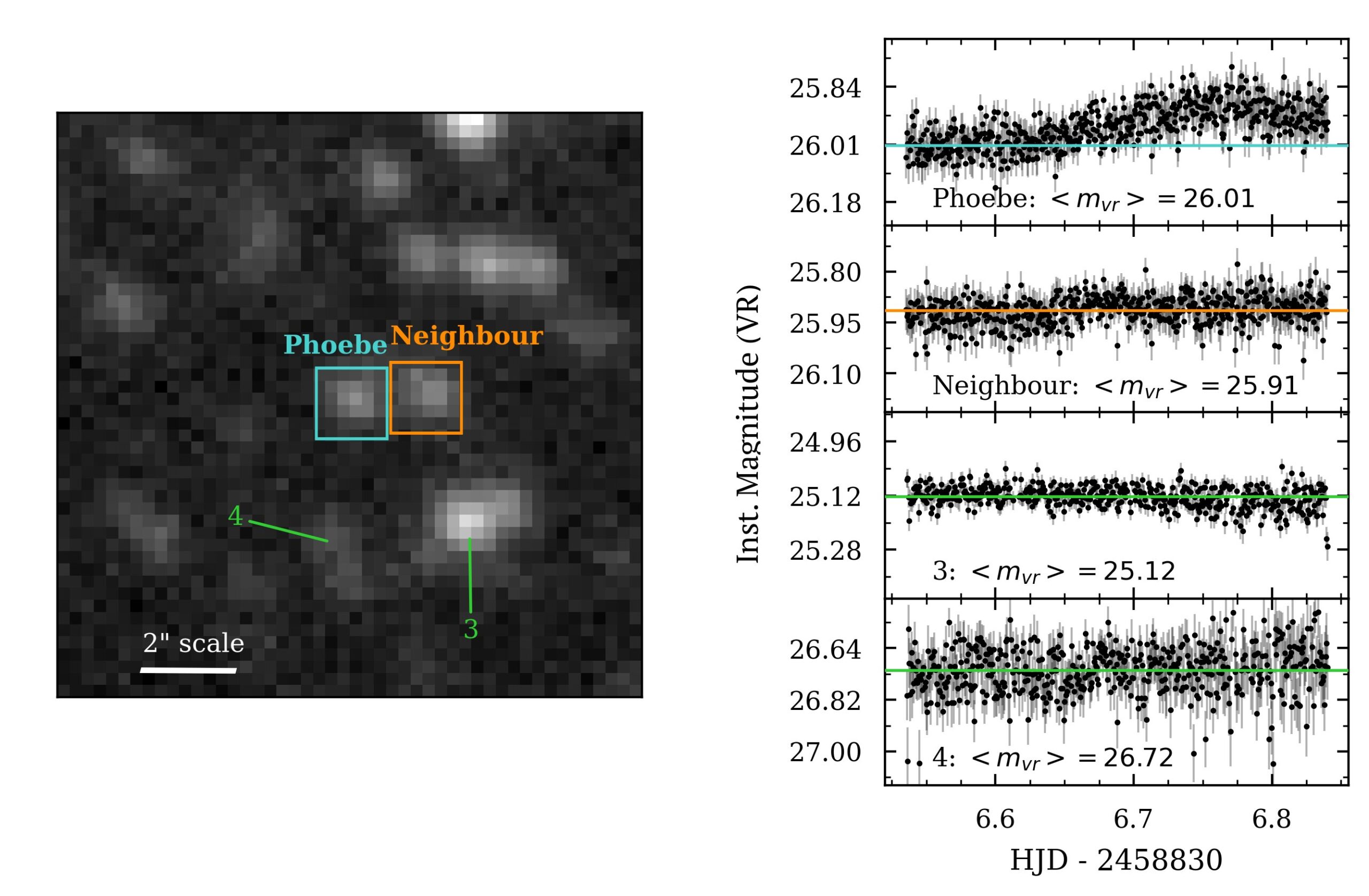
The star brightened on at least three separate occasions over several years. One of those episodes had previously been interpreted as the signature of a primordial black hole passing in front of the star.
The researchers also found that the star’s average brightness changed over time.
This pattern is incompatible with a genuine microlensing event. A single compact object passing between Earth and a distant star produces a one-time event. Once the object moves away, the same event cannot repeat.
The repeated brightening instead suggested that the source of the changing light was the star itself.
Evidence Pointed to an Ordinary Variable Star
To ensure the observed changes were genuine and not caused by problems with the telescope data, the researchers compared the behavior of Phoebe with two nearby stars of similar brightness.
Those neighboring stars remained stable throughout the observations.
That comparison confirmed the changing brightness was unique to Phoebe and reflected real variations rather than measurement errors.
Taken together, the repeated brightening events and the long-term shifts in average brightness match the well-known behavior of variable stars, which naturally fluctuate in brightness over time.
The researchers concluded that Phoebe is an ordinary variable star, not evidence of a lunar-mass primordial black hole.
As they wrote, “These observational characteristics indicate that Phoebe is an ordinary variable star, rendering the claims of the discovery of a lunar-mass PBH in the Milky Way dark matter halo invalid.”
An interesting detail is that the nickname “Phoebe” referred to different objects in the two studies. In the earlier work, it described the suspected primordial black hole, while the new paper uses the nickname for the star itself.
Why Long-Term Observations Matter
The new findings also highlight a broader challenge in astronomical observations.
According to the researchers, this is not the first time that a naturally varying star has been mistaken for a short-duration microlensing event.
When observations cover only a few days, distinguishing between a genuine one-time gravitational event and a star that naturally flickers can be difficult.
By extending the timeline with additional observations collected over months and years, astronomers can determine whether an apparent flash was truly unique or simply one episode in a recurring pattern of stellar variability.
In Phoebe’s case, the longer observational record made the distinction clear.
Why This Matters
The new study removes what had appeared to be rare evidence for a lunar-mass primordial black hole and brings the DECam observations back into agreement with results from the long-running OGLE survey. Rather than supporting the idea that such black holes make up dark matter, the reanalysis shows that ordinary stellar variability can closely mimic the signals astronomers are searching for. The result underscores the importance of long-term monitoring and careful independent verification before extraordinary claims become accepted, especially when they have implications for one of the biggest unanswered questions in modern astronomy.