Far beyond our own galaxy, about 86.7 million light-years away, a spiral of light turns slowly in the dark. Its formal name is NGC 5938. But to the astronomers who studied it, it carries a more poetic nickname: Araish, meaning “adornment” in Urdu. The name feels fitting. Seen edge-on, Araish is a striking barred spiral galaxy, its glowing disk alive with ongoing star formation, its shape elegant and composed.
Yet beneath that beauty, something unexpected was happening.
Spiral galaxies like Araish are usually known for their graceful arms and steady birth of stars. When astronomers think of powerful radio jets—those immense, energetic beams launched from galactic centers—they usually picture something else entirely: massive elliptical galaxies or blazing quasars. Spiral galaxies are not supposed to roar like that.
And yet, Araish does.
Listening to the Galaxy in Many Colors
To understand what was happening inside this distant spiral, an international team of astronomers led by Hina Zakir of Western Sydney University turned to a powerful strategy: multi-wavelength observations. Instead of looking at the galaxy in just one type of light, they examined it across several parts of the electromagnetic spectrum, each revealing a different layer of its story.
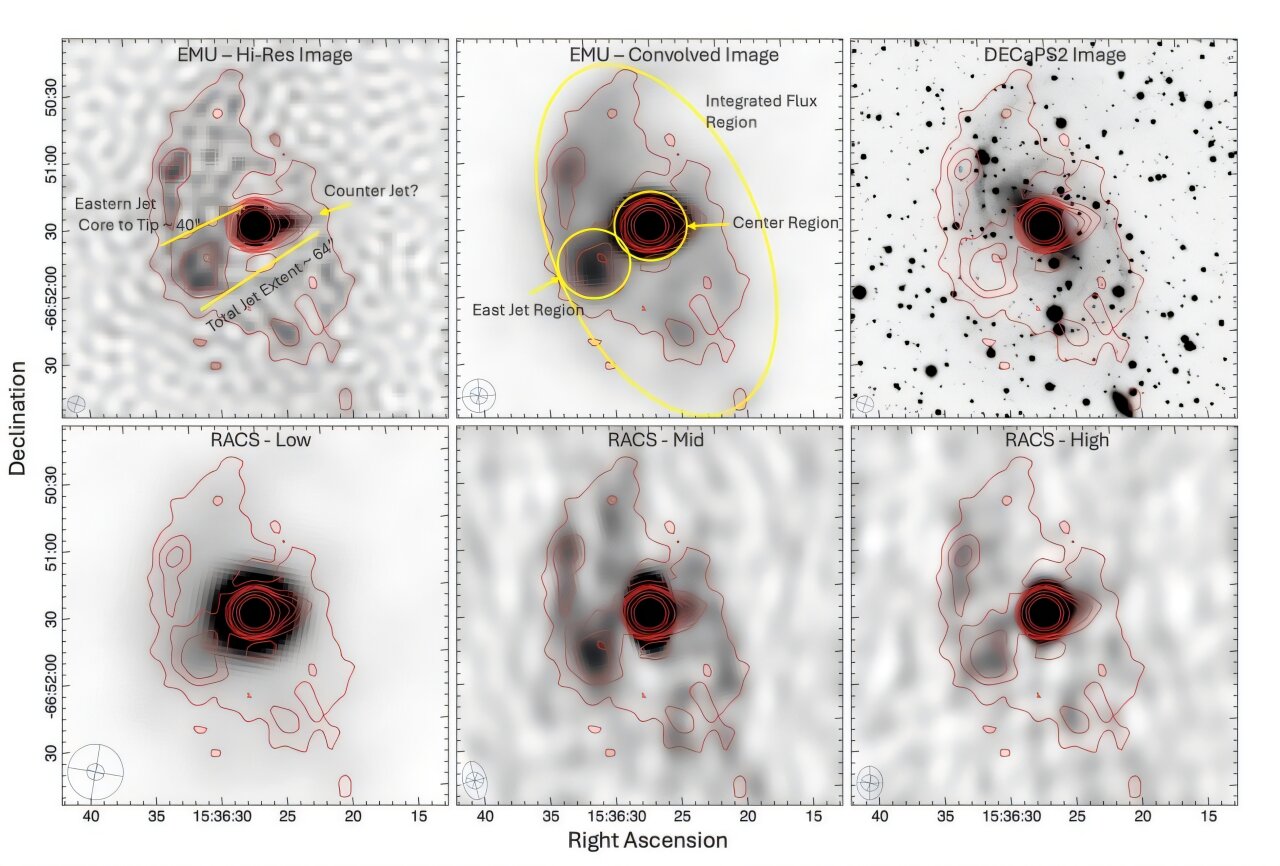
The backbone of their investigation came from the Evolutionary Map of the Universe (EMU) survey, conducted with the Australian Square Kilometre Array Pathfinder. They also used data from the Rapid ASKAP Continuum Survey (RACS), along with observations from the Wide-field Infrared Survey Explorer, the Dark Energy Camera Plane Survey 2, and the extended Roentgen Survey with an Imaging Telescope Array.
Each instrument offered a different “sense.” Radio waves could reveal high-energy processes invisible to human eyes. Infrared light traced warm dust and star-forming regions. Optical data showed structure. X-rays exposed violent and energetic activity near the galaxy’s core.
Together, these observations allowed the team to ask a simple but profound question: what is truly powering the radio emission from Araish?
The Surprise in the Radio Waves
When the radio data came into focus, the surprise was unmistakable.
Stretching out from Araish was an extended radio jet—a colossal structure reaching roughly 26,700 light-years into space. It shot out perpendicular to the galaxy’s major axis, cutting through space like a cosmic lance.
The radio emission carried another important clue. It had a steep spectral index of about −1.2, a telltale signature of synchrotron emission. That term refers to radiation produced when high-speed particles spiral through magnetic fields. In galaxies, such emission is strongly associated with jets powered by an active galactic nucleus, or AGN.
In simpler terms, Araish wasn’t just quietly forming stars. Its central engine was actively launching material outward at tremendous energies.
Even more intriguing, the galaxy’s nucleus itself displayed a different but related signature. Its spectral index measured −0.7, a value consistent with core AGN activity. The heart of Araish was not dormant. It was awake.
An Engine Hidden in a Spiral
Astronomers have long observed dramatic radio jets in massive elliptical galaxies and quasars. But spiral galaxies—those elegant, disk-shaped systems—rarely host such large-scale radio structures.
That rarity is what makes Araish extraordinary.
Galaxies like this are known as spiral double radio-source associated with galactic nuclei, abbreviated as DRAGNs. The name sounds fierce, and in a sense, it is. These systems are unusual hybrids. They retain the classical disk morphology of a spiral galaxy—complete with active star formation—while simultaneously producing vast radio jets more commonly associated with entirely different galactic environments.
Araish appears to be one of these rare creatures.
The team’s findings suggest that the extended radio emission arises from a synchrotron jet driven by its central AGN. At the same time, the galaxy’s disk continues forming stars at a rate of about 0.58 solar masses per year. Beauty and power coexist here. A swirling disk of newborn stars surrounds a central engine capable of hurling energetic particles tens of thousands of light-years into space.
The X-Ray Glow at the Core
Radio waves told part of the story, but the X-ray observations added crucial detail.
The X-ray emission from Araish’s nucleus aligns with the radio contours, indicating a concentrated central source. This alignment strengthens the interpretation that the activity seen in radio wavelengths originates from the same energetic heart.
The galaxy’s soft X-ray luminosity was measured at approximately 3.4 duodecillion erg per second. That level of emission is consistent with what astronomers would expect from X-ray binary populations and shock-heated plasma, given the galaxy’s current star-formation rate.
In other words, the X-ray glow fits within what is expected for a galaxy actively forming stars, while also housing a dynamic central engine. Nothing appears wildly out of balance. Instead, the different observations weave together into a coherent picture.
Araish is not merely a spiral galaxy with random radio noise. It is a structured, organized system where star formation and AGN-driven jets operate side by side.
A New Member of a Rare Family
With all the pieces in place, the researchers reached a compelling conclusion. Araish is a new example of a spiral DRAGN.
This designation matters because such galaxies are uncommon. The coexistence of a star-forming disk and large-scale radio jets challenges the traditional expectations of how galaxies behave. Classical models often associate strong radio jets with massive elliptical galaxies, not delicate spirals.
Araish defies that pattern.
Its disk continues to produce stars. Its central nucleus shows clear AGN activity. Its extended radio jet, with a steep spectral signature, stretches tens of thousands of light-years into space. Each line of evidence supports the idea that this is not an anomaly or a measurement error. It is a genuine, large-scale structure emerging from a spiral galaxy.
The team’s work demonstrates how powerful systematic surveys like EMU can uncover these rare systems. By scanning the sky in radio frequencies with unprecedented sensitivity, astronomers can identify more spirals that hide energetic jets within their elegant forms.
Why This Discovery Matters
At first glance, this might seem like just another galaxy added to a catalog. But the implications run deeper.
Galaxies evolve over billions of years. Their shapes, star-formation rates, and central black holes all interact in complex ways. When a spiral galaxy launches a large radio jet, it raises important questions about how these processes connect. How does a galaxy maintain its disk structure while powering such energetic outflows? What does this tell us about the life cycles of galaxies?
Araish provides a crucial data point.
By confirming it as a new spiral DRAGN, the researchers highlight the importance of wide, sensitive radio surveys in revealing hidden aspects of galaxy evolution. Each newly identified system helps astronomers constrain how common these hybrids truly are and what role they play in shaping galaxies over cosmic time.
There is something poetic about it. A galaxy nicknamed “adornment,” admired for its graceful spiral form, turns out to harbor a powerful, unseen force at its center. It reminds us that appearances in the cosmos can be deceiving. Beneath calm, luminous disks, immense energies may be at work.
Araish is not just beautiful. It is dynamic. It is active. It is, in its own quiet way, revolutionary.
And somewhere, 86.7 million light-years away, its jet continues to stream outward into the dark, carrying with it clues about how galaxies grow, change, and sometimes surprise us.
Study Details
H. Zakir et al, EMU Radio Observations of Barred Spiral Galaxy NGC 5938 (Araish), arXiv (2026). DOI: 10.48550/arxiv.2602.09658