At the heart of almost every galaxy, including our own, lies something immense and unsettling: a supermassive black hole. Astronomers have known they are there for decades, quietly anchoring galaxies with their enormous gravity. But knowing something exists is very different from understanding what it does. For years, scientists have suspected these giants dramatically influence their surroundings, yet the details remained frustratingly out of reach. Now, a newly launched satellite has pulled back the curtain, revealing a scene far more active and violent than static images ever suggested.
Using data from the XRISM satellite, a team led by researchers at the University of Chicago has captured the clearest measurements yet of how gas moves around two supermassive black holes sitting at the centers of massive galaxy clusters. For the first time, astronomers can directly measure the kinetic energy of gas stirred by these black holes, turning long-standing theories into something tangible and measurable. One of the researchers described it as discovering that each black hole sits calmly in the “eye of its own storm,” while chaos rages all around it.
A New Way to Read the Universe’s Heat and Motion
The breakthrough comes from XRISM’s unusual abilities. Launched in 2023 by the Japanese Aerospace Exploration Agency, in partnership with NASA and the European Space Agency, the satellite was designed to do something previous missions could not. It can track both the motion and the chemical makeup of extremely hot gas that shines in X-rays, the kind of gas that fills galaxy clusters.
This matters because galaxy clusters are anything but quiet. They are filled with seething clouds of gas, influenced by many forces at once. Until now, astronomers struggled to separate gas motions caused by black holes from those driven by other cosmic events. XRISM changes that. By precisely measuring the energy of incoming X-rays, it allows scientists to unambiguously distinguish gas movements powered by black holes from motions caused by other processes. What once looked like a frozen snapshot now reveals itself as a living, churning system.
Messy Eaters at the Centers of Galaxies
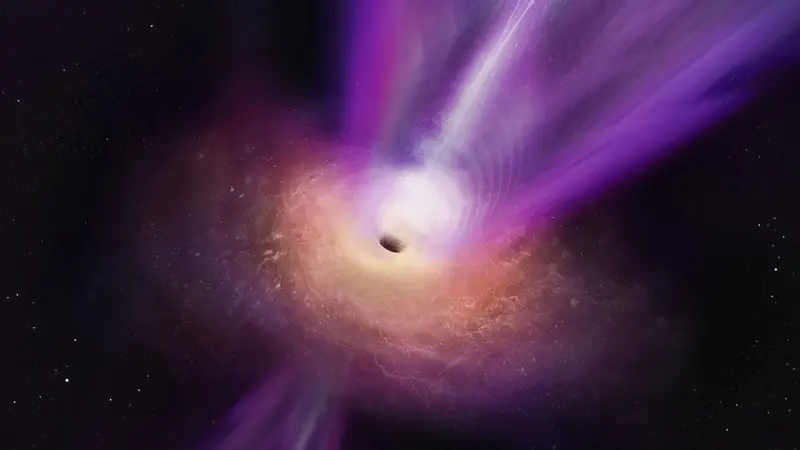
One reason supermassive black holes are so influential is that they are not neat consumers. As gas and stars fall toward a black hole’s event horizon, not all of that material disappears. Instead, streams of energetic particles are launched outward at speeds approaching that of light. These outflows crash into surrounding gas, stirring it violently and injecting enormous amounts of energy into their environments.
The reach of this influence is staggering. The black hole’s activity does not stay confined to its immediate neighborhood but can extend hundreds of thousands of light-years away, reshaping conditions across an entire galaxy cluster. Scientists have long believed this energy plays a major role in controlling how galaxies grow, especially by regulating star formation. But while hints of this process appeared in earlier X-ray images, those images were static. They could not show how fast the gas was moving or how much energy was involved.
XRISM finally adds motion to the picture. Each element in the hot gas emits X-rays at specific energies, like unique atomic fingerprints. By studying the shape of these fingerprints, scientists can tell how fast the gas is moving. What emerges is not a calm environment but a turbulent, restless one.
When a Nearby Giant Stirs the Gas
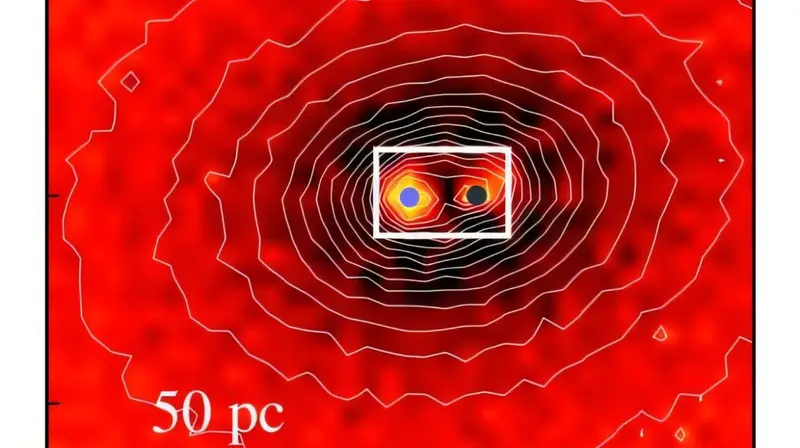
One of the studies focused on the Virgo Cluster, the closest galaxy cluster to Earth. At its center sits the famous black hole M87*. Because of the cluster’s proximity, XRISM was able to zoom in on a relatively small region around the black hole, offering an unusually detailed view.
What the scientists found was startling. The gas near M87* showed the strongest turbulence ever measured in a galaxy cluster, even more intense than the turbulence seen when galaxy clusters collide. Such mergers are among the most violent events since the Big Bang, yet the black hole’s influence here rivals them.
The measurements revealed that gas velocities are highest closest to the black hole and then drop off sharply with distance. This pattern suggests that the fastest motions come from a mix of swirling eddies of turbulence and a shockwave of outflowing gas, both produced by the black hole’s activity. Instead of a smooth flow, the environment resembles a storm with its most violent winds concentrated near the center.
Untangling Motions in a Brighter Cluster
The team also turned XRISM toward the Perseus Cluster, the brightest galaxy cluster in the X-ray sky as seen from Earth. Its intense X-ray glow allowed scientists to map gas motions both near the cluster’s core and farther out. This broader view revealed a complex dance of forces.
In Perseus, the researchers clearly identified a distinct boost in gas velocities driven by the central black hole. On top of that, they saw large-scale motions caused by another event entirely: Perseus is currently merging with a chain of galaxies. For the first time, astronomers could separate these influences, teasing apart what the black hole was doing from what the larger cosmic environment was contributing.
This ability to disentangle overlapping processes is crucial. It allows scientists to see the black hole’s role not as a vague background effect but as a specific, measurable source of energy injected into its surroundings.
The Mystery of Missing Stars
These observations feed directly into a long-standing puzzle. Astronomers have noticed that the centers of massive galaxy clusters contain fewer stars than expected. One possible explanation is that the energy released by supermassive black holes heats the surrounding gas, preventing it from cooling and collapsing into new stars.
The new XRISM data bring this idea into sharper focus. If the energy contained in the measured gas motions is fully converted into heat, the researchers found it would be just enough to counteract the rapid cooling that normally fuels star formation. In other words, the turbulence stirred up by the black hole could be acting as a brake on star birth.
This does not mean the case is closed. Scientists emphasize that it remains an open question whether this turbulence is the only heating process at work. But the findings make one thing clear: turbulent motion is a necessary part of how energy flows from supermassive black holes into their environments.
Why This Changes the Story of Galaxies
For decades, black holes have been portrayed as cosmic vacuum cleaners, silently swallowing whatever strays too close. The picture emerging from XRISM is far more dynamic. These objects are not just consumers but powerful engines that stir, shock, and energize the gas around them. Their influence shapes entire galaxy clusters, affecting where and when stars can form.
As XRISM continues to collect data, scientists hope to track how these interactions change over time, how violently black holes inject energy into their surroundings, and how that energy ultimately turns into heat. Each new observation brings them closer to understanding the delicate balance between growth and suppression that governs galaxies.
This research matters because it connects the smallest scales of extreme gravity with the largest structures in the universe. By finally measuring how supermassive black holes move and heat the gas around them, astronomers are learning how galaxies evolve, why some regions shine with new stars while others fall quiet, and how the universe organizes itself on the grandest scales. What once looked like a still image has become a living storm, and for the first time, we can measure the wind.
Study Details
Annie Heinrich et al, Disentangling multiple gas kinematic drivers in the Perseus galaxy cluster, Nature (2026). DOI: 10.1038/s41586-025-10017-x
Preprint: Hannah McCall et al, A XRISM/Resolve view of the dynamics in the hot gaseous atmosphere of M87, arXiv (2025). DOI: 10.48550/arxiv.2512.06596