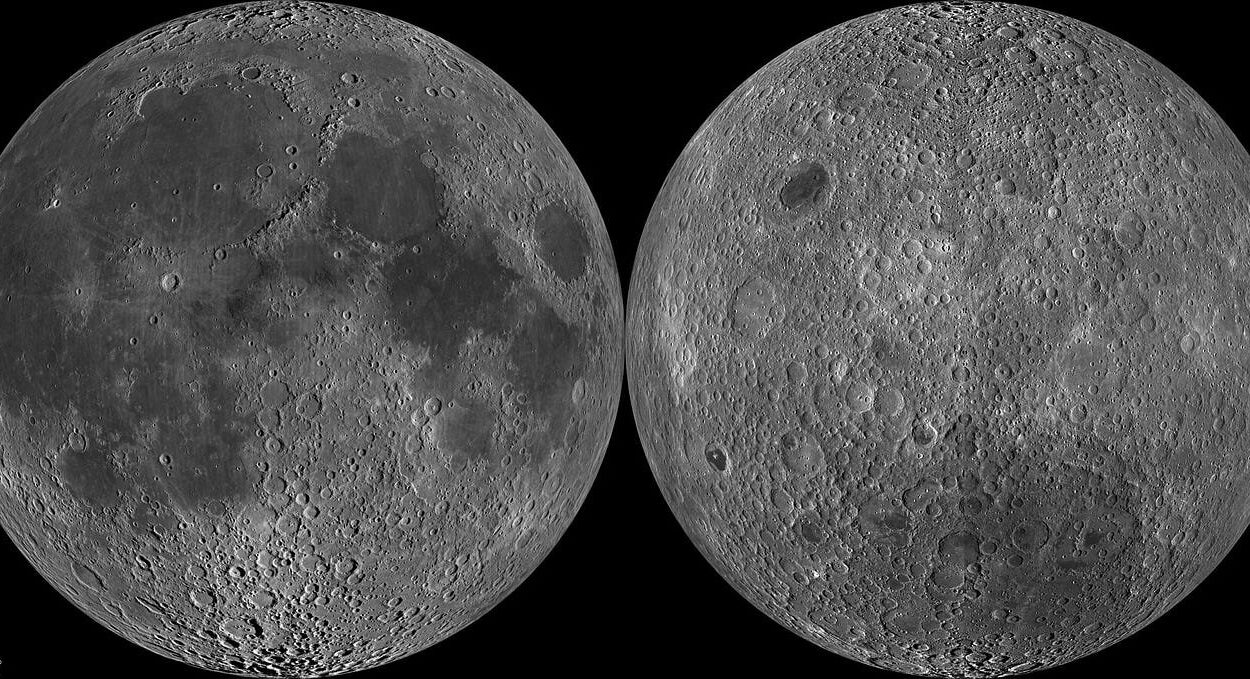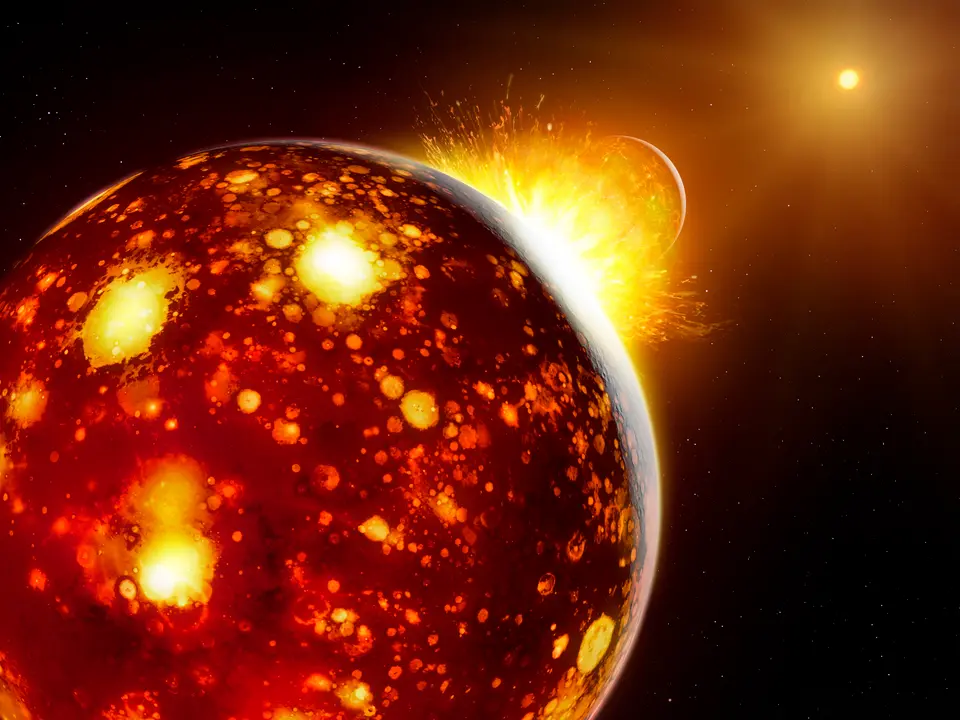
About 4.5 billion years ago, the Earth was not yet the vibrant blue planet we know today. It was a young, molten world, forming and evolving through violent cosmic forces. Then came an event that would forever alter its fate: a colossal celestial body—now known as Theia—collided with our planet. It was a cataclysmic moment, one that not only changed the course of Earth’s development but also gave birth to the moon, our eternal companion in space. The aftermath of this cosmic crash continues to echo through the very rocks beneath our feet.
But who, or what, was Theia? What was this mysterious body that so profoundly shaped the Earth? And from where did it originate? These are questions that have long intrigued scientists, but answering them is far from simple. Theia was destroyed in the collision, leaving no physical trace behind. Still, fragments of its identity remain hidden in the very composition of Earth and the moon—fragments that scientists are now painstakingly trying to uncover.
Tracing Theia’s Origins Through Isotopes
In a groundbreaking study published in Science, a team of researchers from the Max Planck Institute for Solar System Research (MPS) and the University of Chicago embarked on a quest to piece together the puzzle of Theia’s identity. They did so by examining the isotopic composition of Earth and moon rocks, trying to uncover traces of Theia’s presence in the elements that make up our planet and its companion.
“The composition of a body archives its entire history of formation, including its place of origin,” said Thorsten Kleine, Director at MPS and a co-author of the study. Isotopes—the variants of elements that differ only in the number of neutrons in their nuclei—hold the key to this story. They carry a memory of the conditions in which they were created, and the ratios of isotopes in a body can reveal clues about where it came from in the solar system.
The researchers focused on iron isotopes, which are particularly telling. Iron is abundant in both Earth and the moon, and its isotopic composition can reveal a great deal about the history of these bodies. But it wasn’t just iron that the team studied. They also looked at the isotopes of chromium, molybdenum, zirconium, and other elements, each offering insight into different stages of planetary formation.
The Earth and Moon: A Shared Story
The results were striking. The team found that the isotope ratios of Earth and moon rocks were nearly identical. This suggests that the materials that make up our planet and its satellite share a common origin. The moon, it seems, is not just a passive bystander in the aftermath of Theia’s collision, but rather a product of the same cosmic process that formed Earth.
However, this similarity also presents a challenge. While it seems clear that Theia played a role in the moon’s creation, the exact nature of that role remains unclear. How much of the moon’s material came from Theia, and how much came from Earth? Most models suggest that the moon was formed primarily from the debris of Theia, but it’s also possible that Earth’s own mantle contributed significantly to the moon’s composition. In fact, the two bodies could have mixed together so completely that distinguishing between them becomes nearly impossible.
Reverse Engineering the Planetary Collision
To get closer to the truth, the researchers employed a technique known as “reverse engineering.” Instead of trying to directly examine Theia—something that is impossible due to its destruction—they worked backward from the isotope ratios in the rocks of Earth and the moon. By running simulations, they were able to explore what the compositions and sizes of Earth and Theia must have been in order to produce the observed isotope matches.
In their investigations, the team looked at how different elements behaved during the early stages of Earth’s formation. For example, elements like iron and molybdenum, which sank into Earth’s core during its formation, would not have been part of the planet’s mantle. The iron we find in Earth’s mantle today, they determined, must have arrived from Theia, which carried it from the outer solar system. Meanwhile, elements like zirconium, which didn’t sink into the core, offer a broader view of the planet’s formation history.
But there was one more piece of the puzzle to solve: where did Theia come from? And how could scientists be sure?
Meteorites: Clues from Ancient Space Travelers
The team turned to meteorites for help. Meteorites are like time capsules from the early solar system, containing clues about the conditions and materials that existed in the distant past. The researchers compared the isotopic compositions of meteorites to those of Earth and the moon, looking for similarities and differences.
The results were illuminating. While Earth’s composition matched well with certain types of meteorites, Theia’s did not. This led the researchers to a surprising conclusion: Theia was not made up of the same materials as the early Earth. Instead, it seems that Theia may have come from a different region of the solar system—specifically, a location closer to the sun than Earth. This was a key finding, suggesting that Earth and Theia were neighbors, but not identical twins.
“The most convincing scenario is that most of the building blocks of Earth and Theia originated in the inner solar system,” said Timo Hopp, MPS scientist and lead author of the study. “Earth and Theia are likely to have been neighbors.”
Why This Matters
The collision of Earth and Theia is one of the most defining events in our planet’s history. It set the stage for the Earth we know today—its size, composition, and even its orbit were shaped by this ancient impact. But understanding what happened during that collision, and where Theia came from, is more than just an academic exercise. It offers us a glimpse into the early solar system, and provides insight into the processes that shaped not only Earth, but also other planets and moons in our solar system and beyond.
The findings of this study are significant because they help us understand the birth of the moon, a key part of our planet’s history. They also shed light on the conditions in the early solar system, where planets and other bodies were forming and colliding in ways we are only beginning to understand.
Perhaps most importantly, this research helps us answer a question that has fascinated humankind for centuries: Where did we come from? By studying the remains of Theia, scientists are not just piecing together the history of our planet—they are uncovering the origins of Earth itself, and, by extension, the origins of life as we know it.
More information: Timo Hopp et al, The Moon-forming impactor Theia originated from the inner Solar System, Science (2025). DOI: 10.1126/science.ado0623. www.science.org/doi/10.1126/science.ado0623