In the quiet language of climate models, the future sometimes announces itself with unsettling clarity. According to a new study led by scientists at The Hong Kong University of Science and Technology, the Northern Hemisphere summer monsoon is on course for a dramatic transformation. Beginning around the year 2064, under a high-emission pathway, vast regions of Asia and the tropics may experience a new rhythm of weather that no longer flows but snaps back and forth. Torrential rain gives way to parching dryness, only to reverse again within weeks. This phenomenon, known as subseasonal whiplash, unfolds on timescales of roughly one to three months, and its consequences extend far beyond discomfort or inconvenience. It threatens the foundations of food production, water management, and clean energy systems across some of the world’s most densely populated regions.
The study, published in Science Advances under the title “Increased Global Subseasonal Whiplash by Future BSISO Behavior,” is the result of an international collaboration involving researchers from Hong Kong, Hawaiʻi, mainland China, and beyond. Together, they set out to understand how a powerful but often overlooked climate system, the Boreal Summer Intraseasonal Oscillation, may behave in a warming world. Their conclusion is stark: the oscillation that already governs the pulse of the Asian summer monsoon is likely to become faster, broader, and far more disruptive.
Following the Hidden Pulse of the Monsoon
At the heart of this research lies the Boreal Summer Intraseasonal Oscillation, or BSISO. This system operates quietly but persistently, shaping weather patterns across the tropics during Northern Hemisphere summers. Over periods lasting from 30 to 90 days, it generates alternating zones of enhanced and suppressed rainfall, marching across regions that depend heavily on predictable monsoon rains.
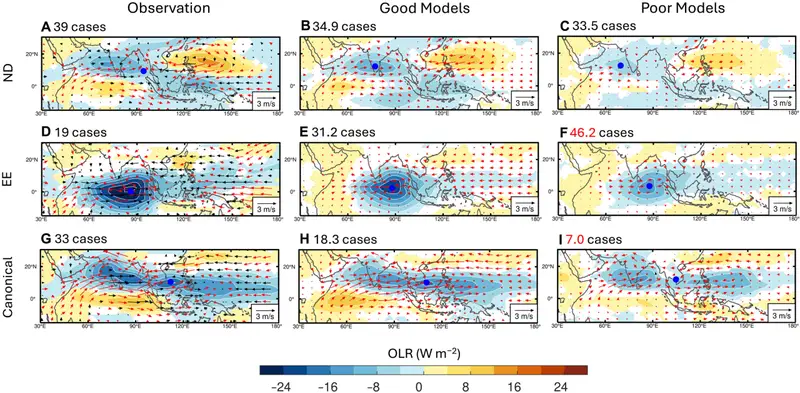
To peer into the future of this oscillation, the research team turned to an ensemble of up to 28 coupled general circulation models drawn from the latest generation of global climate simulations known as CMIP6. These models represent some of the most advanced tools available for projecting how Earth’s climate may respond to different emissions trajectories. By focusing on a high-emission scenario, the scientists explored a future in which greenhouse gas concentrations continue to rise rapidly.
The sheer volume of data produced by these simulations demanded sophisticated analytical techniques. Using unsupervised K-means clustering, the researchers sorted complex patterns of atmospheric behavior into distinct modes of BSISO propagation. This process revealed three characteristic ways in which the oscillation travels: a canonical mode that propagates northeastward, a northward dipole mode, and an eastward expansion mode. Each of these patterns carries its own signature of rainfall and dryness, and each responds differently to a warming climate.
When Familiar Patterns Grow More Extreme
The study shows that the canonical northeastward mode and the northward dipole mode are both projected to intensify in the future. For South Asia and East Asia, this intensification translates into stronger swings between wet and dry conditions. Monsoon rains may arrive with greater force, while dry spells deepen and linger. Such extremes strain agricultural systems that are finely tuned to seasonal expectations and test water infrastructure designed for a more stable climate.
Yet it is the third pattern, the eastward expansion mode, that emerges as the most consequential finding of the research. Historically, this mode has tended to weaken as it approaches the complex geography of the Maritime Continent, including regions such as Indonesia. In the future envisioned by the models, that restraint disappears.
Dr. Cheng Tat-Fan, the first author of the study, describes a system gathering speed and reach. “Under a high-emission scenario (SSP5-8.5), the propagation speed of this EE mode, eastward-moving rain-bearing wave is projected to double by the end of this century. Interestingly, the system is expected to expand eastward by approximately 30 degrees of longitude. Where it once typically dissipated over the Maritime Continent, such as Indonesia, it will now push deep into the West Pacific.”
This acceleration means that regions may experience rapid alternations between soaking rains and drying conditions within a single season. The oscillation does not merely intensify existing patterns; it reorganizes them, delivering weather extremes to places unaccustomed to such volatility.
Ripples That Reach Beyond the Tropics
Although the BSISO is rooted in tropical dynamics, its influence does not remain confined there. The study highlights how atmospheric teleconnections can transmit the effects of intensified subseasonal whiplash to distant parts of the globe. As the oscillation grows more energetic, it sends ripples through the atmosphere that alter rainfall patterns far from its origin.
One of the most striking examples emerges in high northern latitudes. The researchers identify heightened swings in precipitation over Greenland and northern Russia, regions where rainfall variability can have profound implications for ice, ecosystems, and local communities. These changes underscore the interconnectedness of Earth’s climate system, where disturbances in one region can reverberate across hemispheres.
Farther south, in central and northern Africa, increased whiplash events are projected to influence Saharan dust emissions. Dust lifted from arid landscapes plays a role in atmospheric processes that extend across oceans. The study suggests that altered dust dynamics could potentially disrupt tropical cyclone formation over the Atlantic Ocean, linking monsoon variability to storms thousands of kilometers away.
The Human Cost of Sudden Swings
Behind these atmospheric patterns lies a deeply human story. Subseasonal whiplash is not merely a meteorological curiosity; it represents a severe challenge for societies dependent on stable climate rhythms. Prof. Lu Mengqian, co-leader of the study and Director of the Otto Poon Center for Climate Resilience and Sustainability, emphasizes the particular danger posed by rapid transitions from drought to flood.
“The type of sudden shift from drought to flood is particularly damaging––there is evidence suggesting the risk of global rice yield loss is 43% higher from such an event than from a wet-to-dry swing,” she explains. Rice cultivation, which relies on carefully managed water regimes, is especially vulnerable to abrupt inundation following dry periods. Fields hardened by drought cannot absorb sudden deluges, leading to runoff, erosion, and crop loss.
The researchers foresee that changes in BSISO behavior will increase the frequency of these dry-to-wet events across arable regions in Asia and Africa. In areas already grappling with food security challenges, such disruptions could directly threaten future global food production. Water resources, too, are at risk, as reservoirs and irrigation systems struggle to cope with rapid inflows followed by extended shortages. Clean energy systems, particularly those dependent on hydropower, may find their reliability undermined by erratic water availability.
Learning to Anticipate the Whiplash
Faced with this emerging picture of climatic volatility, the authors of the study argue that adaptation must begin with better anticipation. Prof. Lu calls for a concerted effort to strengthen forecasting systems capable of capturing subseasonal dynamics. “There is an urgent need to invest in and improve subseasonal-to-seasonal (S2S) forecasting models to stay ahead of these evolving challenges,” she says.
Improved forecasts would provide critical lead time for decision-makers, allowing farmers, water managers, and energy planners to prepare for impending shifts. The benefits extend beyond immediate risk reduction. Prof. Lu highlights the importance of strengthening urban infrastructure against climate impacts, ensuring sustainability across the interconnected water-energy-food-economy nexus, and enhancing the ability to predict outbreaks of diseases sensitive to climate variations. Such capabilities would empower governments and the private sector to make informed choices in long-term planning and policy development.
Why This Research Matters Now
This study matters because it reveals a future in which climate change does not simply amplify familiar extremes but reorganizes the tempo of weather itself. By showing how the Boreal Summer Intraseasonal Oscillation may accelerate and expand under a high-emission scenario, the research illuminates a pathway toward more frequent and damaging subseasonal whiplash events. These rapid alternations between drought and flood threaten food systems, water security, energy reliability, and even distant climate processes through atmospheric connections.
Equally important, the study demonstrates the power of advanced climate models and data-driven analysis to uncover hidden vulnerabilities before they fully emerge. Understanding these dynamics decades in advance offers a narrow but invaluable window for preparation. As the monsoon’s pulse quickens, the challenge for society will be to match that pace with foresight, resilience, and informed action.
More information: Tat Fan Cheng et al, Increased global subseasonal whiplash by future BSISO behavior, Science Advances (2025). DOI: 10.1126/sciadv.adv6355