From a distance, Abell 3571 appears almost serene. Floating quietly in space, this vast galaxy cluster gives the impression of balance and symmetry, a cosmic city settled into calm after a long history of growth. Earlier X-ray observations seemed to confirm this image, portraying the cluster as relaxed and orderly, with a smooth structure and a cool, stable core at its heart. But appearances, as astronomers are learning once again, can be deeply misleading.
Using the Einstein Probe (EP), a space-based observatory designed to study the X-ray universe, astronomers from China and Germany decided to take a closer look. What they uncovered beneath the surface was not a tranquil giant, but a massive system still echoing with the aftershocks of an ancient disturbance. Their findings, published on January 8 on the arXiv pre-print server, reveal a story of hidden motion, displaced gas, and a cluster still recovering from a subtle cosmic collision.
Inside One of the Universe’s Largest Structures
Galaxy clusters are among the most enormous structures in the universe. They can contain thousands of galaxies, all bound together by gravity, growing over billions of years as smaller groups merge and fall inward. Because of this long and violent history, clusters like Abell 3571 act as natural laboratories for understanding how galaxies evolve and how matter behaves on the largest scales.
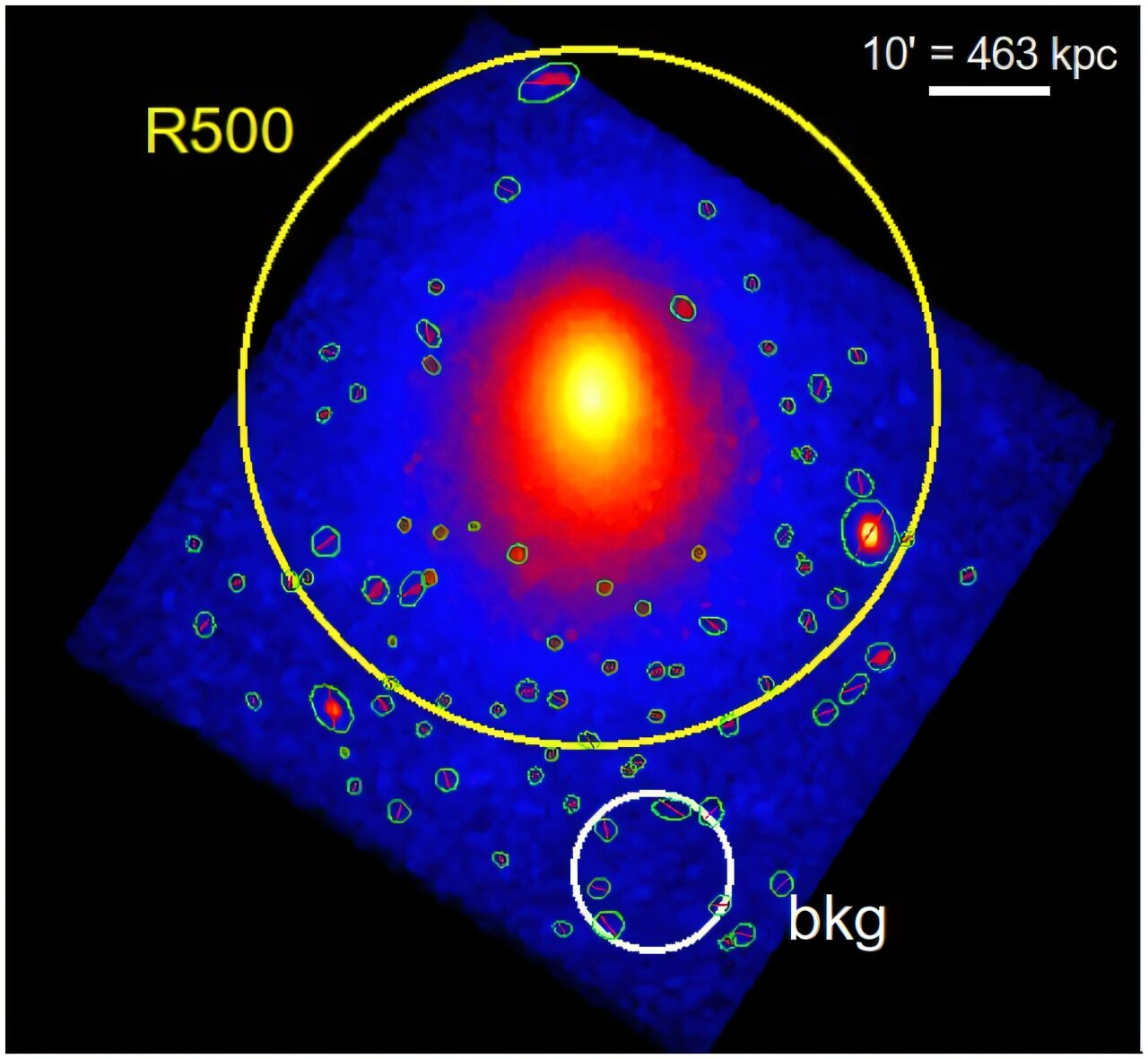
Abell 3571, also known as A3571, resides in the Shapley Supercluster, a crowded region of the cosmos. At a redshift of 0.039, it is relatively nearby by cosmic standards, making it an ideal target for detailed observation. The cluster stretches across a radius of about 5.5 million light years and carries an astonishing mass of roughly 910 trillion solar masses.
At its center lies the brightest cluster galaxy, MCG–05–33–002, which itself shows a clear north–south elongation. This stretched appearance hinted that the cluster’s history might not be as peaceful as once thought, encouraging astronomers to look deeper.
A Calm Surface Hiding an Uneasy Past
Earlier X-ray studies painted Abell 3571 as morphologically relaxed, meaning it appeared largely spherical and stable, with a central cooling flow where hot gas slowly radiates energy. Such features are often associated with clusters that have not experienced recent major disruptions.
Yet observations in other wavelengths told a different story. When astronomers examined the cluster using optical and additional data, signs of a more complex past began to emerge. These studies suggested that Abell 3571 may have experienced a merger or other disturbance events, subtle enough to leave the overall shape intact but powerful enough to stir the cluster’s interior.
To investigate this tension between calm appearance and hidden complexity, a research team led by Xinyi Zheng of Beijing Normal University turned to the Follow-up X-ray Telescope (FXT) aboard the Einstein Probe. They paired the X-ray data with optical observations from the DESI Legacy Imaging Surveys, allowing them to examine both the hot gas and the galaxies themselves.
The First Clues Beneath the X-Ray Glow
At first glance, the new observations seemed to reinforce the earlier picture. The X-ray morphology of Abell 3571 looked regular, and both its surface brightness and temperature profiles displayed classic cool-core characteristics. The cluster appeared settled, stable, and well-behaved.
But the story changed when the team examined the data more closely. Residual maps, which highlight deviations from a smooth model, and detailed two-dimensional thermodynamic maps revealed something unexpected. In the inner regions of the cluster, the structure was disturbed, showing signs of motion and imbalance that contradicted the cluster’s calm exterior.
These disturbances were not random. They followed patterns, directions, and temperature variations that pointed to a specific cause hidden in the cluster’s recent past.
Two Bright Patches That Refused to Stay Quiet
Within 20 arcminutes of the cluster’s center, the astronomers identified two prominent regions of surface brightness excess. One lay to the southwest, the other to the north. These glowing patches stood out clearly against the surrounding X-ray emission, demanding explanation.
The southwestern excess was linked to high-temperature features, suggesting regions where the gas had been heated or compressed. The northern excess, in contrast, corresponded to a cooler structure, an unexpected find in a cluster core that was supposed to be calm.
This cooler northern feature was particularly revealing. The team interpreted it as evidence of gas sloshing, a phenomenon where dense, low-entropy gas in the core is displaced and begins to oscillate within the cluster’s gravitational potential. Like water sloshing in a bowl after a gentle push, the gas retains memory of the disturbance long after the initial event has passed.
A Cosmic Axis of Disturbance
As the researchers mapped the cluster’s temperature in detail, a striking pattern emerged. The temperature distribution showed a clear north–south asymmetry, breaking the illusion of perfect symmetry suggested by earlier studies. This same north–south alignment appeared in the optical galaxy density distribution, linking the behavior of the hot gas to the arrangement of galaxies themselves.
This alignment was not a coincidence. Together, the X-ray and optical data pointed to a merger event that unfolded along the north–south direction. Rather than a dramatic collision between two massive clusters, the evidence suggested something quieter but still influential.
According to the team’s interpretation, a low-mass subcluster passed by Abell 3571 on an off-axis trajectory, moving from south to north. This encounter did not tear the cluster apart, but it was enough to disturb the delicate balance of the core.
When Small Collisions Leave Lasting Scars
The astronomers propose that this off-axis passage triggered the gas sloshing now visible in the X-ray data. As the subcluster moved past, it displaced the low-entropy gas in the cool core, pushing it northward and creating a fan-shaped brightness excess. Over time, the gas began to oscillate, leaving behind the temperature and brightness patterns now observed.
Importantly, this scenario explains how Abell 3571 can appear relaxed while still bearing the marks of a recent disturbance. Minor mergers, unlike major collisions, can leave a cluster’s overall shape largely intact while profoundly affecting its internal structure.
In this view, Abell 3571 is not broken or chaotic. It is healing.
A Cluster in Recovery
The final conclusion of the study is both subtle and powerful. Despite its symmetric appearance and cool-core properties, Abell 3571 is still recovering from a minor merger. The cluster has entered a post-merger phase, where the largest motions have faded, but the gas continues to settle back into equilibrium.
This finding reshapes how astronomers interpret relaxed clusters. It shows that calm X-ray images can hide complex dynamics beneath, and that even small interactions can leave long-lasting imprints on massive cosmic structures.
Abell 3571 stands as a reminder that the universe does not forget easily. Even gentle encounters echo for millions of years, written not in stars or galaxies alone, but in the invisible motions of hot gas filling the space between them.
Why This Discovery Matters
This research matters because it challenges simple assumptions about what a “relaxed” galaxy cluster truly is. By revealing hidden disturbances in Abell 3571, the study demonstrates the power of detailed X-ray observations to uncover the subtle physics shaping the universe’s largest structures.
Understanding gas sloshing, minor mergers, and post-merger phases is essential for using galaxy clusters as tools in cosmology. These processes influence how mass is distributed, how temperatures evolve, and how accurately clusters can be used to study the history and structure of the cosmos.
In the quiet glow of Abell 3571’s X-ray light, astronomers have found a story of motion, memory, and recovery. It is a story that reminds us that even the universe’s giants are shaped not only by dramatic collisions, but also by gentle pushes that leave lasting, hidden scars.
Study Details
Zheng et al, The X-ray properties and structure of A3571 up to R500, arXiv (2026). DOI: 10.48550/arxiv.2601.04619