Hidden deep in the early universe, the newly identified galaxy M1149-BSG-z5 has become the highest-redshift barred galaxy ever discovered. Observed by the James Webb Space Telescope (JWST), the massive spiral system challenges expectations by showing a well-developed stellar bar, rapid star formation, and signs of advanced chemical evolution at a remarkably early cosmic epoch.
The early universe was expected to be a difficult place for galaxies to develop orderly structures. Yet astronomers continue to uncover surprises, and the latest one may be among the most remarkable so far.
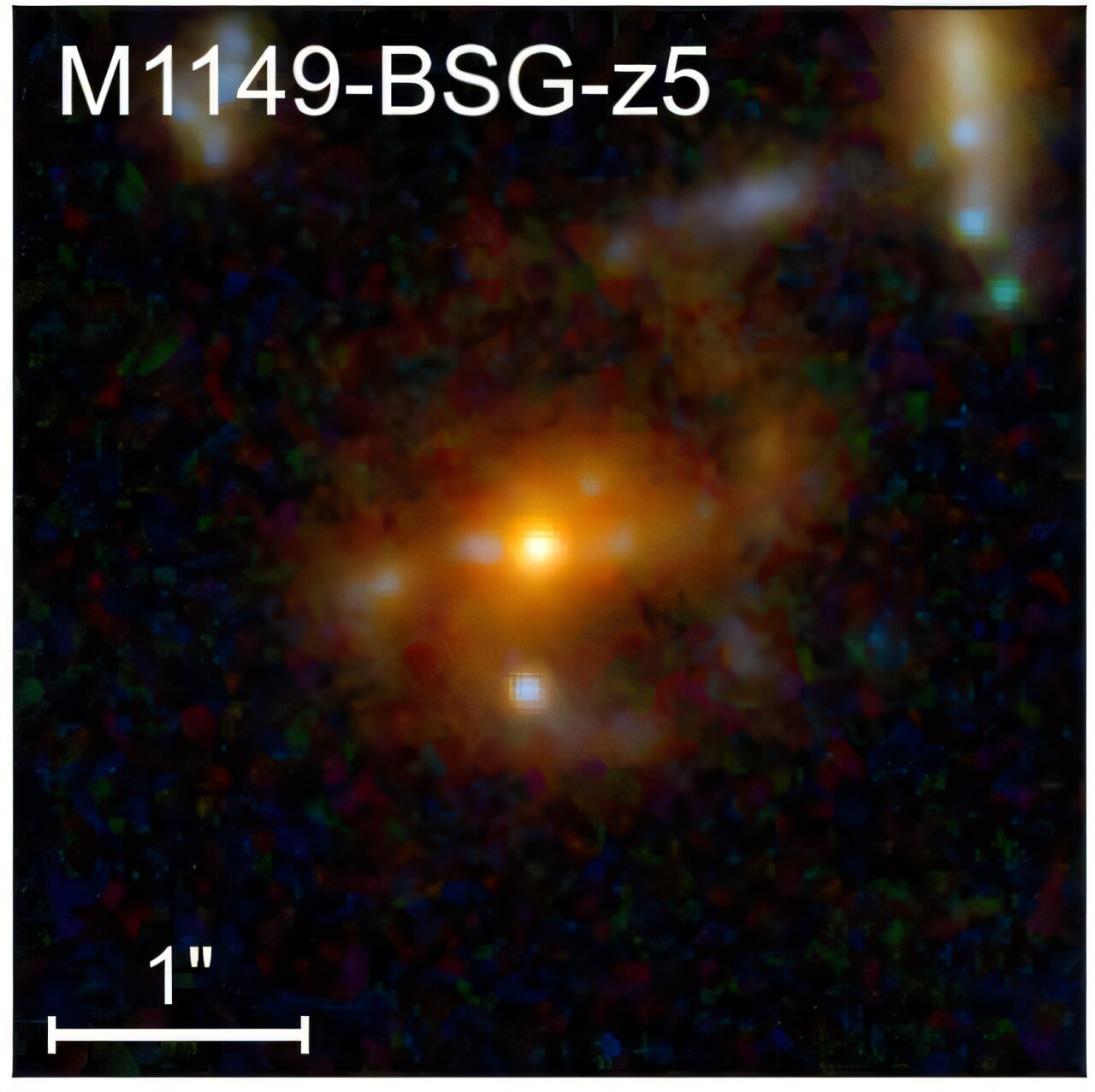
An international team of astronomers has identified a previously unknown massive barred spiral galaxy named M1149-BSG-z5 using observations from the James Webb Space Telescope (JWST). The discovery, described in a paper published on June 23 on the arXiv preprint server, marks the most distant barred galaxy known to date, providing another glimpse into how complex galaxies formed far earlier than once anticipated.
A Rare Galactic Structure in the Early Universe
Bars are elongated structures of stars that stretch across the centers of many spiral galaxies. Astronomers consider them important because they are closely linked to the long-term, or secular, evolution of galaxies.
In nearby disk galaxies, these stellar bars are common. However, conditions in the distant universe were dramatically different. At high redshifts, where astronomers observe galaxies as they existed much earlier in cosmic history, the turbulent environment was expected to suppress the formation of such organized structures.
Despite those expectations, the James Webb Space Telescope has steadily expanded the number of known barred galaxies from the early universe. Previous observations had already shown that barred galaxies existed at redshifts of around 4.0, although they represented only 3–7% of observed galaxies at a redshift of 3.5.
The discovery of M1149-BSG-z5 pushes that record even farther back.
JWST Reveals the Most Distant Barred Galaxy Yet
The newly discovered galaxy was identified by a research team led by Xiaohan Wang of Tsinghua University in Beijing.
The galaxy was found in imaging collected by the Near-Infrared Imager and Slitless Spectrograph (NIRISS) during the JWST Cycle-2 observing program titled Medium-band Astrophysics with the Grism of NIRCam in Frontier Fields.
Measurements show that M1149-BSG-z5 has a redshift of 5.1, making it the highest-redshift barred galaxy currently known.
Its central stellar bar stretches approximately 14,700 light-years, demonstrating that large-scale galactic structures had already formed surprisingly early in the universe.
A Massive Galaxy With Rapid Star Formation
The observations also reveal that M1149-BSG-z5 is an exceptionally substantial galaxy.
Researchers measured an effective radius of roughly 8,500 light-years, while its spiral arms extend outward to approximately 17,900 light-years.
The galaxy’s total mass is estimated at about 28 billion solar masses, indicating that it had already accumulated an enormous amount of material despite its great distance.
At the same time, the galaxy remains highly active. The study estimates a star-formation rate of 144 solar masses per year, suggesting that new stars are being created at an impressive pace.
Together, these characteristics paint the picture of a galaxy that is both massive and rapidly growing.
Evidence of an Active Galactic Nucleus
The research team also found that M1149-BSG-z5 hosts an active galactic nucleus (AGN).
Its central black hole appears to have a relatively low black-hole-to-stellar mass ratio of approximately 0.001. According to the researchers, this value is lower than those measured for many other high-redshift AGNs and is instead comparable to those observed in nearby active galaxies.
This combination of a massive galaxy and a relatively modest black hole adds another intriguing characteristic to the newly discovered system.
Signs of Advanced Chemical Evolution
Beyond its size and structure, M1149-BSG-z5 appears to be chemically mature.
The study reports a metallicity of about 50% of the Sun’s, indicating that the galaxy had already undergone significant chemical enrichment.
Researchers also examined the galaxy’s position on the BPT (Baldwin, Phillips, and Terlevich) diagram, a diagnostic tool used to determine whether gas within a galaxy is primarily ionized by intense star formation or by an active supermassive black hole.
Taken together, the galaxy’s metallicity, AGN properties, and placement on the BPT diagram led the team to conclude that M1149-BSG-z5 represents a massive, chemically evolved high-redshift galaxy.
Larger Than Many Galaxies of Its Time
When compared with other galaxies from roughly the same cosmic era, M1149-BSG-z5 stands out for its size.
The researchers found that it is larger than typical galaxies observed at a redshift of about 5.0. Its overall dimensions are instead comparable to barred galaxies observed at redshifts between 2.0 and 4.0, making it unusually developed for such an early point in cosmic history.
The team also noted that the nearest neighboring galaxy lies about 69,000 light-years away.
That proximity suggests that interactions between galaxies may have contributed to the formation of the stellar bar, offering one possible explanation for how such an organized structure emerged so early.
Why This Matters
The discovery of M1149-BSG-z5 extends the known history of barred galaxies deeper into the early universe than ever before. Its combination of a redshift of 5.1, a 14,700-light-year stellar bar, 28 billion solar masses, rapid star formation, and evidence of chemical evolution demonstrates that some galaxies became remarkably complex much earlier than previously expected.
By revealing another mature barred spiral galaxy at such an early epoch, the James Webb Space Telescope continues to reshape astronomers’ understanding of how galaxies assembled, evolved, and developed organized structures during the universe’s formative years.