A massive galaxy in the young universe appears to be caught in the middle of a dramatic transformation, with more than half of its star-forming gas stripped away as it travels through an emerging galaxy cluster. The observations suggest astronomers may be witnessing the early stages of a galaxy becoming one of the universe’s mysterious “red and dead” systems far earlier than expected.
Astronomers have long been puzzled by the existence of massive galaxies that stopped forming stars surprisingly early in cosmic history. These so-called “red and dead” galaxies appear mature despite existing when the universe itself was still young. Now, fresh observations may have captured one galaxy in the act of making that transition.
The findings, described in a paper posted to the arXiv preprint server on June 16, focus on an unusual galaxy known as C26, located within the young galaxy cluster SPT2349–56. Rather than simply finding another inactive galaxy, researchers believe they have identified one that is actively losing the raw material needed to create new stars.
A Comet-Shaped Galaxy Stands Out
SPT2349–56 is an emerging galaxy cluster, or protocluster, containing roughly 30 star-forming galaxies packed into a region about 100 kiloparsecs across.
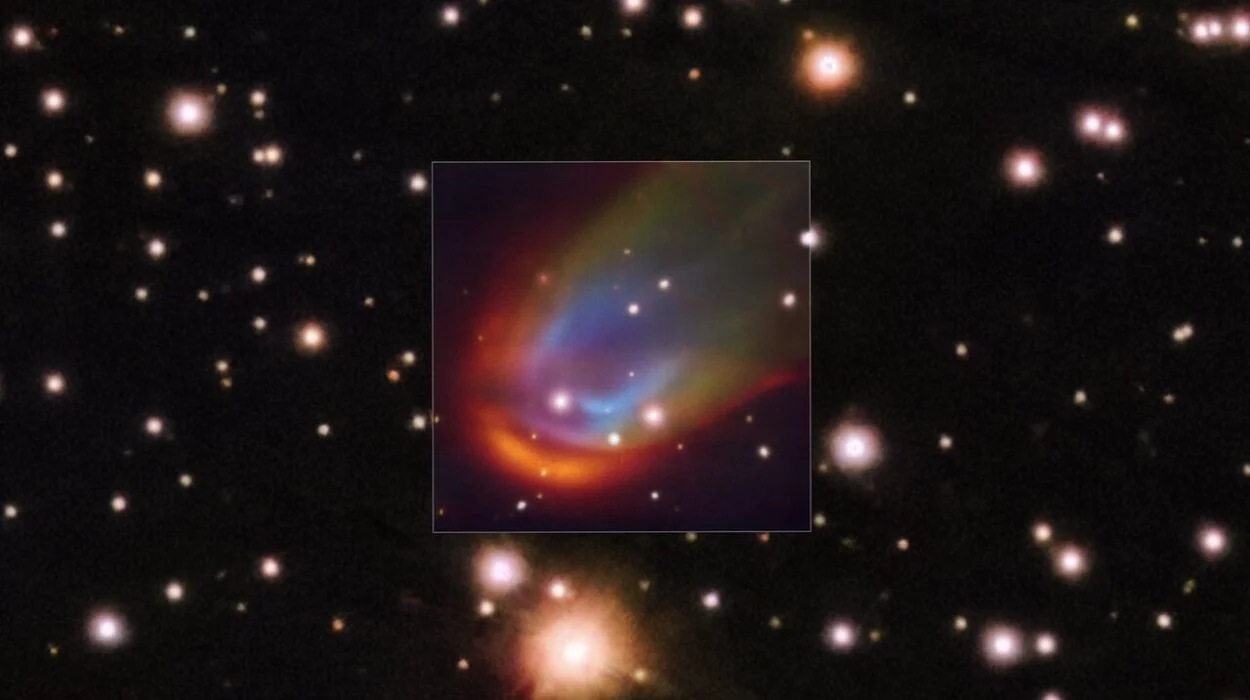
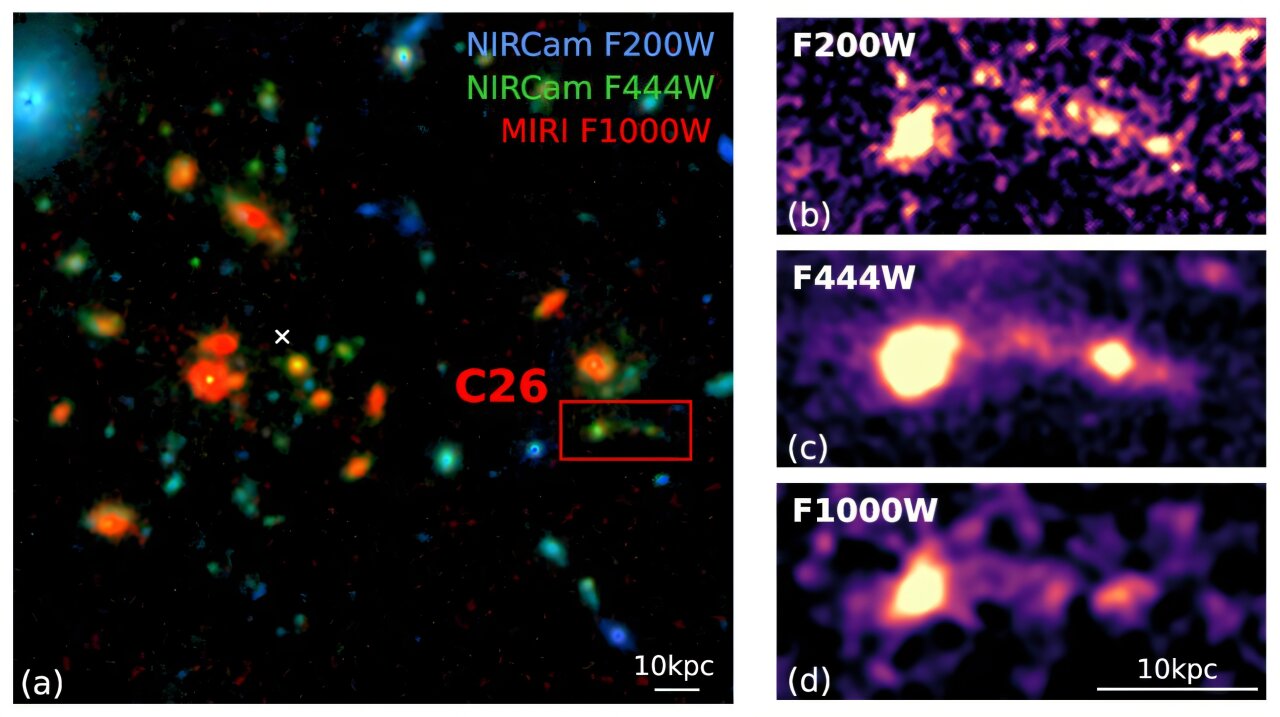
Among them, C26 immediately drew attention because of its unusual appearance. Images first captured by ALMA revealed a structure resembling a comet, with a bright “head,” a long trailing “tail,” and a dense, luminous region embedded within the tail known as the knot.
To better understand the galaxy, researchers led by Dazhi Zhou of the University of British Columbia combined observations from the Hubble Space Telescope and the James Webb Space Telescope. By studying the galaxy’s head, tail, and knot, they estimated both their masses and their star-forming activity.
The observations revealed that the tail contains a younger population of stars, as indicated by its detection in ultraviolet light. The stellar head has a mass of approximately 22 billion solar masses, while the tail, including the knot, contains about 6 billion solar masses.
The team also found that the galaxy’s head is forming stars at a lower rate than expected for a typical star-forming galaxy, while the tail and knot show star-formation rates more consistent with expectations.
Most of the Galaxy’s Cold Gas Is No Longer Inside It
The biggest surprise came when researchers examined the galaxy’s supply of cold gas, the essential ingredient for creating new stars.
Although C26 still contains tens of billions of solar masses of cold gas, the study found that more than half of it has already been displaced outside the galaxy.
Instead of remaining concentrated where stars could form, the gas has been stretched into the long trailing tail. The researchers describe this displaced material as diffuse and relatively calm rather than dense and turbulent, making it poorly suited for ongoing star formation.
This suggests the galaxy is steadily losing the fuel needed to continue producing new generations of stars.
The Evidence Points to Ram-Pressure Stripping
Galaxies generally lose gas through one of two main processes.
One possibility is a merger or tidal interaction, where the gravity of another galaxy pulls gas away. The other is ram-pressure stripping, which occurs when a galaxy moves through hot, dense gas within a galaxy cluster. The pressure exerted by that surrounding gas physically strips material from the galaxy.
After examining the evidence, the researchers conclude that a merger is unlikely.
The only possible companion galaxy is the bright knot within the tail, but it is simply too small to remove such a large amount of gas through gravity alone.
Instead, several observations favor ram-pressure stripping.
The stripped gas forms a smooth, continuous trail rather than appearing as a torn-off fragment. It remains calm and diffuse, and despite retaining a substantial gas supply overall, the galaxy is not undergoing the burst of star formation typically expected after a merger.
The direction of the tail provides another clue. It points toward the center of the protocluster, matching the pattern expected if gas is trailing behind a galaxy as it moves through the hot gas filling the cluster.
The researchers write that, together with the tail’s alignment and independently detected hot intracluster gas within SPT2349–56, these observations favor ram-pressure stripping as the primary process shaping C26.
A Process Usually Seen in Older Galaxy Clusters
Ram-pressure stripping is well known for producing so-called “jellyfish galaxies,” whose long gas tails resemble trailing tentacles.
However, this process is generally thought to require a mature galaxy cluster containing a hot, dense intracluster medium capable of efficiently stripping gas away.
That makes C26 particularly intriguing.
SPT2349–56 is still a young protocluster forming just 1.4 billion years after the Big Bang. If ram-pressure stripping is already operating effectively in such an early environment, it suggests that galaxy clusters may begin influencing galaxy evolution much earlier than previously assumed.
A Galaxy Caught Between Life and Death
Without its reservoir of cold gas, a galaxy gradually loses its ability to form new stars in a process known as quenching.
The researchers suggest C26 represents an intermediate stage in that transformation.
According to the team, most of the galaxy’s cold gas has already been removed by its environment, yet the stellar head has not completely stopped forming stars. In other words, astronomers may be observing the galaxy midway through its journey from an active star-forming system to a quiet, inactive one.
The study also notes that other galaxies near the center of the same protocluster appear to show signs of being gas-poor. This raises the possibility that ram-pressure stripping is not affecting only C26 but may be reshaping multiple galaxies throughout the developing cluster.
To better understand these interactions, the researchers say future high-resolution observations with ALMA and the James Webb Space Telescope could provide a clearer picture of how hot cluster gas interacts with the cold gas that fuels star formation.
Why This Matters
The discovery offers a possible explanation for one of astronomy’s enduring mysteries: how massive “red and dead” galaxies appeared so early in the universe’s history. If ram-pressure stripping can remove star-forming gas even within young, still-forming galaxy clusters, it may accelerate the shutdown of star formation far earlier than expected. C26 could represent a rare snapshot of this transition in progress, providing valuable insight into how galaxies evolve from vibrant star factories into quiet cosmic relics.