A faint object detected just 52.32 milliarcseconds from Betelgeuse has given astronomers their clearest evidence yet that the iconic red supergiant may not be alone. If confirmed by future observations, the discovery could explain the star’s mysterious six-year brightness cycle and open a new way to identify hidden companions around other massive aging stars.
Few stars have attracted as much attention as Betelgeuse. As one of the nearest and brightest red supergiants, it has been studied for generations, yet some of its behavior has remained difficult to explain.
Among its most puzzling features is a long secondary period, a roughly 2,200-day cycle in which the star’s brightness changes over nearly six years. Astronomers have long debated the origin of this slow variation. While several shorter brightness cycles are widely associated with pulsations inside the star, the longest one has resisted a clear explanation.
In recent years, researchers proposed a different possibility: perhaps Betelgeuse’s long cycle is caused not by the star itself, but by an unseen companion orbiting nearby. That hypothesis predicted where such a companion should appear in late 2024, when it would reach its greatest apparent separation from Betelgeuse.
Now, observations made with one of the world’s most advanced astronomical imaging systems have revealed a faint source almost exactly where those predictions placed it.
Looking for an object hidden beside one of the brightest stars in the sky
Finding a dim companion beside Betelgeuse is exceptionally challenging.
The primary star is enormous, intensely bright, and covered by complex surface activity that makes it difficult to distinguish genuine nearby objects from imaging artifacts. Because of this, previous reports of companions dating back decades never gained convincing confirmation.
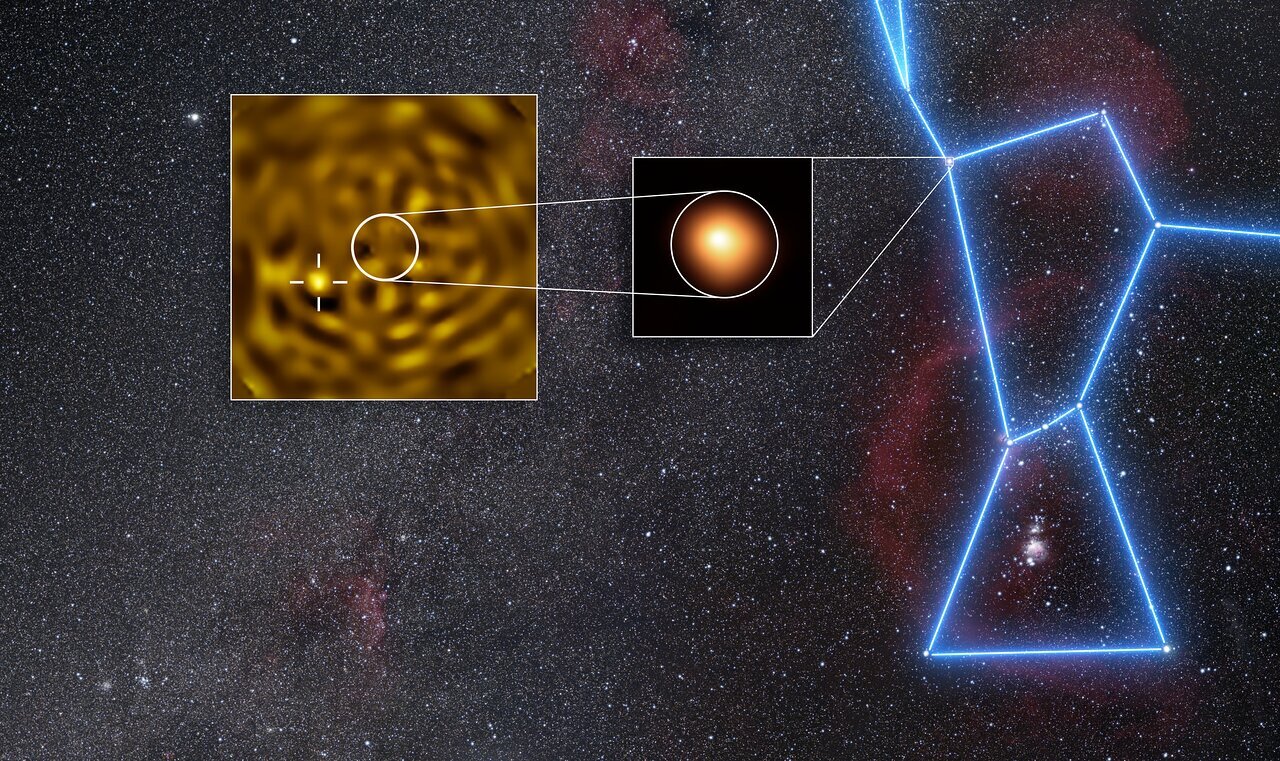
To search for the predicted object, the research team observed Betelgeuse on December 3 and December 6, 2024, using the SPHERE instrument mounted on the European Southern Observatory’s Very Large Telescope. Specifically, they used the visible-light ZIMPOL camera, operating without a coronagraph so the region immediately surrounding the star could be examined directly.
Rather than relying on a single processing method, the team analyzed the observations using two independent image-processing techniques designed to separate real astronomical sources from distortions created by Earth’s atmosphere and the telescope itself. One approach, known as PACO ASDI, is optimized for identifying faint point-like objects close to bright stars. The second used principal component analysis (PCA) as an independent check.
Both methods pointed to the same location.
A detection stronger than previous hints
The strongest evidence came from the PACO ASDI analysis.
The candidate object appeared with a statistical significance of 6.1 sigma, while the independent PCA analysis also recovered it at approximately 5.1 sigma. Both detections occurred in the CntHa filter, which measures light in the visible continuum near the hydrogen-alpha wavelength. No corresponding object appeared in the narrow hydrogen-alpha filter.
The detected source lies 52.32 ± 0.18 milliarcseconds from Betelgeuse at a position angle of 117.12 ± 0.60 degrees. Its measured brightness is only about 0.082% that of the primary star.
These measurements closely match an earlier, much weaker 1.5-sigma hint reported using Gemini North’s ʻAlopeke speckle imager. The new observations therefore substantially strengthen the case that the previously suggested object is real.
The researchers refer to it as Betelgeuse B, while emphasizing that it remains a candidate companion until its orbital motion can be confirmed.
Why the companion has not been confirmed yet
Even though the detection is statistically strong, astronomers stop short of declaring Betelgeuse a confirmed binary system.
The reason is straightforward.
A single observation can show that a faint object exists near the star, but it cannot prove that the object is gravitationally bound to Betelgeuse. In principle, although considered extremely unlikely by earlier work, an unrelated foreground or background star could happen to appear in nearly the same direction.
The decisive test requires patience.
If Betelgeuse B truly orbits the giant star, it should eventually appear on the opposite side after approximately half an orbital period. Observing that expected motion would provide direct confirmation that both stars belong to the same system.
The orbit fits remarkably well with an earlier prediction
Although one observation cannot fully determine the orbit, it already provides useful constraints.
The measured separation corresponds to a projected distance of approximately 8.80 astronomical units, assuming Betelgeuse lies about 168 parsecs from Earth using an earlier distance estimate adopted by the researchers.
Combined with estimated masses for Betelgeuse of 16.5 to 19 solar masses, that separation implies a minimum orbital period between roughly 5.5 and 5.9 years.
That agrees well with the previously proposed orbital solutions and closely matches the star’s mysterious 2,200-day, or approximately 6-year, long secondary period.
The researchers note that this agreement depends on the adopted distance to Betelgeuse. A larger distance estimate published previously would imply a wider orbit lasting more than eight years, making the match with the observed brightness cycle much weaker. In their view, the shorter distance estimate fits the binary interpretation more naturally.
The newly detected object appears to be a young hot star
After measuring the brightness contrast between the two objects, the researchers estimated the companion’s physical properties.
Using stellar atmosphere models together with Betelgeuse’s measured brightness and correcting for dust extinction, they calculated the companion’s intrinsic light output.
Assuming both stars formed together and therefore have the same age, evolutionary models indicate that the companion most likely has a mass between 2.6 and 3.1 times that of the Sun.
That places it among young main-sequence stars, corresponding roughly to spectral types B8.5V to B9.5V.
The observations also provide indirect support for this interpretation.
The companion was not detected in hydrogen-alpha emission, nor had earlier studies detected it in far-ultraviolet or X-ray observations. According to the researchers, those missing signals are consistent with a young main-sequence star rather than a younger pre-main-sequence object that would still possess an active accretion disk.
Dust surrounds the system—but probably does not explain everything
The observations included polarized-light imaging, which maps dust around Betelgeuse.
The resulting images revealed bright patches of polarized light extending roughly one to 4.5 stellar radii from the giant star. These features indicate dust grains scattering the star’s light.
The companion appears to sit within one of these dusty regions.
The researchers investigated whether the companion might create Betelgeuse’s six-year brightness cycle simply by clearing away dust as it travels through the circumstellar environment.
Their calculations suggest this explanation is insufficient.
For a companion with about 3.1 solar masses, dust would be destroyed only within approximately 0.3 astronomical units around the star. Even under favorable assumptions, that clearing would expose only about 12% of Betelgeuse’s apparent disk and produce brightness changes of roughly 0.1 magnitude.
The observed long secondary period varies by approximately 0.5 magnitude, making dust removal alone too weak to account for the phenomenon.
Instead, the authors argue that dynamical interactions between the companion and Betelgeuse’s extended atmosphere and surrounding material are likely to play the dominant role.
A possible new tool for studying red supergiants
If future observations confirm Betelgeuse B as a genuine companion, the implications extend well beyond this single star.
Astronomers already know that most massive stars are born in binary or multiple systems. Yet the observed fraction of red supergiants with companions is substantially lower, partly because detecting faint stars beside such luminous, turbulent giants is extraordinarily difficult.
The new results strengthen the idea that long secondary periods could serve as valuable indicators of hidden companions in red supergiants. Since roughly 25% to 30% of red supergiants exhibit these long brightness cycles, confirming this connection could provide astronomers with a new strategy for identifying binary systems that have previously escaped detection.
For now, however, the researchers remain cautious.
Although the imaging provides compelling evidence for a nearby companion and agrees closely with earlier orbital predictions, they stress that only additional observations tracing the object’s motion over time can establish beyond doubt that Betelgeuse B is truly orbiting one of the most famous stars in the night sky.
Publication details
VLT/SPHERE images the candidate companion of Betelgeuse, Astronomy & Astrophysics (2026). www.eso.org/public/archives/re … eso2611/eso2611a.pdf