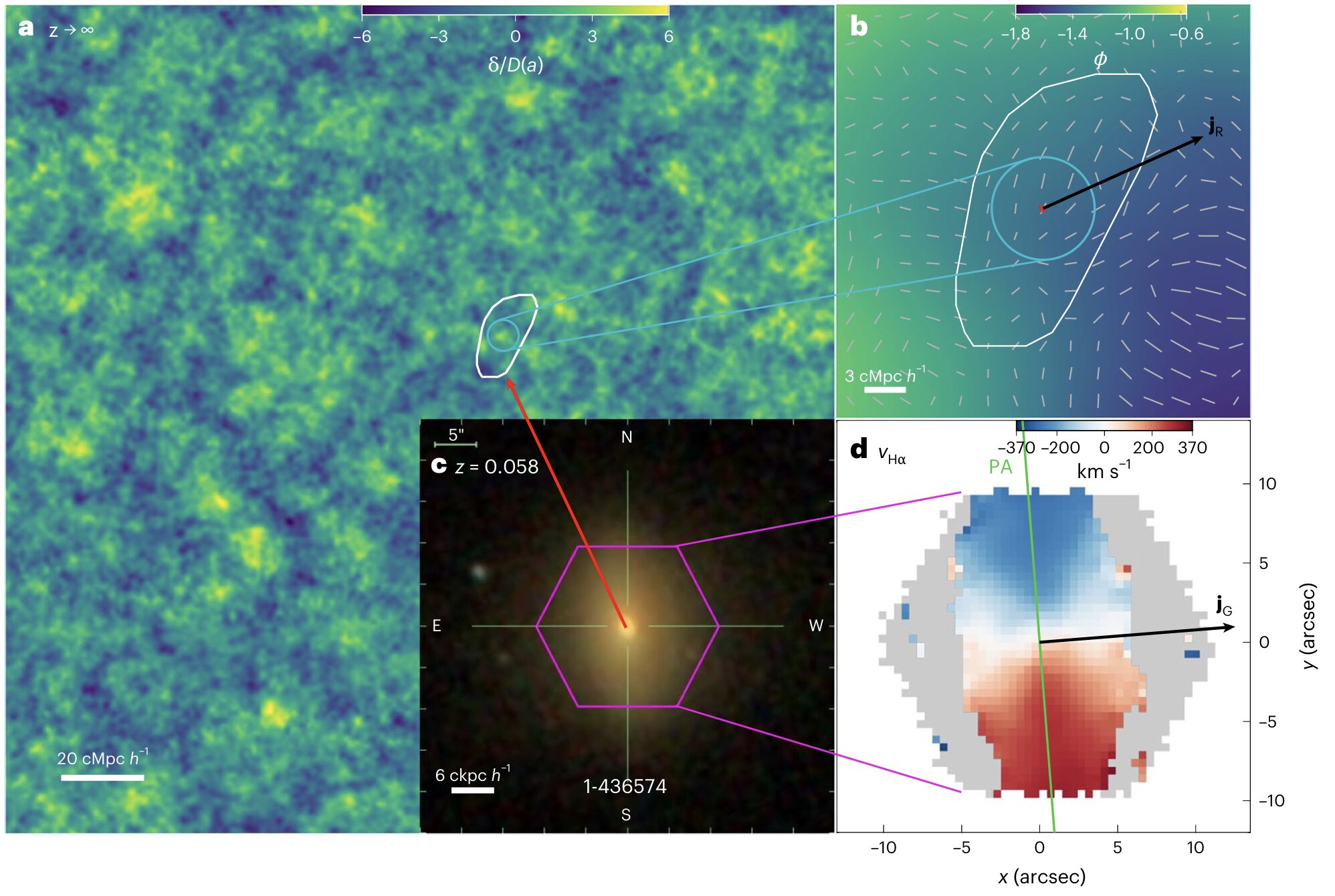
A galaxy can look like a thoroughly reshuffled system, its stars and gas stirred by billions of years of growth and mergers, yet some of its motion may still preserve a remarkably old memory. New research suggests that the spin of massive elliptical galaxies is correlated with gravitational tidal forces that acted on matter in the very early universe, offering some of the clearest evidence yet for a connection between cosmic beginnings and the galaxies we see today.
A galaxy’s spin is not just a visual feature. Its angular momentum helps determine the galaxy’s size and shape and influences the internal motions of its stars and gas.
But where that spin originally came from has remained a difficult question.
One leading idea is called tidal torque theory. The basic picture reaches back to a time before galaxies themselves had formed, when matter was gathered into uneven clumps of gas and dark matter.
Imagine one of those early clumps sitting near a larger concentration of matter. If the clump were slightly stretched rather than perfectly round, gravity would not pull equally on every part of it. The end closer to the massive neighbor would feel a stronger gravitational influence.
That uneven pull could make the clump begin to rotate.
If the idea is correct, the galaxies that eventually grew from those early structures should retain at least some trace of that ancient gravitational twisting.
The challenge has been finding that trace.
Looking backward from galaxies today
Ming-Jie Sheng of Xiamen University and colleagues approached the problem by starting with something astronomers can actually observe: galaxies in the universe today.
Their work, published in Nature Astronomy, used information from the ELUCID project. That project reconstructs the distribution of matter in the early universe from the positions of galaxies that can be observed now.
The researchers used that reconstruction to work backward, tracing the pattern of present-day galaxy spins to the primordial tidal forces that could have produced them.
They then compared that predicted pattern with actual measurements of how gas and stars move inside individual galaxies. Those measurements came from an instrument capable of mapping internal galactic motion, and the comparison involved a substantial sample of galaxies from the nearby universe.
The question was straightforward, even if the cosmic history behind it was anything but:
Would galaxies today spin in a pattern connected to those ancient gravitational forces?
The strongest connection appeared in massive elliptical galaxies
The clearest match emerged in the gas inside large, massive elliptical galaxies.
When the researchers compared the observed spin of this gas with the pattern predicted from primordial tidal forces, the correlation was strong enough to rule out chance with very high confidence.
That result provides the clearest evidence to date, according to the source material, that galaxies today can retain an imprint from the universe’s infancy.
It does not mean that a galaxy’s present-day rotation is simply a frozen record of its birth.
Galaxies are not perfectly preserved cosmic fossils.
Billions of years can scramble the evidence
A galaxy can undergo mergers and other forms of disordered growth as it develops. Those events can alter and scramble much of its rotation.
That makes the apparent survival of a connection to primordial tidal forces particularly important to the story—but it also sets a limit on what the result can establish.
The research does not prove that a galaxy’s spin was completely predetermined by conditions in the early universe.
Instead, it supports a more limited conclusion: a thread appears to remain between the gravitational pushes and pulls acting on primordial structures and the spins of galaxies that exist today.
Some of the original cosmic influence can survive even after the galaxy has experienced a long and complicated history.
A possible new window onto the early universe
The result could also have implications beyond the question of how galaxies acquire their spin.
If present-day galaxy rotation preserves information about primordial tidal forces, those patterns could potentially become a tool for probing properties of the universe that are otherwise extremely difficult to measure.
The source material points specifically to subtle cosmic ingredients such as neutrinos. These particles may also leave their imprint on the primordial tidal forces.
That possibility remains a future application rather than a conclusion established by the current result.
For now, the striking part is simpler.
A galaxy that formed long after the universe’s earliest structures may still be carrying a faint signature of the gravitational forces that acted before the galaxy existed at all.