For decades, one part of the primate brain seemed like the obvious explanation for the extraordinary size and complexity of brains in monkeys, apes and humans: the frontal lobe. But when scientists looked inside the skulls of living and extinct primates in a more quantitative way, a different story emerged. The strongest signal was not a frontal cortex expanding dramatically on its own. It was vision.
The idea challenges a long-standing assumption about one of the most remarkable changes in primate evolution: how the neocortex became so large.
The neocortex is the folded outer layer of the brain involved in sensory perception, cognition and other complex functions. Compared with other mammals, primates have a greatly enlarged neocortex. But because brains themselves do not fossilize, figuring out exactly how that expansion happened over the past 56 million years has been difficult.
Richard F. Kay, a professor emeritus of Evolutionary Anthropology at Duke University Trinity College of Arts & Sciences and the Nicholas School of the Environment, led a new study that approached the problem from inside the skull.
The research, published in Science, examined the braincases of living and extinct primates using virtual models of their interiors. The results point away from the idea that primates repeatedly evolved unusually large frontal lobes and toward a different evolutionary story, one in which expanding visual processing regions played a much larger role.
Looking at brains that no longer exist
The researchers could not examine the brains of extinct primates directly. Instead, they turned to their skulls.
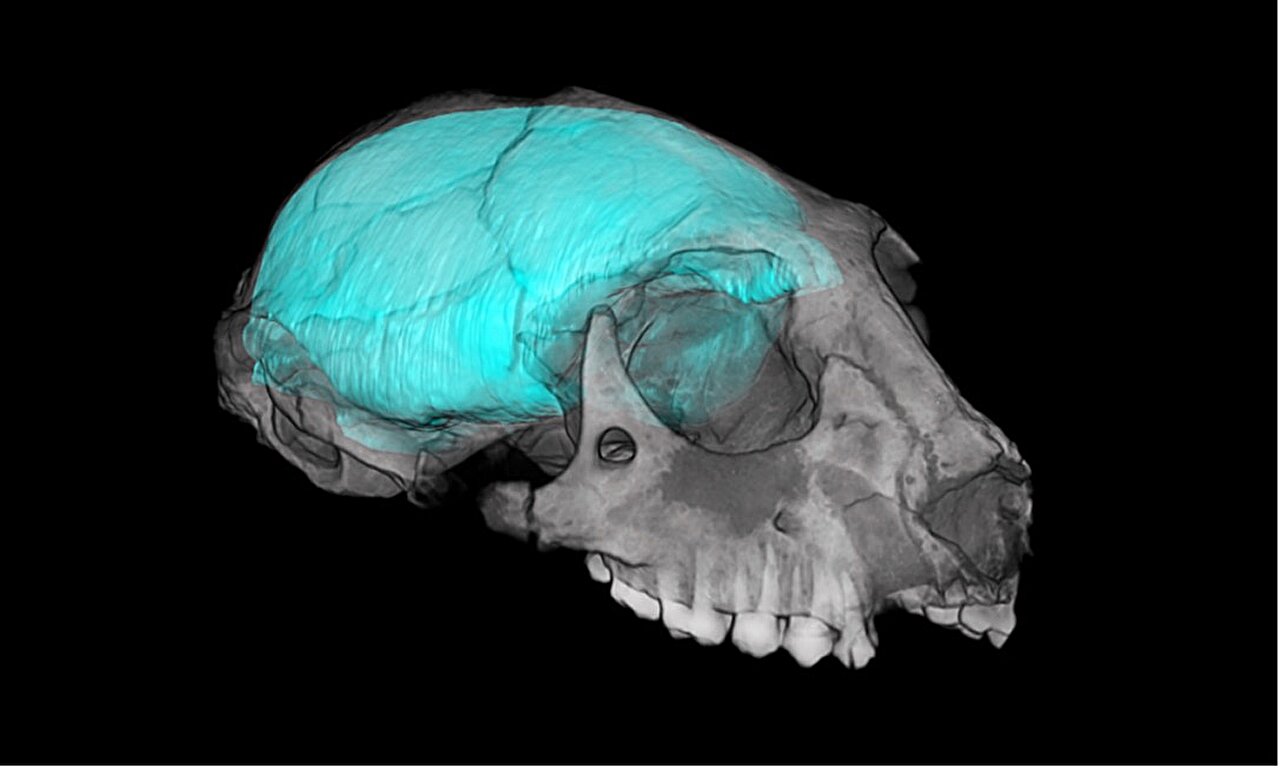
The team worked with a distinctive collection of skulls, including many specimens from the Duke Lemur Center Museum of Natural History. Using high-resolution micro-CT scans conducted at the Duke Shared Materials Instrumentation Facility, they reconstructed the spaces inside the braincases as digital three-dimensional models.
These virtual casts, known as endocasts, provide a way to study the shape and dimensions of the space once occupied by the brain.
The researchers compared the volumes and related surface areas of these endocasts across primate species. That allowed them to examine how different parts associated with the neocortex changed as primate brains evolved.
Instead of relying mainly on what a fossil skull appeared to look like, they could make quantitative comparisons among the reconstructed braincases.
And that distinction turned out to matter.
The frontal lobe followed the brain instead of racing ahead
The frontal lobe has often been treated as the natural candidate for explaining the evolution of sophisticated primate brains. It is the region most commonly associated in popular descriptions with advanced cognition.
The new analysis, however, did not find evidence that the frontal lobe repeatedly underwent dramatic, independent expansions in different primate lineages.
Instead, its size increased gradually as the overall brain became larger. The researchers found the same scaling pattern across the major primate groups throughout their evolutionary history.
In other words, a larger brain generally came with a larger frontal lobe, rather than the frontal lobe suddenly becoming disproportionately large.
“Everything from humans down to tree shrews, they all fall on the same line: Relative to the size of the brain, the proportion of the frontal lobe is a constant,” Kay said.
That result challenges earlier interpretations based on visual inspection of fossils, which had proposed that the frontal lobe expanded dramatically and independently in multiple primate lineages.
The study instead points toward a more consistent relationship between frontal lobe size and total brain size.
The most dramatic changes were happening somewhere else.
The strongest expansion was in the parts of the brain processing vision
The occipital, parietal and temporal regions of the brain are heavily involved in processing visual information. In the study, these regions showed a striking pattern.
They expanded rapidly and disproportionately in tarsiers and anthropoids. Anthropoids include monkeys, apes and humans.
That expansion occurred along the same branches of the primate family tree where the optic nerve also became larger.
The optic nerve carries visual information from the eye into the brain. Because the brain itself is not preserved in fossils, the researchers needed another way to estimate how much visual information ancient primates were receiving.
The skull provided one.
A tiny opening offered a clue about ancient vision
The optic nerve passes through a hole in the skull called the optic foramen. By examining the size of this bony opening, the researchers could use it as a proxy for the size of the optic nerve and, in turn, for the amount of visual information entering the brain.
The pattern was striking.
Tarsiers and anthropoids had both the largest optic foramina and the most strongly vision-dominated neocortices.
The visual processing regions of the brain also appeared to have expanded even faster than the optic nerve that supplied them.
That means relatively small increases in visual input were associated with much larger increases in the amount of brain tissue devoted to processing it.
For Kay, this quantitative approach changed what the fossil record could tell scientists about the evolution of primate brains.
“Fossil brains have been frustratingly silent on this question for a long time,” he said. “When we let the fossils speak quantitatively rather than relying on impressions of their shape, the enlarged brains of monkeys, apes and humans turn out to be tied to vision much more than to the frontal lobe, which simply kept pace with overall brain size.”
Why would better vision require so much brain?
The study identifies the connection between visual input and the expansion of visual processing regions, but it does not settle exactly why that visual information became such an important force in primate evolution.
Kay offered two possibilities.
One is that increasingly complex visual information could have been connected to more complicated social communication.
Another is that better visual processing could have been related to how efficiently these animals foraged for food.
Both possibilities, he suggested, could have had a strong effect on natural selection and primate evolution.
Those ideas remain possibilities rather than conclusions established by the study.
What the research does provide is a clearer evolutionary pattern: the parts of the neocortex associated heavily with vision expanded disproportionately in the primate groups that also showed evidence of receiving more visual input.
A very old feature of the anthropoid brain
The findings also place the origin of the large anthropoid brain deep in primate history.
According to the study, the hallmark large brains of anthropoids are an ancient feature dating back at least 33 million years.
The researchers connect that ancient expansion to the evolution of high-acuity vision, including adaptations such as a retinal fovea and a bony partition that shields the eye.
The implication is not that the frontal lobe is unimportant. Rather, the study argues against the idea that an independently enlarged frontal lobe, by itself, explains the dramatic expansion of the primate neocortex.
The frontal lobe appears to have kept pace with the overall growth of the brain.
The stronger evolutionary signal came from the regions processing vision.
For a question that has remained difficult precisely because fossil brains disappeared long ago, the answer emerged from something that did remain: the shape of the skull around them.
The ancient brains may be gone, but their spaces left behind a record—and in that record, vision leaves a surprisingly strong mark.