A white dwarf more massive than the Sun, packed into a sphere roughly half the size of Earth, has given astronomers an unusual glimpse into something they normally cannot see: its core. By measuring how strongly the star’s gravity shifts the light coming from its surface, researchers found evidence that this ultramassive stellar remnant likely has a core dominated by oxygen and neon rather than carbon and oxygen—a difference that could determine whether a star like this can ever become a Type Ia supernova.
White dwarfs are, in a sense, stars stripped down to their essentials. They are the dense remnants left after stars have exhausted the nuclear fuel that once powered them, and their outer atmospheres reveal only a thin glimpse of what lies underneath.
That creates a frustrating problem for astronomers.
For an ultramassive white dwarf, the most important question may be buried deep inside: What is the core made of?
The answer matters because carbon and oxygen behave differently from oxygen and neon under the extreme conditions inside these objects. A carbon-rich core can, under the right circumstances, be driven toward the runaway nuclear burning associated with a Type Ia supernova. A white dwarf with an oxygen-neon core is instead expected to follow a different fate, eventually collapsing into a neutron star when conditions trigger electron-capture reactions.
Now, observations of an ultramassive white dwarf called SDSS J060851.44-005950.3, or SDSS J0608−0059 for short, have provided evidence favoring an oxygen-neon core.
The result comes from Stefan M. Arseneau and colleagues, who used high-resolution spectroscopy and measurements of the star’s light to determine its mass and radius. Their work was published in The Astrophysical Journal.
The evidence does not amount to an absolute identification of the star’s core. The researchers explicitly describe their result as a preference for an oxygen-neon composition, with a Bayes factor of 2.7. But the observation offers a valuable new way to probe the hidden interiors of massive white dwarfs—and it fits a broader picture involving a mysterious region of the white-dwarf population known as the Q-branch.
The star is almost unimaginably dense
SDSS J0608−0059 is an unusual object even before anyone asks what is inside it.
The researchers measure its mass at about 1.226 times the mass of the Sun, with an uncertainty of +0.024 and −0.025 solar masses. Its radius is only about 0.491 times Earth’s radius, with an uncertainty of roughly 0.009 Earth radii.
In other words, this object contains more mass than the Sun in a body less than half Earth’s radius.
Its enormous density produces another useful feature: an exceptionally strong gravitational field.
Gravity does not merely pull objects toward a star. It also affects light. As photons climb out of a strong gravitational field, their wavelengths are shifted toward the red end of the spectrum. This phenomenon is known as gravitational redshift.
For an ordinary white dwarf, that shift is already measurable. For an ultramassive white dwarf like SDSS J0608−0059, the effect is much stronger.
The researchers measured a gravitational redshift of 174.5 ± 1.3 kilometers per second.
That number is not simply a measurement of the star’s motion through space. The key was finding a nearby stellar companion that shares the white dwarf’s motion.
A distant companion became the measuring stick
SDSS J0608−0059 has a main-sequence companion separated from it by about 2,684 astronomical units.
That enormous separation is important. The researchers say the two stars are sufficiently far apart that they have never interacted in the past.
Because the two stars belong to the same wide system, their ordinary motion through space can be compared. The companion provides a reference for the white dwarf’s true radial velocity.
The companion’s radial velocity measured by Gaia was 28.80 ± 0.78 km/s. After accounting for the companion’s own small gravitational redshift and the possible orbital motion within the wide system, the researchers adopted a corrected radial velocity of 28.1 ± 1.0 km/s.
The white dwarf’s spectral lines, meanwhile, revealed a much larger apparent velocity.
Comparing the two allowed the researchers to isolate the shift caused by the white dwarf’s gravity.
They obtained 174.5 ± 1.4 km/s from the higher-resolution UVES observations and 173.0 ± 3.5 km/s from observations with the MagE spectrograph. Combining those measurements produced the adopted value of 174.5 ± 1.3 km/s.
That gravitational redshift is especially useful because it provides a constraint on the relationship between the white dwarf’s mass and radius without relying primarily on assumptions about its atmospheric spectrum.
And for the most massive white dwarfs, that relationship carries information about something much deeper.
The hidden core changes the star’s size
The basic idea is remarkably powerful.
Different core compositions produce slightly different structures inside a white dwarf. That means two white dwarfs with otherwise comparable properties can have different mass-radius relationships depending on whether their cores are made primarily of carbon and oxygen or oxygen and neon.
For ordinary white dwarfs, the mass-radius relationship is particularly sensitive to factors such as temperature and the thickness of the hydrogen envelope.
For the most massive white dwarfs, however, the core composition becomes especially important.
That gave the researchers a way to turn measurements of the star’s gravitational redshift and brightness into a test of what may be happening deep below its surface.
They combined the gravitational-redshift measurement with photometry from Gaia, the Sloan Digital Sky Survey, Pan-STARRS and SkyMapper. They then used models of the star’s atmosphere and a Markov Chain Monte Carlo analysis to determine the most likely combinations of mass, radius, temperature, distance and extinction.
The resulting model gave the white dwarf an effective temperature of about 17,820 K, a radius of 0.491 Earth radii, and a mass of about 1.226 solar masses.
The distance was measured at about 61.65 parsecs, or roughly 201 light-years.
More importantly, the resulting mass-radius constraints could be compared directly with theoretical models for white dwarfs containing different types of cores.
The oxygen-neon models came out ahead.
Oxygen and neon fit better than carbon and oxygen
The researchers found good agreement between their measurements and models of a white dwarf whose degenerate core consists primarily of oxygen and neon.
Their statistical comparison favored the oxygen-neon models over carbon-oxygen models by a Bayes factor of 2.7.
That is evidence in favor of the oxygen-neon interpretation, but it is not the same thing as proving the core’s composition beyond doubt.
The researchers are careful about that distinction.
Their measurements constrain the star’s structure in a way that is largely independent of the assumed mass-radius relation because the mass and radius are inferred from gravitational redshift and the measured solid angle. But the statistical significance of the core-composition measurement is limited mainly by the uncertainty in the photometric radius, rather than by the gravitational-redshift measurement itself.
So the gravitational-redshift measurement worked extremely well. The remaining challenge is knowing the star’s radius precisely enough to make the difference between competing interior models unmistakable.
That distinction is important because the core itself cannot simply be photographed.
Why astronomers care about the core in the first place
The composition of a white dwarf’s core is not merely an interesting detail about its interior.
It can affect the star’s ultimate fate.
The paper explains that Type Ia supernovae are generally understood to involve runaway thermonuclear carbon burning in a degenerate carbon-oxygen white dwarf. In that scenario, carbon in the core plays a central role.
An oxygen-neon white dwarf is different.
When such a star reaches conditions that might otherwise lead a carbon-oxygen white dwarf toward a Type Ia explosion, electron-capture reactions involving neon and magnesium are expected to reduce the electron degeneracy pressure supporting the star. The result is expected to be gravitational collapse into a neutron star rather than a Type Ia supernova.
That means a white dwarf can be enormous, dense and seemingly poised for a dramatic stellar ending while still being structurally incapable of producing the kind of explosion astronomers are looking for.
The researchers therefore describe stars with a core composition similar to SDSS J0608−0059 as likely structurally incapable of producing Type Ia supernovae under current understanding.
The core composition also matters for the question of how these ultramassive white dwarfs formed.
Did this white dwarf form alone—or through a merger?
There is another mystery surrounding very massive white dwarfs.
Some may form from the evolution of a single star. Others may be created when two white dwarfs merge.
The distinction matters here because the two pathways can produce different core compositions and leave different clues behind.
Ultramassive white dwarfs with masses above about 1.2 solar masses are predicted to form from single stars whose original main-sequence masses were roughly 7 to 9.5 solar masses. In those stars, temperatures during a late stage of stellar evolution can become high enough to ignite carbon burning, producing cores composed primarily of oxygen and neon.
But mergers complicate that picture.
A substantial fraction of white dwarfs above about 0.90 solar masses are expected to be merger remnants. Depending on their evolutionary history, some merger products could instead retain carbon-oxygen cores.
So if SDSS J0608−0059 were clearly a merger remnant, its likely oxygen-neon core would fit into a more complicated evolutionary story. If it formed through single-star evolution, the observation would provide stronger evidence for the expected connection between ultramassive white dwarfs and oxygen-neon cores.
The researchers therefore looked for clues about the star’s history.
The star does not look like a typical delayed merger remnant
One particularly interesting clue comes from the white dwarf’s motion through the Galaxy.
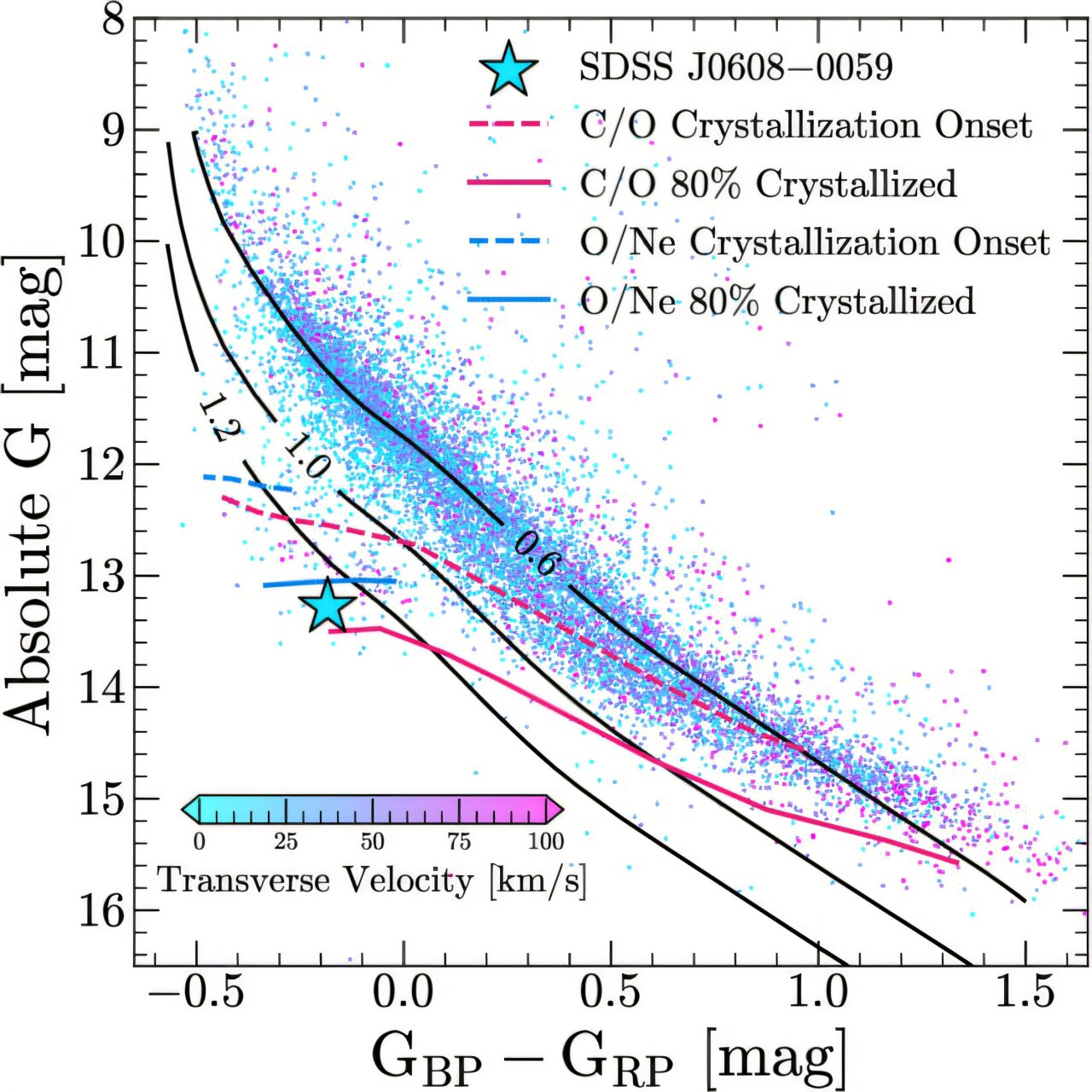
SDSS J0608−0059 has a transverse velocity of only 10.84 ± 0.06 km/s, according to Gaia astrometry.
The researchers compared its three-dimensional velocity with those of other white dwarfs. SDSS J0608−0059 falls around the 35th percentile of that velocity distribution.
That is not what they would expect from a particularly old population with unusually high velocities.
The reasoning involves the cooling history of white dwarfs. A merger resets a white dwarf’s cooling age, making a merger product intrinsically older than a single-star white dwarf at the same mass and effective temperature. Over longer periods, older stars have had more opportunity to experience gravitational scattering that can increase their velocities as they move through the Galactic disk.
If SDSS J0608−0059 were a merger product of the relevant type, the researchers say it would likely have unusually large kinematics.
It does not.
The researchers also note that the white dwarf is not known to have a magnetic field and remains part of a very widely separated binary system. They point to previous work suggesting that the small natal kick associated with binary mergers can often be enough to disrupt weakly bound wide binaries.
Taken together, these clues are consistent with a nonmerger origin.
But again, the researchers stop short of calling that settled.
They cannot definitively prove that SDSS J0608−0059 formed from a single star.
The possibility that it is a merger product cannot be excluded.
That uncertainty is central to how the new result should be interpreted.
The Q-branch provides another piece of the puzzle
SDSS J0608−0059 also occupies an intriguing place on the white-dwarf cooling diagram.
It is located on the so-called Q-branch, a region where astronomers have observed an unexpected concentration of ultramassive white dwarfs.
The Q-branch has become particularly interesting because some of the white dwarfs found there appear to cool much more slowly than expected.
One leading explanation involves crystallization inside carbon-oxygen white dwarfs.
As the interior crystallizes, buoyant crystals containing neon-22 can move outward through the inner carbon-oxygen core. According to the explanation discussed in the paper, that process can release gravitational potential energy as heat and delay the star’s cooling.
For oxygen-neon white dwarfs, however, neon-22 couples with neon-20 during crystallization. The crystallization therefore proceeds normally from the inner core outward, without the significant cooling delay expected from the process proposed for carbon-oxygen cores.
That difference offers an intriguing observational test.
If an ultramassive white dwarf passes through the Q-branch without experiencing a long cooling delay, its behavior may be consistent with having an oxygen-neon core.
SDSS J0608−0059 appears to fit that picture.
The researchers find that it is likely mostly crystallized and has evolved through the Q-branch. At the same time, its low kinematics do not show the signature expected for the delayed Q-branch population associated with unusually old merger products.
Their result is therefore consistent with the idea that ultramassive white dwarfs that pass through the Q-branch without experiencing an extended cooling delay are likely to have oxygen-neon cores.
But the authors frame this as a consistency with that picture, not as a definitive demonstration of it.
Seeing inside a white dwarf without seeing inside it
Astronomers have another method for investigating white-dwarf interiors: listening to their vibrations.
Some hydrogen-rich white dwarfs pulsate, producing waves that travel through their interiors. This technique, called asteroseismology, can in principle distinguish between carbon-oxygen and oxygen-neon cores.
The problem is that ultramassive white dwarfs are already substantially crystallized by the time they reach the relevant pulsation stage. Their pulsation modes therefore have limited access to the deepest regions of the star.
Most variable white dwarfs also offer only a small number of detectable pulsation modes.
That makes the new approach particularly useful.
Instead of relying on waves traveling through the interior, the researchers use the star’s gravitational redshift together with its measured brightness, distance and apparent size to constrain its mass and radius. The interior composition then leaves its signature through the theoretical mass-radius relationship.
It is not a direct chemical sample of the core.
It is more like weighing and measuring a locked box so precisely that different internal designs begin to give different answers.
The measurements are strong, but the answer can still be sharpened
The researchers tested several possible effects that could alter the mass-radius relationship and therefore influence their conclusion.
For a white dwarf of about 0.6 solar masses, the thickness of the hydrogen envelope can affect the inferred gravitational redshift by as much as about 1 km/s. For SDSS J0608−0059, which is much more massive, the models predict an effect smaller than 0.2 km/s.
That is too small to substantially change the result.
The researchers also considered possible effects involving the precise carbon-to-oxygen or oxygen-to-neon ratios in the core, general relativity, rotation and magnetism. For this particular star, they conclude that these effects are smaller than the hydrogen-layer effect and do not materially undermine the evidence for an oxygen-neon composition.
There is, however, a straightforward way to improve the measurement.
The limiting factor is the photometric constraint on the star’s radius.
The researchers combined Gaia parallaxes for the white dwarf and its companion to reach a parallax uncertainty of about 15 microarcseconds. They note that future Gaia DR4 astrometry could bring that uncertainty close to the 10-microarcsecond noise floor.
Additional ultraviolet observations could also improve the temperature measurement.
With better constraints on the star’s radius and temperature, the core composition could potentially be determined more conclusively.
A small difference inside a star can decide its fate
SDSS J0608−0059 is already a remarkable object: about 1.23 times the Sun’s mass compressed into a body less than half Earth’s radius.
But the most important thing about it may be something no telescope can see directly.
Deep inside is a core whose composition appears to lean toward oxygen and neon rather than carbon and oxygen.
The evidence is not yet definitive. The Bayes factor of 2.7 represents a preference, not an unambiguous detection, and the star’s evolutionary history cannot be pinned down with certainty because a merger origin remains possible.
Still, the observation connects several pieces of the ultramassive-white-dwarf puzzle: gravitational redshift, mass and radius, crystallization, the Q-branch, possible merger histories and the question of which white dwarfs can become Type Ia supernovae.
And that is what makes this distant, faint remnant so interesting.
Its surface light carries information about a place hidden far beneath it.
By measuring how gravity shifts that light and how the star’s size responds to its enormous mass, astronomers are beginning to infer what may be inside one of the universe’s densest stellar remnants—and, perhaps, which stellar remnants have the ingredients needed to explode and which are destined for a very different ending.