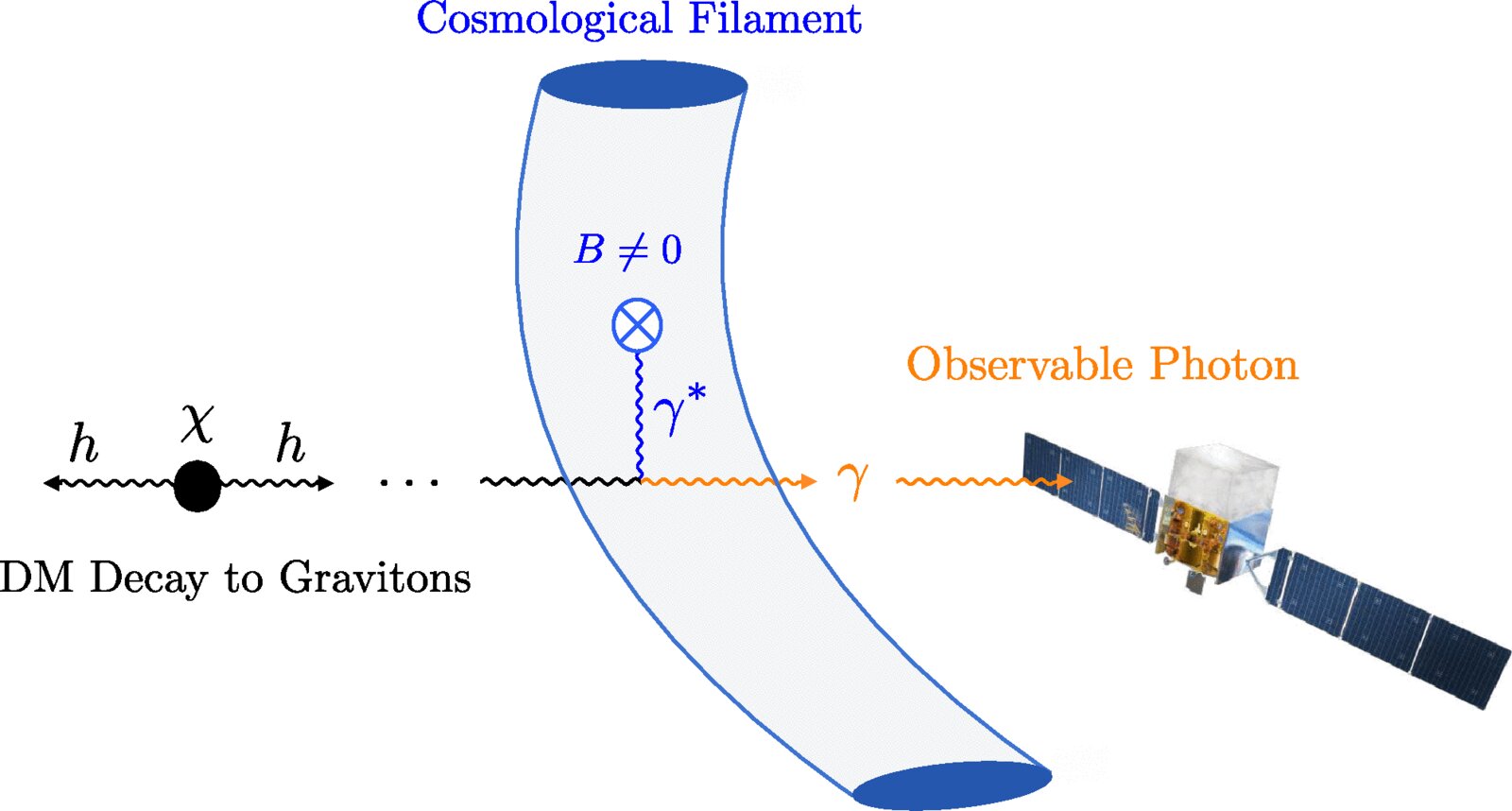
Imagine that dark matter has been quietly falling apart for billions of years, producing particles that are almost impossible to detect directly. Now imagine that some of those particles cross the enormous magnetic fields threaded through the space between galaxies and, after traveling across the universe, turn into light that telescopes can actually see. That is the striking possibility explored by a new study, which proposes using the cosmic web itself as part of a giant detector for a dark matter decay channel that has never before been constrained by indirect observations.
Dark matter is one of the biggest mysteries in modern physics. We know it is there because its gravity affects galaxies, galaxy clusters and the large-scale structure of the universe. But despite decades of searching, scientists still do not know what dark matter is made of.
One reason the mystery is so difficult is that dark matter appears to interact with ordinary matter extraordinarily weakly. Its only established interaction with the Standard Model of particle physics is gravity.
That leaves open an unusual possibility.
What if dark matter can decay into gravitons—the hypothetical quantum particles associated with gravitational waves?
Gravitons would be extremely difficult to detect. They do not carry electric charge, and their interaction with ordinary matter is extraordinarily weak. A dark matter particle could, in principle, decay and leave behind gravitons that simply travel through the universe without announcing themselves.
But a team of physicists has identified a remarkable loophole.
Those gravitons may not remain completely invisible.
As they travel through large-scale magnetic fields, some could convert into photons. Those photons would then contribute to the diffuse gamma-ray glow of the universe, giving astronomers a way to search for evidence of a dark matter decay process that would otherwise be almost impossible to observe.
The study, by David I. Dunsky, Gordan Krnjaic and Elena Pinetti, was published in Physical Review D on July 29, 2026. The researchers use this idea to derive what they describe as the first constraints on dark matter decaying into gravitons through an indirect-detection method, covering dark matter masses from 0.1 GeV to (10^8) GeV under their assumptions.
The invisible decay problem
To understand why the proposed method is interesting, it helps to start with what scientists normally look for when searching for decaying dark matter.
If a dark matter particle decays into familiar particles, the products might eventually produce something detectable: photons, neutrinos, electrons or other particles. Astronomers can then look for an excess of those signals coming from places where dark matter should be abundant.
But a decay into gravitons creates a very different problem.
Gravitons interact so weakly that they are effectively invisible to the usual particle detectors used to search for dark matter. The paper notes that indirect searches have already placed limits on dark matter decays into other Standard Model particles, including neutrinos, but there had previously been no observational limits specifically on the graviton decay channel.
That does not mean scientists know that such decays occur.
It means the possibility had remained largely unconstrained by this kind of observation.
The researchers therefore ask a deceptively simple question: if dark matter decays into gravitons, is there some way those gravitons can leave a detectable trace?
The answer comes from an effect known as the Gertsenshtein effect.
When gravity can become light
The Gertsenshtein effect is a predicted process in which a graviton can convert into a photon while passing through a magnetic field.
The idea sounds almost like science fiction: a particle associated with gravity enters a magnetic field and emerges, with some probability, as light.
But the effect is a consequence of known physics. The new study does not introduce a new interaction that makes gravitons convert into photons. Instead, it uses this already-known Standard Model process as a possible bridge between an otherwise invisible dark matter decay and an observable gamma-ray signal.
The conversion probability is extremely small.
That might seem to end the story.
Except the universe is enormous.
A graviton produced by dark matter decay could travel across cosmological distances and pass through many magnetized regions. Even if the probability of conversion inside any individual region is tiny, a very large number of opportunities can accumulate along the journey.
This is where the cosmic web becomes important.
The universe is threaded with magnetic filaments
On the largest scales, matter in the universe is arranged in an enormous network of galaxies, galaxy clusters and long structures known as cosmic filaments.
These filaments are not empty space. They contain diffuse gas and magnetic fields, although the strength and detailed properties of those fields remain uncertain.
The researchers focus on these filaments because they combine several features that are useful for graviton-photon conversion.
The magnetic fields can be on the order of tens to hundreds of nanogauss, while the relevant structures can extend over megaparsec scales. The paper considers present-day filament magnetic fields ranging from about 1 to 600 nanogauss based on existing observations and estimates, with coherence lengths of roughly 1 to 10 megaparsecs.
For their reference calculation, the researchers adopt a present-day magnetic field of 60 nanogauss when discussing the basic conversion physics and use a fiducial filament radius of about 2 megaparsecs.
They also take the filaments to occupy about 15% of the cosmic volume in their main treatment.
That number matters because the proposed signal does not depend on a single lucky encounter.
A graviton traveling across gigaparsec distances can encounter many different filamentary regions. Each encounter provides another opportunity for conversion.
The individual chances are tiny. The universe supplies the mileage.
Why the distance matters
There is another important feature of the calculation: the graviton-photon oscillation length is enormous.
For the paper’s reference parameters, the present-day oscillation length can be around 20,000 gigaparsecs. That is vastly larger than the roughly 4-gigaparsec Hubble radius used in the comparison and enormously larger than the typical size of an individual filament.
At first glance, that sounds like a problem. If the oscillation length is so huge, why should anything happen inside a filament?
The answer is that the conversion probability accumulated across many separate magnetic patches can still become appreciable enough to matter for an astrophysical search.
The researchers treat encounters with individual filaments as independent conversion opportunities. Their calculation combines the probability inside one filament with the number of filaments encountered along the path.
For a sufficiently short path through an individual filament compared with the oscillation length, the conversion probability has an approximate dependence on the square of the magnetic-field strength and the square of the distance traveled through the field.
That makes magnetic field strength particularly important.
A stronger field can dramatically increase the conversion probability.
And that becomes one of the biggest uncertainties in the entire proposed search.
The magnetic fields are the weak link
The researchers are careful about this point.
Their constraints are not universal numbers that apply regardless of what the cosmic web looks like. They depend significantly on the assumed magnetic field strength inside cosmic filaments.
For their main results, they present a benchmark case with a present-day filament field of 100 nanogauss and an optimistic case with 250 nanogauss. The paper emphasizes that the actual typical field strength remains uncertain, with current estimates spanning roughly one to a few hundred nanogauss.
This uncertainty directly affects how efficiently gravitons can become photons.
If the fields are stronger, the proposed signal becomes easier to detect.
If they are weaker, the signal becomes correspondingly harder to detect.
The researchers therefore do not present their limits as independent of astrophysical assumptions. Instead, the strength of the constraint must be understood in the context of what is currently known about cosmic-filament magnetism.
That is an important qualification because the method effectively turns an uncertain property of the cosmic web into part of the detector.
The gamma-ray background becomes the detector
Once a graviton converts into a photon, the problem becomes much more familiar.
The photon can contribute to the diffuse gamma-ray emission that fills the sky.
Astronomers already measure this gamma-ray background. One of the key datasets used in the study comes from NASA’s Fermi Large Area Telescope, or Fermi-LAT.
The researchers calculate the gamma-ray spectrum expected if dark matter decays into pairs of gravitons and those gravitons subsequently convert into photons while traveling through cosmic filaments.
They then compare the predicted signal with the observed isotropic gamma-ray background.
The logic is straightforward.
If a particular combination of dark matter mass and lifetime would produce more gamma-ray flux than the observed background allows, that combination can be ruled out within the assumptions of the model.
This turns an invisible decay into a measurable astrophysical constraint.
The researchers assume a 100% branching fraction into graviton pairs when deriving their main limits. In other words, their primary calculation considers the case in which this is the dark matter particle’s decay channel.
That is a model assumption used to establish the sensitivity of the proposed search, not evidence that real dark matter actually decays this way.
What happens to the photons on the way here?
The story does not end when a graviton becomes a photon.
Very energetic gamma rays traveling through intergalactic space can interact with background light. In particular, photons above roughly 100 GeV can undergo pair production through interactions with cosmic background photons, producing an electron and a positron.
Those particles can then generate additional, lower-energy photons through processes such as inverse-Compton scattering and synchrotron radiation.
The result is an electromagnetic cascade.
This matters because a photon created at extremely high energy may not arrive at Earth with anything close to its original energy. Instead, some of its energy can be redistributed into a population of lower-energy photons.
The researchers model these cascades using the γ-Cascade V4 code.
For dark matter masses between about (10^4) and (10^6) GeV, the paper finds that cascades become important above roughly 1 TeV and lead to a nearly universal spectrum at photon energies below about 100 GeV.
At even higher dark matter masses, another effect begins to change the conversion process itself.
At the highest energies, the signal gets complicated
The conversion between gravitons and photons depends not only on the magnetic field but also on the properties of the medium through which the particles travel.
The paper accounts for two contributions to the effective photon behavior: the plasma frequency associated with free electrons and the Euler-Heisenberg effect associated with the magnetic field.
For the reference filament conditions, these effects become comparable around GeV energies.
At sufficiently high energies, the Euler-Heisenberg contribution becomes important enough that the characteristic oscillation length can fall below the length of a filament.
That changes the conversion probability.
For dark matter masses above roughly (10^6) GeV, the researchers find that the conversion probability becomes suppressed because of the oscillatory behavior in the conversion formula. The resulting photon spectrum can contain an oscillatory pattern at the highest energies, along with a reduced amplitude compared with the lower-energy universal cascade spectrum.
So the predicted signal is not simply a smooth glow.
Depending on the dark matter mass and the magnetic environment, the spectrum can carry information about the underlying conversion process.
What does Fermi-LAT data actually tell us?
The researchers use the measured isotropic gamma-ray background as a ceiling for the additional signal their hypothetical dark matter process could contribute.
They calculate the photon spectra expected for different dark matter masses and lifetimes, then identify parameter combinations for which the predicted gamma-ray flux would exceed what Fermi-LAT observes.
This gives them limits on the dark matter lifetime.
The resulting constraints become particularly strong around the TeV mass scale when the assumed present-day filament magnetic field is at least about 100 nanogauss.
One notable feature occurs around a dark matter mass of roughly 2 TeV.
The reason is not that something mysterious happens to dark matter at exactly 2 TeV. Rather, the predicted photon spectrum has a sharp upper cutoff at approximately half the dark matter mass, while the measured isotropic gamma-ray background falls steeply near 1 TeV. Those two features line up in a way that produces a particularly strong constraint.
The study’s main result is therefore a new set of lifetime limits across a broad range of dark matter masses, derived from gamma rays generated indirectly by graviton-photon conversion.
According to the authors, these are the first constraints on this dark matter decay channel from indirect detection.
The signal would look different from many other dark matter searches
There is a particularly intriguing consequence of the enormous distances involved.
For many conventional searches for decaying dark matter, astronomers naturally look toward regions where dark matter is concentrated, such as the center of the Milky Way.
This proposed signal has a different geographic fingerprint on the sky.
Because appreciable graviton-photon conversion requires the gravitons to travel through large-scale magnetic structures over cosmological distances, the signal in this scenario is expected to arise predominantly from extragalactic sources rather than from the Galactic center.
That gives researchers another potential way to distinguish the proposed signal from ordinary astrophysical gamma-ray backgrounds.
A statistically significant excess in the extragalactic gamma-ray flux, accompanied by little or no corresponding excess from the Galactic center, would be an important clue consistent with the scenario explored in the paper.
But even that would not automatically prove that dark matter was responsible.
The gamma-ray sky contains many astrophysical sources and backgrounds, so identifying a genuine dark matter signal would require careful analysis.
The researchers suggest another possibility: cross-correlating gamma-ray observations with tracers of the large-scale structure, such as galaxy clusters and filaments.
That approach takes advantage of the fact that the proposed conversion probability depends strongly on the magnetic environments associated with these structures.
In other words, the cosmic web could potentially help reveal its own fingerprints in the gamma-ray sky.
Cosmic filaments are not just scenery
The idea has an interesting twist.
Cosmic filaments are usually treated as enormous structures that help astronomers understand how galaxies and matter are distributed across the universe.
Here, they become part of the experiment.
The researchers compare filaments with galaxy clusters and cosmic voids. All three environments can contain magnetic fields, but their combination of magnetic-field strength, coherence length and volume-filling fraction differs substantially.
The contribution to the diffuse gamma-ray signal scales with a quantity proportional to (B^2 l f_{\rm vol}), where (B) represents the magnetic field, (l) the characteristic scale, and (f_{\rm vol}) the fraction of cosmic volume occupied by the environment.
Under the assumptions used in the paper, cosmic filaments provide the most favorable combination.
Clusters can have much stronger magnetic fields, but their characteristic scales and volume-filling fractions work against them in this particular calculation.
Cosmic voids occupy enormous volumes but have extremely weak magnetic fields.
The researchers therefore focus conservatively on filaments.
They note that including conversion in clusters and voids could strengthen the results, rather than weaken them.
They also point out that targeted observations could be promising. A telescope looking at a particular target would effectively have a different geometry from a search for the entire diffuse gamma-ray background, and point-source sensitivity can be much better than diffuse-emission sensitivity for gamma-ray telescopes.
A systematic study of those targeted searches, however, is left for future work.
The method also depends on what dark matter has been doing over cosmic time
There is another subtle point in interpreting the limits.
The paper notes that observations of the cosmic microwave background and large-scale structure already place generic constraints on dark matter that decays into invisible radiation.
Those observations indicate that no more than roughly 4% of dark matter could have decayed invisibly by today under the assumptions used by the authors.
This corresponds to an effective lifetime requirement of roughly (10^{19}) seconds.
The new gamma-ray method is therefore not operating in a completely unconstrained landscape. It probes a particular channel in which some of the supposedly invisible energy can eventually become visible through graviton-photon conversion.
The researchers also point out that if only a fraction of dark matter decays into gravitons, the resulting low-redshift signal can resemble the case in which all dark matter participates but has a correspondingly longer effective lifetime, provided the effective lifetime is longer than the age of the universe.
That means the analysis can also be interpreted in terms of an effective decay contribution rather than requiring every dark matter particle to follow the same decay path.
Future gamma-ray telescopes could push the idea further
Fermi-LAT provides the current observational basis for the constraints, but the researchers also look ahead.
They examine the potential of the proposed Advanced Particle-astrophysics Telescope, or APT.
According to the paper, APT is expected to improve gamma-ray sensitivity and effective area by roughly an order of magnitude compared with Fermi-LAT in the relevant context. It could also resolve many point sources that currently contribute to the isotropic gamma-ray background.
That matters because unresolved astrophysical sources are part of the background against which a faint dark matter signal would have to be detected.
If future observations reduce that background and improve gamma-ray sensitivity, the proposed search could become substantially more powerful.
The paper projects that APT could improve sensitivity to this dark matter decay channel by about an order of magnitude beyond the limits obtained with Fermi-LAT data under the signal-dominated assumptions used for the projection.
If the measurement is instead dominated by statistical noise, the improvement would be smaller. The authors estimate that the projected lifetime reach could be reduced by roughly a factor of four for most of the photon energies of interest.
The exact future sensitivity therefore depends on how the gamma-ray background and instrument performance ultimately behave.
Better maps of the cosmic web could matter just as much
The future of this search does not depend only on better gamma-ray telescopes.
It also depends on better understanding the magnetic fields threading the universe.
That may sound like a separate astrophysical problem, but in this scenario it directly determines how efficiently gravitons could turn into photons.
The paper points to future X-ray observations with missions and observatories including AXIS, Athena and XRISM, as well as radio observations with the ngVLA, the Square Kilometre Array and its pathfinders. These observations could improve knowledge of the properties of cosmic filaments.
Large hydrodynamical simulations—including EAGLE, BAHAMAS, IllustrisTNG, MillenniumTNG and FLAMINGO—can also help researchers study the large-scale filamentary structures relevant to the proposed signal.
The better scientists understand where filaments are, how much volume they occupy, how large they are and how strongly magnetized they are, the more precisely they can calculate the expected graviton-to-photon conversion probability.
The cosmic web would become a better-defined detector.
The biggest idea is not that dark matter has been found
It is important not to lose sight of what the study does—and does not—show.
The researchers have not detected dark matter decaying into gravitons.
They have proposed a way to search for it and used existing gamma-ray observations to place the first indirect constraints on that possibility.
The method depends on several ingredients: dark matter must decay into gravitons; the gravitons must pass through magnetized cosmic structures; some must convert into photons through the Gertsenshtein effect; the resulting photons must contribute to the observed gamma-ray background; and the properties of cosmic filaments must be close enough to the assumptions used in the calculation.
The strength of the resulting constraints therefore depends significantly on the uncertain magnetic fields in those filaments.
That uncertainty is not a minor footnote. It is central to the result.
The researchers explicitly present their conclusions using different benchmark assumptions for the filament magnetic field and note that improved observations and simulations could change the limits as the uncertainty narrows.
A cosmic detector built from ordinary physics
What makes the proposal especially striking is how little new physics it requires.
The dark matter decay itself is hypothetical. But once that possibility is assumed, the conversion of gravitons into photons relies on an established physical effect rather than a newly invented interaction.
The universe supplies the magnetic fields.
The cosmic web supplies the enormous distances.
Dark matter supplies the hypothetical gravitons.
And gamma-ray telescopes supply the observations.
Together, those ingredients turn something that should be almost completely invisible into a possible astrophysical signal.
There is even a potential signature that could help distinguish it from more conventional dark matter decay scenarios: an excess of extragalactic gamma rays with little corresponding emission from the Galactic center.
That is not yet an observation.
It is a prediction of the scenario.
And for now, that distinction is crucial.
The universe may be full of dark matter particles that never decay at all. Or they may decay on timescales far longer than the age of the universe. Or, if they do decay into gravitons, the resulting photons may simply be too faint to detect with current instruments.
But the study shows that the invisibility of gravitons does not necessarily make the decay channel observationally hopeless.
Somewhere between galaxies, enormous magnetic structures may provide the missing step: allowing a tiny fraction of gravity’s most elusive quanta to become light.
For the first time, astronomers can look at the gamma-ray sky and ask whether that possibility has already left a trace.