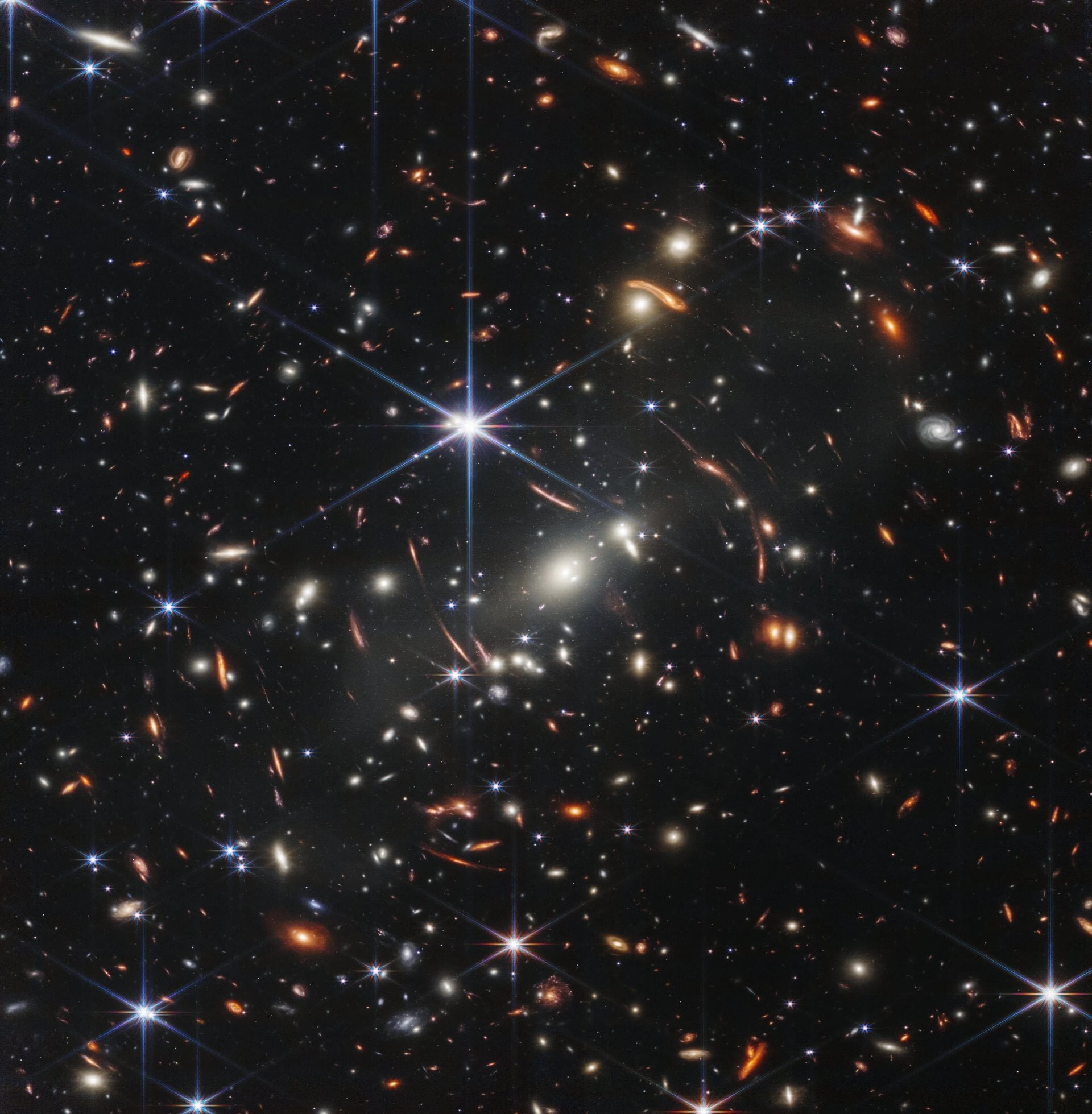
More than 50 arcseconds from the center of a massive galaxy cluster, the James Webb Space Telescope has revealed a faint, dramatically stretched object that looks remarkably like a gravitational arc—and if the interpretation holds up, the light may have traveled from a galaxy when the universe was only a small fraction of its present age.
The object does not look like an ordinary distant galaxy.
In an image from the James Webb Space Telescope, it appears as a long, narrow streak, stretched almost seven times longer than it is wide. More strikingly, the streak is curved, and its curve bends toward the center of a huge galaxy cluster in the foreground.
That combination is what makes the object so interesting.
Astronomers have identified it as A1, a strong candidate for a gravitational arc in the galaxy cluster MACS J0308.9+2645. The object has a photometric redshift of about 4.4, meaning its light appears to come from a much earlier era of cosmic history. And its position is especially intriguing: an independent lens model places it close to a region where the cluster’s gravity should strongly magnify light from a more distant background galaxy.
But there is an important word in all of this: candidate.
The evidence is unusually suggestive, but the researchers have not yet confirmed that A1 is gravitationally lensed. Spectroscopic observations and dedicated lens modeling will be needed to settle the question.
A galaxy cluster acting like a cosmic lens
To understand why a strange-looking streak can become scientifically important, it helps to imagine what happens when light passes a huge concentration of matter.
According to Einstein’s theory of general relativity, massive objects curve spacetime. Light traveling through that curved spacetime can therefore have its path bent.
A massive galaxy cluster is an especially powerful example.
Instead of using glass to bend light, nature uses an enormous concentration of galaxies, dark matter, and other mass. A distant galaxy behind the cluster can consequently appear stretched, magnified, or distorted to an observer on Earth.
These distorted images are called gravitational lenses. When the alignment is right, a background galaxy can be stretched into a long curved structure known as a gravitational arc.
That makes shape and orientation important clues.
A1 has several of them.
The object is highly elongated, with a catalogued axis ratio of about 6.5. Its ellipticity is 0.85, and its catalogued length is 3.9 arcseconds. When the researchers examined a lower-surface-brightness region around it, the visible extent reached about 5.1 arcseconds.
But the most revealing feature may be the curvature.
The curve is difficult to ignore
Astronomers measured the shape of A1 by tracing the surface-brightness-weighted ridge running through the object.
They compared that curved ridge with what would be expected from a straight line and fitted a parabola to the observed structure. The resulting sagitta—a measure of how far a curve bows away from a straight chord—was 0.18 ± 0.01 arcseconds.
Bootstrap tests rejected the possibility of zero curvature at greater than 7 sigma.
In other words, within the statistical analysis used by the researchers, the object is very clearly curved rather than simply appearing curved because of measurement noise.
And the direction of that curvature matters.
A1 is concave toward the center of MACS J0308.9+2645, the foreground galaxy cluster. It is also aligned almost perfectly with the direction expected for a tangential arc: the measured misalignment from the tangential direction is only about 1 degree.
That is a particularly interesting combination.
An elongated object can occur for many ordinary reasons. A distant galaxy viewed edge-on, for example, can look like a thin streak. But an elongated object that is strongly curved, points in the right direction around a massive cluster, and sits near a predicted high-magnification region presents a much more suggestive picture.
Still, suggestive is not the same as proven.
JWST found it in a surprisingly simple search
The discovery did not require a complicated artificial-intelligence system searching millions of images.
The researchers used public JWST/NIRCam observations of MACS J0308.9+2645 from observing program GO-5293. The observations contain six infrared bands: F115W, F150W, F200W, F250M, F300M, and F410M.
Rather than starting with individual pixels and trying to teach a computer what a gravitational arc should look like, the researchers searched the official source catalog for objects with the basic characteristics expected of tangential arcs.
They selected extended sources brighter than AB magnitude 28, required substantial elongation, required a sufficiently large semi-major axis, and limited the search to objects between 3 and 70 arcseconds from the cluster center.
They then calculated how each source was oriented relative to the cluster.
Objects whose orientations were sufficiently close to the tangential direction were retained as candidates.
The researchers tested this approach across 54 public JWST/NIRCam fields, examining 1,591 extended sources. These included galaxy clusters as well as quasar and calibration fields.
The initial selection produced many things that could fool a simple shape-based search.
There were clumpy edge-on disks, barred galaxies, two-armed spirals, and radial features. These became false positives that required additional morphological checks and visual inspection.
After that vetting, only two objects in the entire campaign survived as strong tangential-arc candidates.
Both were in MACS J0308.9+2645.
The brighter and more convincing one was A1.
Its colors point to the distant universe
The object’s shape is only part of the story.
Its light also looks different from the galaxies belonging to the foreground cluster.
Across the six JWST filters, A1 becomes progressively brighter toward longer wavelengths. Its catalogued brightness changes from AB = 25.65 ± 0.04 in F115W to AB = 22.50 ± 0.01 in F410M.
That steadily rising infrared spectral energy distribution is unlike the behavior of the cluster’s red-sequence galaxies, whose flux declines across the same wavelength range.
The researchers used the EAZY photometric-redshift code to estimate how far away A1 might be.
The best-fitting result was a photometric redshift of
z = 4.4 +0.1/−0.3.
The analysis gives a 99 percent probability that the source has a redshift greater than 3.
That does not mean there is a 99 percent probability that the gravitational-lensing interpretation is correct. The probability refers to the photometric-redshift result. The lensing question remains open.
The distinction is important because the source’s apparent distance and its apparent distortion are related pieces of evidence, but they are not the same measurement.
A1 appears to be far behind the cluster
MACS J0308.9+2645 itself lies at a redshift of 0.356.
A1, if its photometric redshift of about 4.4 is correct, would therefore be far behind the cluster.
That is exactly the geometry required for cluster-scale gravitational lensing: a massive foreground structure sits between Earth and a more distant source.
The researchers also tested whether a much closer object could produce the observed photometry.
The best solution constrained to redshift below 2 was at z = 1.6, but it was strongly disfavored. Its fit was worse than the global solution by Δχ² = 96.
There is a subtle limitation here.
All six filters used in the analysis cover wavelengths from about 1.15 to 4.10 micrometers. The redshift estimate is therefore driven mainly by the overall ultraviolet-to-optical shape of the source’s spectrum and the Balmer/4000 Å break, rather than the Lyman break that is often used to identify very distant galaxies.
So the researchers regard z ≈ 4.4 as the favored photometric solution, but spectroscopy is still needed for a direct redshift measurement.
Then comes the most striking coincidence
The strongest evidence for A1 being lensed comes from comparing its location with an existing model of the cluster’s gravitational field.
The researchers used the public Zitrin-LTM-Gauss lens model developed from earlier Hubble Space Telescope observations of MACS J0308.9+2645.
This is important because the model was created independently of the new JWST detection.
The researchers scaled the model to a source at z = 4.4 and examined where the tangential critical curve—the region associated with strong lensing—should appear.
A1 lies remarkably close to that predicted curve.
Across 10 public Monte Carlo realizations of the model, its median projected separation from the tangential critical curve was about 4.6 arcseconds, with a reported 16th–84th percentile range of 3.7–4.6 arcseconds.
The same model predicts a median absolute magnification of about 7.1, with a reported range of 7.1–9.5 across those realizations.
A1 lies just inside the tangential critical curve and has negative parity in the model.
That does not prove lensing.
But it is another independent piece of evidence pointing in the same direction.
The object’s shape says something unusual is happening. Its orientation agrees with the expected tangential geometry. Its photometry places it well behind the cluster. And an independently constructed model places it near a region where strong magnification is expected.
Together, those clues make the gravitational-arc interpretation plausible.
The cluster is already known to be a powerful lens
MACS J0308.9+2645 is not an ordinary galaxy cluster.
It is one of the massive Planck-selected clusters and was previously studied through the Reionization Lensing Cluster Survey, or RELICS. Earlier Hubble observations identified multiple gravitationally lensed systems and measured an effective Einstein radius of at least about 30 arcseconds for sources at redshift 2.
Earlier work also estimated a projected mass of about 2.5 ± 0.4 × 10¹⁴ solar masses within the critical curves.
The cluster has already demonstrated that it can strongly distort the appearance of galaxies behind it.
More recently, JWST observations have focused on another remarkable lensed system in the same field: MACS0308zD1, nicknamed the “Cosmic Spear,” a source at approximately z = 6.2.
A1 is not that object.
The researchers found that A1 and A2 are spatially and redshift-distinct from the known z ≈ 6.2 system. The brightest image of the Cosmic Spear is about 16 arcseconds away, while another reported counter-image is about 71 arcseconds away.
A1 is also absent from the previously published multiple-image inventory of the cluster.
That makes the new candidate potentially interesting for another reason: it appears to be a previously unrecognized lensing feature in a field that has already received considerable attention.
There is a second, fainter candidate
A1 is not alone.
The researchers also identified A2, a much fainter arclet at a projected radius of about 52.7 arcseconds from the cluster’s X-ray center.
A2 is also tangentially aligned, with a reported misalignment of about 1 degree. Its apparent length is roughly 2.5 arcseconds and its axis ratio is about 3.8.
Its photometric redshift is estimated at 3.0 ± 0.4.
But the researchers are cautious about treating the two objects as part of the same lensed system.
A2 is detected in only four of the six filters and is not detected in the catalog at F300M and F410M. Its photometric-redshift estimate is therefore less constrained. More importantly, the redshift estimates of A1 and A2 are in mild tension.
For that reason, the paper treats A2 only as a secondary candidate rather than claiming that A1 and A2 are multiple images of one background galaxy.
The lens model also gives A2 less support than A1. It lies farther from the relevant critical curve and in a lower-magnification region.
A1 remains the main story.
Could A1 simply be a strange galaxy?
Yes.
That possibility has not been eliminated.
The most plausible non-lensing explanation identified by the researchers is an edge-on disk galaxy at roughly z ≈ 4 that happens, by chance, to be projected in the tangential direction near the cluster’s critical curve.
Such a galaxy could naturally look long and thin.
The problem for that explanation is the combination of properties.
A1 is not merely elongated. It is significantly curved. The curvature is concave toward the cluster center. Its orientation is almost exactly tangential. And its position falls close to the high-magnification region predicted by an independent lens model.
That collection of clues makes the chance-aligned disk explanation less attractive.
But the researchers explicitly say it is not impossible.
That caution is central to the result.
The object is not being announced as a confirmed gravitationally lensed galaxy. It is being reported as a strong candidate.
The mass implied by its position is enormous
If A1 really does trace the tangential critical region at its estimated redshift, its position can also provide a rough indication of the amount of mass enclosed by the lens.
Using the standard critical-mass relation for gravitational lensing, the researchers estimate a critical projected mass of approximately 4 × 10¹⁴ solar masses within the relevant angular radius of 50.9 arcseconds.
That is of the same general order as the mass previously measured within the cluster’s critical curves.
But the researchers are careful about what this number means.
It is not presented as an independent measurement of the cluster’s mass.
Instead, it is the critical mass implied by interpreting the location of A1 as a gravitational-arc position.
That distinction matters because the calculation depends on the lensing interpretation that the observations are still trying to establish.
Why JWST makes this kind of discovery possible
The James Webb Space Telescope was built to see extremely faint infrared light from the distant universe, and its sharp imaging can reveal small structures that are difficult to recognize in more crowded observations.
Here, the researchers were able to work with public JWST/NIRCam mosaics and their associated source catalogs rather than relying solely on a previously identified lens system.
The approach was deliberately straightforward: look for extended, highly elongated objects whose orientations make sense for tangential lensing around a galaxy cluster, then inspect the survivors carefully.
That simplicity is part of the appeal.
A huge astronomical image contains countless galaxies with odd shapes. Most are not gravitational arcs. Some can look like arcs because of their own internal structure. A search method therefore has to separate genuinely interesting candidates from galaxies that merely happen to look stretched.
In the 54-field test, 143 sources produced high-significance residual signals, but most were ordinary astrophysical false positives. Only two objects survived the researchers’ morphological and visual vetting as strong tangential-arc candidates.
That result does not establish the overall efficiency of the method in every JWST field, but it demonstrates that a catalog-based search can uncover unusual lens candidates in public imaging.
The next test will be much harder to fake
The strongest remaining question is simple: what is A1’s actual redshift?
Photometry can estimate it, but spectroscopy can measure it more directly through spectral features.
The researchers identify spectroscopy as an immediate next step.
A confirmed redshift would establish whether the source really lies at the distance suggested by the photometric analysis. But even that would not, by itself, prove strong lensing.
A robust confirmation would also require a dedicated lens model that is consistent with A1’s observed properties. Ideally, astronomers would find a counter-image with matching spectral features.
That would be especially powerful evidence because gravitational lensing can produce multiple images of the same background source.
There is also a useful warning in the paper about another possible observation.
A resolved velocity gradient in A1 would not automatically settle the issue. A rotating galaxy viewed edge-on could show a velocity gradient, but a lensed rotating galaxy could show one too.
So even a beautiful spectroscopic observation would need to be interpreted in the full lensing geometry.
A tiny curve with a very large question behind it
For now, A1 occupies an interesting middle ground between discovery and confirmation.
It is a small, faint object in a JWST image. Yet its shape carries a remarkably coherent set of clues.
It stretches dramatically across the sky. It curves by an amount measured at greater than 7-sigma significance. Its curve faces the center of a massive galaxy cluster. Its long axis is almost perfectly tangential to that cluster. Its infrared colors favor a source at about redshift 4.4. And an independent Hubble-based lens model places it only a few arcseconds from the predicted critical curve, where the magnification is expected to be around seven.
Any one of those facts could have a mundane explanation.
Taken together, they make A1 a compelling gravitational-arc candidate.
But astronomy has a useful habit of making its most exciting claims earn their final sentence.
A1 has not yet earned the word “confirmed.”
For that, astronomers will need to take the next step: obtain its spectrum, model the lens in detail, and, ideally, find another image of the same distant source.
Until then, the strange curved streak remains exactly what the researchers call it—a strong candidate, sitting in the right place, shaped in the right way, and waiting for the universe to reveal what it really is.