Scientists have identified erythrulose, the first sugar ever detected in the interstellar medium, inside a molecular cloud near the center of the Milky Way. The discovery suggests that biologically important sugars can form in space and may have been delivered to early Earth in quantities large enough to contribute to the chemical processes that preceded life.
For decades, one of the biggest puzzles in origin-of-life research has been explaining how the first sugars became available on the young Earth. These molecules are fundamental to biology, serving as building blocks for DNA and RNA while also playing essential roles in metabolism. Yet laboratory studies have consistently struggled to produce sugars in sufficient amounts under conditions thought to resemble the prebiotic Earth.
The new discovery points to a different possibility: some of the ingredients needed for life may have formed long before Earth itself, within the icy environments of interstellar space.
Published in Nature Astronomy, the research reports the first confirmed detection of erythrulose in the interstellar medium, marking a milestone for astrochemistry and studies of life’s chemical origins.
First sugar identified in interstellar space
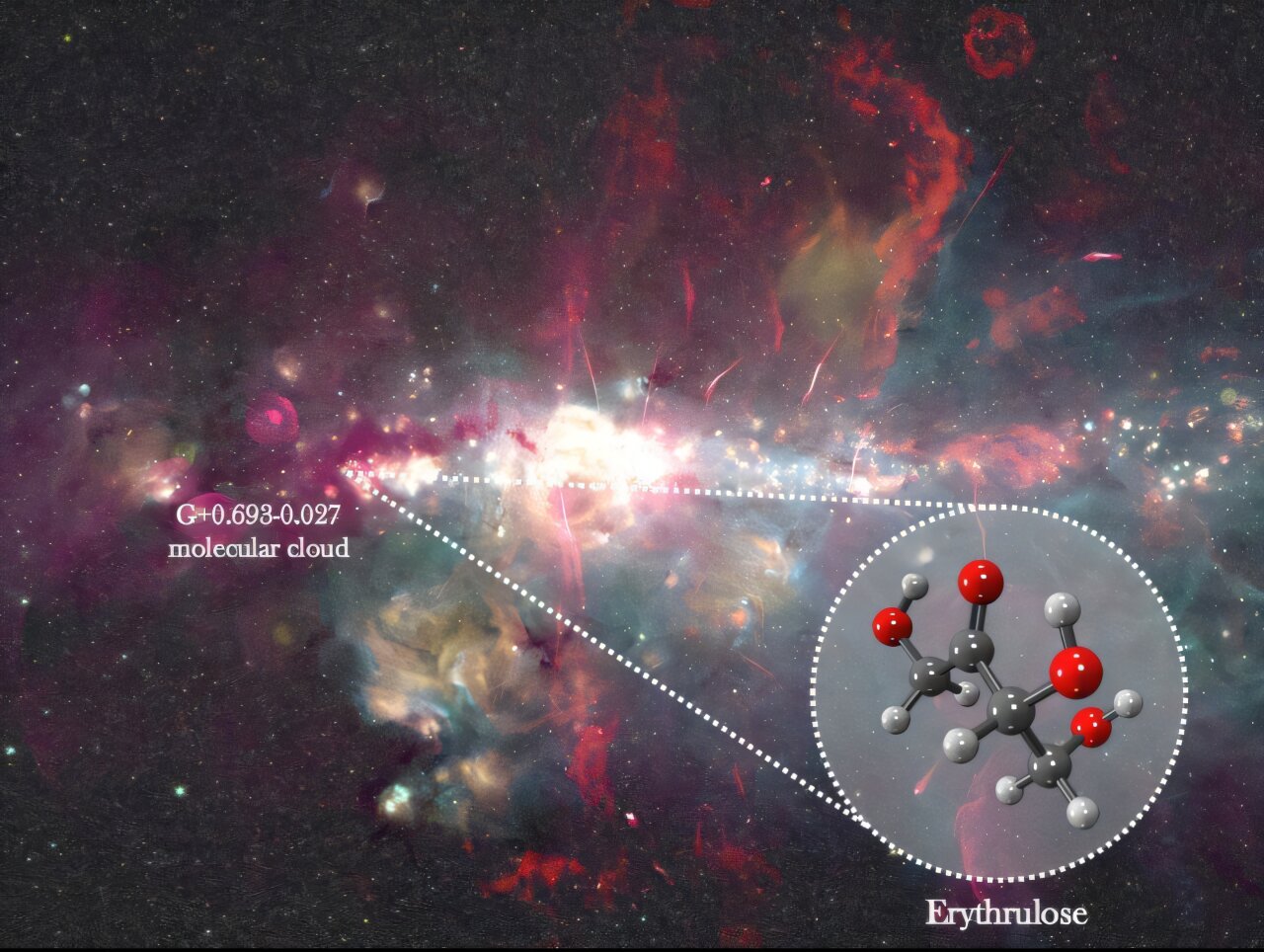
The international research team, led by CAB researcher Izaskun Jiménez-Serra, detected erythrulose in the molecular cloud G+0.693−0.027, located near the center of the Milky Way.
Erythrulose is the only known four-carbon ketose sugar. On Earth, it naturally occurs in raspberries and is also used in sunless tanning products. While sugars including ribose and glucose have previously been identified in meteorites and samples returned from asteroids, scientists had never before directly observed a sugar floating in the interstellar medium—the vast space between stars.
That distinction makes the new finding particularly significant because it confirms that sugars can exist before becoming incorporated into planets, comets, or asteroids.
Sensitive radio telescopes revealed the molecule
The detection relied on highly sensitive broadband spectroscopic observations made with the 40-meter Yebes radio telescope and the 30-meter telescope of the Institute for Radio Astronomy in the Millimeter Range (IRAM).
Researchers identified 12 spectral lines that matched laboratory measurements of erythrulose obtained at the University of the Basque Country. Matching multiple spectral signatures is essential for confidently identifying molecules in space, where many different compounds can produce overlapping signals.
The observations also revealed something unexpected about the molecule’s abundance.
The team found that erythrulose was at least eight times more abundant than comparable three-carbon sugars, which were not detected in the same molecular cloud.
Discovery challenges prevailing ideas about molecular growth
The abundance of erythrulose surprised the researchers because it does not fit the chemical pathway that has traditionally been assumed to dominate interstellar chemistry.
“This finding was unexpected, as the prevailing view in astrochemistry is that interstellar molecules grow in size through the sequential addition of carbon atoms,” said lead author Izaskun Jiménez-Serra.
To investigate how the sugar could form, the research team collaborated with chemists from the University of Extremadura and Radboud University in the Netherlands.
Their work indicates that erythrulose can instead be synthesized within interstellar ices from simpler two-carbon alcohols and aldehydes. That proposed formation route offers an alternative mechanism for producing increasingly complex organic molecules in the cold environments between stars.
Rather than relying solely on gradual carbon-by-carbon growth, the results suggest that chemical reactions inside icy grains may generate more complex sugars through different pathways.
Implications for the origin of life on Earth
The findings also raise the possibility that interstellar sugars were delivered to Earth during one of the Solar System’s most violent periods.
Using the measured abundance of erythrulose in the molecular cloud, the researchers estimate that between 0.5 million and 50 million metric tons of the sugar could have reached Earth’s surface during the Late Heavy Bombardment, approximately 4.1 to 3.8 billion years ago.
If such deliveries occurred, interstellar sugars could have supplemented the limited amounts thought to form naturally on the early Earth.
That possibility is important because sugars are indispensable components of biology. They form the structural backbone of nucleic acids and participate in metabolic reactions that sustain living organisms. An external supply from space could therefore have contributed to the chemical inventory needed for the earliest metabolic and replication processes.
The researchers emphasize that the presence of erythrulose in interstellar space represents an alternative source of these critical molecules rather than replacing existing theories about prebiotic chemistry on Earth.
A step toward finding even more complex sugars
The discovery also broadens the search for other biologically significant molecules in space.
“The detection of erythrulose is very exciting because it opens up the possibility of discovering in space other sugars such as ribose, which is part of RNA, and other important molecules for the origin of life,” said study co-author Carlos Briones.
Ribose is especially important because it forms part of RNA, one of the central molecules involved in storing and transmitting genetic information.
Although ribose itself has not yet been detected in the interstellar medium, the identification of erythrulose demonstrates that complex sugars can exist beyond planets and meteorites. That finding expands the range of organic chemistry known to occur in space and provides researchers with a new target in the ongoing search for the molecular ingredients that may have helped make life possible.